
Tech
domikyo.com Review: Content, Safety, and Trust Guide


Searching for domikyo.com usually leads to a simple set of questions: What is this website, what type of information does it publish, and should its content be trusted?
Domikyo.com is a multi-topic blog covering subjects such as technology, business, education, finance, health, lifestyle, sports, fashion, and travel. Its broad editorial model makes it useful for general reading, but it also means visitors should evaluate individual articles carefully instead of assuming that every post follows the same research or review standards.
This guide explains how the platform works, what readers may find there, which trust signals matter, and how to use its content responsibly.
Quick Facts About domikyo.com
| Feature | Current overview |
|---|---|
| Website type | Multi-category informational blog |
| Main topics | Business, education, finance, health, lifestyle, sports, technology, travel and fashion |
| Content style | Guides, educational articles, opinion pieces and promotional topics |
| Search intent | Informational and navigational |
| Publication history | Indexed posts and archives extend across several years |
| Policy pages | About, disclaimer, privacy, DMCA and terms pages are listed |
| Best use | General discovery and introductory research |
| Important precaution | Verify financial, medical, legal and purchasing advice independently |
The website has indexed material dating back to at least 2021, while search results also show posts published during 2025 and 2026. This indicates that Domikyo is not simply a single temporary landing page; it has accumulated content over multiple years.
What Is domikyo.com?
Domikyo.com is a general-interest publishing website rather than a narrowly focused specialist publication. Visitors may encounter an article about electronic waste, followed by content about personal finance, business coaching, travel, health, sports or consumer technology.
The homepage describes the platform as a resource for technology, business, finance, health and lifestyle information. Its navigation and archive pages broaden that scope further by listing education, sports, travel and other categories.
This wide coverage has two practical consequences.
First, readers can explore several unrelated subjects without visiting multiple websites. Second, authority must be judged at the article level because expertise in one category does not automatically establish expertise in another.
Understanding the Search Intent Behind domikyo.com
The primary search intent is informational and navigational.
Some users already know the domain and want to reach it. Others discover the name through search results, backlinks or shared articles and want to understand what the website represents.
The most useful article for this keyword should therefore answer four questions:
- What does the website publish?
- Who is the content intended for?
- How reliable is the information?
- What precautions should readers take?
A purely promotional description would fail to satisfy this intent. Readers need a balanced overview that explains both the convenience and the limitations of a broad-content website.
Main Content Categories on domikyo.com
Technology
The technology section includes practical and consumer-focused subjects. Indexed examples include electronic-waste disposal, iPhone call-recording guidance and sensor-fusion training courses.
Technology articles may be useful for discovering terminology, tools or possible solutions. However, software instructions can become outdated quickly as operating systems, privacy rules and product features change.
Before following technical advice:
- Check the publication or update date.
- Confirm that the instructions match your device version.
- Visit the manufacturer’s official documentation.
- Avoid installing unfamiliar software without reviewing permissions.
- Back up important files before making system changes.
Business and Entrepreneurship
Domikyo.com also publishes articles about coaching, startup studios, lead generation, professional development and business growth. Indexed examples include content about improving a coaching business and evaluating startup-studio models.
These articles may help readers discover business concepts or develop a list of questions for further research. They should not automatically be treated as personalised consulting advice.
A strong business article should explain:
- Who the strategy is designed for
- What resources are required
- Which risks are involved
- How success will be measured
- What alternatives should be considered
Be cautious when an article promises rapid growth without discussing costs, market conditions or execution challenges.
Finance
The finance category appears to focus on accessible topics such as budgeting, financial habits and personal money management. One indexed article discusses habits associated with financial freedom.
Introductory finance content may be valuable for building awareness, but it should not replace professional financial advice. Tax rules, investment products, interest rates and consumer protections vary by country and may change over time.
Before acting on financial content, confirm:
- The country or jurisdiction being discussed
- Whether figures are current
- Whether risks and fees are disclosed
- Whether the writer has relevant qualifications
- Whether the article contains commercial links or promotions
Never transfer money or share banking information merely because a recommendation appears in an online article.
Health and Wellness
Health-related posts on the website have included anti-ageing treatments, body recovery, conditioning and plasma-donation locations.
This type of content requires additional scrutiny. General wellness suggestions may be suitable for educational reading, but diagnosis, medication, treatment and donation eligibility should be confirmed through qualified medical professionals or recognised health organisations.
Look for:
- Named medical reviewers
- References to clinical evidence
- Clear publication and update dates
- Balanced discussion of benefits and risks
- Advice about when professional care is necessary
Avoid any article that encourages readers to ignore symptoms, discontinue prescribed treatment or use an unverified product as a guaranteed cure.
Travel and Lifestyle
The site publishes lifestyle and travel-oriented material covering subjects such as airport transportation, clothing, citizenship-related topics and everyday decision-making. Recent indexed titles include an airport car-service guide and an article discussing reasons to consider Portuguese citizenship.
Travel information can be helpful during the inspiration stage, but prices, entry rules, transportation schedules and immigration requirements can change.
Confirm important details through:
- Government immigration portals
- Airlines and airport authorities
- Licensed legal advisers
- Official tourism organisations
- Direct service-provider websites
Sports, Fashion and General Topics
Domikyo also maintains sports and fashion categories alongside general and uncategorised content. A fashion archive includes material dating back to 2021, while the sports category remains visible in the current site structure.
These sections expand the site’s audience but reinforce its identity as a broad publishing platform rather than a specialist journal.
Is domikyo.com a Guest-Post Website?
Search results from the website display the phrase “Guest Post Marketplace 2026” alongside a public contact email. That presentation suggests the domain may accept, promote or facilitate externally contributed content.
Guest contributions are not automatically unreliable. Many respected publications use freelance writers, industry contributors and sponsored experts.
The important issue is transparency.
Readers should be able to distinguish among:
- Independent editorial articles
- Contributor submissions
- Sponsored content
- Affiliate recommendations
- Advertiser-supported posts
- Brand announcements
When authorship or commercial relationships are unclear, evaluate claims more cautiously.
Trust Signals Visible on the Website
No single feature proves that a website is reliable. Trust comes from several signals working together.
Established Content History
Indexed archives show that Domikyo has published material across multiple years. A longer history provides more information for readers to evaluate than a newly created website with no visible track record.
Longevity alone does not guarantee accuracy, but it is still a useful contextual signal.
Policy and Legal Pages
Search results show links to an About page, disclaimer, DMCA policy, privacy policy and terms and conditions.
These pages are important because they may explain:
- How personal data is handled
- Who owns submitted material
- How copyright complaints are processed
- What limitations apply to published information
- Which responsibilities belong to users
Readers should open and review these pages before submitting personal information, purchasing a service or proposing a content partnership.
Public Contact Information
A contact email is displayed in indexed pages and site snippets. This gives users a visible communication route for editorial, business or copyright-related questions.
A public email is helpful, but it does not replace a complete company identity, physical business details or named editorial leadership.
Technical Infrastructure
Public DNS information shows that the domain currently uses Cloudflare-related nameservers and routing infrastructure. Cloudflare commonly provides services such as traffic management, performance optimisation and security filtering.
This is a technical observation, not proof that every article or external offer on the site is trustworthy.
Potential Limitations Readers Should Consider
Extremely Broad Subject Coverage
Publishing across finance, health, law, technology, travel and business creates an expertise challenge. These fields require different qualifications, evidence standards and fact-checking processes.
A website may provide useful introductions across many topics, but readers should prefer specialist sources when a decision carries financial, legal, medical or safety consequences.
Inconsistent Writing Quality
Some indexed snippets contain awkward wording, grammatical issues or unclear phrasing. For example, search results for older technical and environmental posts show language that may reduce clarity or suggest limited editorial review.
Poor grammar does not automatically make a factual claim false. It does, however, justify checking the claim against stronger sources.
Possible Promotional Intent
A guest-post marketplace, contributor submissions or commercially oriented articles may create mixed editorial incentives. Some content might be designed partly to build links, promote brands or attract search traffic.
Before trusting a recommendation, ask:
- Is a specific company repeatedly promoted?
- Are alternatives discussed fairly?
- Is sponsorship clearly disclosed?
- Does the article provide evidence?
- Would the advice remain useful without the promotional links?
Older Articles May Be Outdated
Domikyo.com contains content published across different years. Older posts about phones, apps, laws, health services or financial products may no longer reflect current conditions.
A publication date should be treated as a starting point, not a guarantee of freshness.
How to Evaluate an Article on domikyo.com
Use the following process before acting on any important claim.
1. Identify the Author
Look for a real name, biography and relevant experience. An author writing about healthcare should demonstrate different expertise from someone discussing smartphones or marketing.
An unnamed article is not automatically wrong, but it provides less accountability.
2. Check the Date
Review both the original publication date and any update date. Time-sensitive articles should be revised when products, laws or official recommendations change.
3. Examine the Evidence
Strong articles link to original research, official statistics, product documentation, court guidance or government sources.
Weak articles rely on phrases such as:
- “Experts say”
- “Studies prove”
- “Everyone knows”
- “Guaranteed results”
- “The best option for all users”
These statements require evidence and context.
4. Separate Facts From Promotion
Determine whether the article is teaching, reviewing or selling.
Promotional content should clearly explain:
- Who benefits financially
- Whether links are sponsored
- What limitations exist
- Which competing options were considered
5. Cross-Check Important Claims
Verify the central claim through at least one authoritative source.
For example:
| Topic | Better verification source |
| Medical treatment | Licensed doctor or recognised health authority |
| Visa or citizenship | Government immigration department |
| Investment or tax | Regulated adviser or government agency |
| Software settings | Official developer documentation |
| Product specifications | Manufacturer documentation |
| Legal rights | Licensed lawyer or official court guidance |
| Travel schedules | Airline, airport or transport operator |
6. Protect Your Personal Information
Do not submit identity documents, payment details, passwords or banking information through a page unless you have confirmed who operates the service and why the information is required.
Use a unique password whenever account registration is necessary.
domikyo.com Versus Specialist Websites
| Evaluation area | domikyo.com | Specialist publication |
| Topic variety | Very broad | Narrow and focused |
| Convenience | High | Moderate |
| Depth | Varies by article | Usually more detailed |
| Author expertise | Must be checked individually | Often easier to establish |
| Best purpose | Discovery and introductory reading | Complex decisions and professional research |
| Risk level | Depends heavily on topic | Usually lower when credentials are strong |
Domikyo.com is best treated as a discovery platform. It can introduce a subject, explain basic terminology or help readers identify what they need to research next.
A specialist website is usually the stronger choice when precision, professional accountability or current regulatory information matters.
Who May Find domikyo.com Useful?
The platform may suit:
- Casual readers exploring several subjects
- Students collecting introductory ideas
- Bloggers researching possible content topics
- Business owners looking for general marketing concepts
- Technology users seeking basic guides
- Travellers searching for planning ideas
- Readers comparing different viewpoints
It is less suitable as the only source for:
- Medical treatment decisions
- Legal disputes
- Immigration applications
- Major investments
- Tax planning
- High-value purchases
- Cybersecurity emergencies
Common Mistakes to Avoid
Trusting the Domain Instead of the Article
A website may contain both useful and weak content. Evaluate each page separately based on authorship, evidence, date and purpose.
Assuming Search Ranking Proves Accuracy
A high search position shows that a page is visible and relevant to a query. It does not confirm professional review or factual correctness.
Following Old Instructions
An older tutorial may refer to menus, products or rules that no longer exist. Always compare the instructions with current official guidance.
Ignoring Commercial Motives
A recommendation may be influenced by advertising, guest-post arrangements or affiliate relationships. Look for clear disclosures before accepting product claims.
Using One Article as Final Proof
Online content should form part of a broader research process. Important decisions deserve confirmation from original or professionally accountable sources.
Frequently Asked Questions
What is domikyo.com used for?
Domikyo.com is used for reading general-interest articles covering technology, business, finance, education, health, lifestyle, sports, travel, fashion and related subjects.
Is domikyo.com a news website?
It is better described as a multi-topic blog or informational publishing platform. Some posts may discuss timely subjects, but the site does not appear to operate solely as a traditional breaking-news organisation.
Is domikyo.com safe to visit?
The available search evidence does not justify labelling the domain either completely unsafe or universally trustworthy. Visitors should use normal browsing precautions, review privacy terms and avoid sharing sensitive information without verifying the recipient.
Does domikyo.com publish guest posts?
The site displays “Guest Post Marketplace 2026” and a public contact email on indexed pages, suggesting that guest-post or contributed-content activity may be part of its publishing model.
Can I trust its finance articles?
Finance posts may provide general education, but figures, regulations and recommendations should be checked through regulated advisers, government sources or established financial institutions.
Should I follow health advice from the site?
Health articles should be treated as general information. Consult a qualified healthcare professional before changing treatment, medication, diet or exercise because of an online post.
How can I check whether an article is sponsored?
Look for labels such as “sponsored,” “partner content,” “advertisement,” “contributed post” or an affiliate disclosure. Also examine whether one product or company receives unusually positive attention without meaningful comparison.
Is domikyo.com updated regularly?
Search results show articles and archives from several years, including content indexed in 2025 and 2026. Publication frequency may vary by category.
Final Verdict on domikyo.com
domikyo.com is a broad informational blog that may help readers discover ideas across technology, business, finance, education, health, lifestyle, sports and travel. Its multi-year archive, visible policy links and public contact details provide useful context about the platform.
Its greatest strength is variety. Its main limitation is that quality, expertise and commercial intent may differ from one article to another.
Use the website for exploration, introductory learning and topic discovery. For decisions involving money, health, law, immigration, privacy or personal safety, verify every important claim through a current and authoritative source before taking action.

If you’ve come across imageflings.com while browsing the internet, you may be wondering what the website offers, whether it’s still active, and if it’s safe to visit. Finding reliable information about lesser-known domains can be challenging, especially when their purpose, ownership, or availability isn’t immediately clear.
This guide examines what can currently be verified about imageflings.com, how to investigate its website status, and what to consider before interacting with unfamiliar online platforms.
Whether you discovered the domain through a search result, an external link, or a direct recommendation, understanding its credibility can help you make an informed decision.
What Is imageflings.com?
imageflings.com is an internet domain whose current purpose and operating status are not clearly established through publicly accessible information.
Although its name might suggest a connection to digital images, photography, or visual content, a domain name alone cannot reliably establish what a website actually provides.
A publicly indexed third-party listing associated with the subdomain view.imageflings.com has indicated that the domain may be available for sale. However, that listing does not independently confirm the present ownership, functionality, or availability of the main website.
An attempt to retrieve the primary domain also returned an HTTP 403 Forbidden response. This means the requested content could not be accessed through that retrieval method, but it does not necessarily mean the website is offline or unsafe.
Quick Facts About imageflings.com
| Feature | Available information |
|---|---|
| Domain | imageflings.com |
| Website category | Not independently confirmed |
| Current operational status | Not conclusively verified |
| Public homepage accessibility | Automated retrieval returned HTTP 403 |
| Domain ownership | Not verified |
| Registration requirements | Unknown |
| Subscription or pricing | Not verified |
| Security reputation | Insufficient evidence for a definitive rating |
| Associated subdomain | view.imageflings.com |
| Possible domain sale status | Suggested by a third-party listing, not confirmed |
The most important distinction is between a domain’s existence and its actual services. A registered domain can be active, parked, redirected, restricted, or undergoing redevelopment.
Until the website’s current content and operator can be independently verified, specific claims about its features or services should be treated cautiously.
Is imageflings.com Currently Working?
A website can appear unavailable for several reasons, and not all indicate a permanent shutdown.
For imageflings.com, the available information does not establish whether ordinary visitors can consistently access a functioning service.
Possible Reasons the Website May Not Open
Several technical or administrative conditions can affect access:
-
Server restrictions: The website may reject certain automated requests or visitor connections.
-
Temporary maintenance: The domain could be undergoing technical updates.
-
Domain parking: An owner may retain the domain without hosting an active application.
-
Access limitations: Geographic restrictions, firewalls, or anti-bot systems may prevent access.
-
DNS problems: Domain configuration errors can interrupt connections.
-
Ownership changes: A domain may be transferred, sold, or repurposed.
A 403 Forbidden response specifically indicates that the server or an intermediary refused access to the requested resource. It should not automatically be interpreted as proof of malware, a scam, or permanent closure.
How to Check Whether imageflings.com Is Accessible
If you want to investigate its current status, follow these steps:
-
Enter the exact address,
https://imageflings.com, into a modern browser. -
Examine the address bar for unexpected spelling changes or redirects.
-
Check whether the website loads a normal page, an error, or a domain-sale notice.
-
Use a reputable website-status checker to determine whether other locations can reach the domain.
-
If access fails, try again later rather than repeatedly following unfamiliar redirect links.
Avoid entering account credentials or payment information merely to test whether a website works.
Is imageflings.com Safe to Use?
There is currently insufficient independently verified evidence to classify imageflings.com as either trustworthy or malicious.
One third-party checker has displayed positive indicators for an associated subdomain, including HTTPS support and the absence of certain detected warnings. However, the checker also acknowledges that its assessment is incomplete.
These findings are limited. They do not verify the website’s owner, content moderation practices, data handling, or financial reliability.
1. Examine HTTPS and Connection Security
HTTPS helps encrypt information transmitted between your browser and a website.
When accessing imageflings.com, check whether the browser establishes a valid HTTPS connection and whether the certificate corresponds to the domain you’re visiting.
However, HTTPS does not guarantee that a website is legitimate. Fraudulent websites can also obtain valid security certificates.
2. Investigate Domain Ownership
Domain registration information can sometimes reveal useful administrative details.
You can search for imageflings.com through an ICANN registration lookup to examine publicly available registration records.
Consider checking:
-
Domain registration and expiration dates
-
The current registrar
-
Available registration-status information
-
Recent changes, where disclosed
-
Whether registrant details are publicly available or privacy-protected
Privacy protection alone is not suspicious. Many legitimate website owners use it to reduce spam and unwanted contact.
The key is to evaluate several indicators together rather than treating any single detail as proof of credibility.
3. Look for Transparent Website Policies
Before creating an account or submitting personal information, inspect the website for essential documentation.
Useful indicators include a clear privacy policy, understandable terms of service, identifiable contact information, and an explanation of how user information is collected or retained.
If the website requests payment, the terms should also explain pricing, billing cycles, cancellation procedures, and refund eligibility.
Missing documentation does not automatically establish fraud, but it creates uncertainty that visitors should consider before proceeding.
4. Check Independent Security Reports
Security reputation services can provide additional context about unfamiliar domains.
Useful resources include:
These services assess different signals, so their results may not always agree.
For example, a domain could have a clean malware scan but still lack clear ownership information or transparent business practices.
A clean security result is evidence of limited detected risk, not a guarantee that every activity on the website is safe.
How to Evaluate imageflings.com Before Using It
When assessing an unfamiliar website, a structured review is more useful than relying on first impressions.
The following framework can help determine whether further interaction is appropriate.
Website Evaluation Checklist
| Evaluation area | What to inspect | Why it matters |
|---|---|---|
| Domain identity | Exact spelling and redirects | Helps detect impersonation |
| HTTPS | Valid browser connection | Protects information in transit |
| Ownership | Public registration and operator details | Supports accountability |
| Privacy | Collection and sharing policies | Clarifies how personal data is handled |
| Payments | Pricing, cancellation, and refund terms | Reduces unexpected billing risks |
| Reputation | Independent reports and reviews | Provides outside perspectives |
| Contact details | Working support methods | Helps resolve account problems |
| Downloads | File source and security warnings | Reduces software-related risks |
No single positive result is sufficient to establish complete trust.
A website becomes easier to evaluate when its identity, services, policies, and reputation can be independently corroborated.
Understanding Website Reputation Scores
One common mistake is treating automated trust scores as definitive verdicts.
These scores generally combine technical, historical, and reputation-related signals. Different providers may use different criteria and may update their assessments at different times.
A service might assign a positive score because a domain supports HTTPS and has no known malware detections.
Another might express caution because the domain has limited public information or unusual redirects.
Both assessments can reflect legitimate observations without establishing the complete picture.
Technical Safety vs. Business Trustworthiness
These concepts are related but distinct.
Technical safety concerns whether a website exposes visitors to risks such as malicious downloads, phishing infrastructure, or compromised connections.
Business trustworthiness concerns whether an operator provides accurate information, handles payments fairly, respects privacy, and delivers advertised services.
A website can be technically secure while operating under confusing or unfavorable business terms.
Conversely, an otherwise legitimate organization can experience temporary security problems.
For imageflings.com, there is not enough confirmed information to complete a meaningful assessment of both categories.
What to Do If imageflings.com Redirects You Somewhere Else
A redirect occurs when a website automatically sends visitors to another address.
Redirects are common across the internet and can serve legitimate purposes, such as moving from an old domain to a new one.
However, unfamiliar redirects deserve additional scrutiny.
How to Evaluate a Redirect
Before interacting with a destination page, examine its full domain name.
Pay attention to subtle spelling differences, unexpected country-code extensions, and URLs that imitate familiar brands.
If the destination requests personal information, consider whether the relationship between the original website and the new destination is clearly explained.
A redirect to a domain-sale marketplace, for example, may suggest that the original domain is parked or being advertised for sale.
A redirect to an unrelated login page should be evaluated more carefully.
Warning Signs to Watch For
Exercise additional caution if a website:
-
Repeatedly redirects through unrelated domains.
-
Requests sensitive information without a clear purpose.
-
Claims that your device is infected and demands immediate action.
-
Forces unexpected downloads.
-
Displays fake security warnings.
-
Requires payment before explaining its services.
-
Provides no identifiable operator or support information.
These are general warning signs, not confirmed behaviors of imageflings.com.
Protecting Your Privacy When Visiting Unfamiliar Websites
Privacy deserves particular attention when a website’s purpose and ownership are uncertain.
Even ordinary browsing can expose information such as an IP address, browser characteristics, approximate location, and certain activity data to website operators or their technology providers.
The information collected depends on the website and the visitor’s settings.
Limit the Information You Share
Avoid providing your full name, telephone number, address, identification documents, or financial information until you understand why the information is needed.
If registration becomes necessary, consider using a unique password and an email address appropriate for that account.
Never reuse a password associated with banking, email, or other important services.
Review Browser Permissions
Websites sometimes request access to features such as notifications, cameras, microphones, or location data.
Only grant permissions that are necessary for a function you understand and intend to use.
For an unfamiliar website, denying unnecessary permissions is generally the safer default.
Be Careful With Uploaded Images
If imageflings.com eventually proves to offer image-related functionality, users should examine any upload policy before submitting photographs.
Images can contain more information than the visible subject.
Depending on the file and device, embedded metadata may include creation times, device information, or geographic coordinates.
Before uploading sensitive photographs to any service, consider removing unnecessary metadata and reviewing the platform’s retention, sharing, and deletion policies.
These precautions apply broadly to online image services and do not establish that imageflings.com currently supports uploads.
Common Mistakes People Make When Researching imageflings.com
Several assumptions can lead to unreliable conclusions about an unfamiliar domain.
Mistake 1: Assuming the Name Reveals the Service
The word image in a domain name may suggest photography or visual content.
However, naming conventions are not reliable evidence of current functionality.
Domains can be repurposed, transferred, or used for services unrelated to their original names.
Mistake 2: Trusting a Single Review Website
An automated review can provide useful signals, but it may rely on incomplete or outdated information.
Compare findings across several independent sources and consider when each assessment was performed.
Mistake 3: Confusing an Error Page With a Scam
A 403, 404, or 503 error does not automatically indicate malicious activity.
These status codes have different technical meanings and can occur on legitimate websites.
Investigate the broader context before drawing conclusions.
Mistake 4: Ignoring Redirect Destinations
A visitor might begin at one address and end up on another without noticing.
Always review the final domain before logging in, purchasing anything, or downloading files.
Mistake 5: Treating Domain Age as Proof of Reliability
Older domains sometimes have longer operating histories, but age does not guarantee trustworthiness.
A domain may change ownership or purpose at any time.
Recent activity and transparent operations matter more than age alone.
How imageflings.com Compares With Established Image Platforms
If your interest in imageflings.com relates to uploading, sharing, or storing images, established services offer alternatives with more clearly documented functionality.
This comparison does not assume that imageflings.com provides equivalent features.
| Platform | Main purpose | Common use case |
|---|---|---|
| imageflings.com | Not verified | Requires further investigation |
| Google Photos | Photo storage and organization | Personal photo libraries |
| Flickr | Photography hosting and communities | Sharing photographic work |
| Imgur | Image hosting and sharing | Sharing images through links |
| Adobe Portfolio | Portfolio website creation | Presenting creative work |
| Unsplash | Photography discovery and licensing | Finding images for permitted use |
These platforms address different needs, so their suitability depends on whether you want private storage, public hosting, professional presentation, or licensed image discovery.
Choose According to Your Actual Goal
For personal photo backups, prioritize storage reliability, account security, and recovery options.
For a public photography portfolio, evaluate design control, image presentation, custom-domain support, and content ownership terms.
For image sharing, consider visibility settings, direct-link functionality, moderation policies, and deletion controls.
For licensed images, check the licensing terms for the specific photograph rather than assuming every image on a platform can be reused freely.
Advanced Tips for Investigating an Unfamiliar Domain
When basic website checks produce inconclusive results, several more detailed methods can help.
Examine Historical Website Snapshots
The Internet Archive’s Wayback Machine may contain historical snapshots of a domain.
Enter imageflings.com into the archive search to check whether older versions of the website are available.
Historical snapshots may reveal previous branding, content categories, or site changes.
However, archived pages cannot establish that the same owner or service is operating today.
Inspect Public DNS Information
DNS records connect domain names with the infrastructure used to serve websites and other online services.
A DNS lookup may reveal name servers, IP addresses, and mail-related records.
These details can assist technical investigations, but they rarely identify the actual business operator conclusively.
For example, two unrelated websites can use the same hosting provider or content-delivery network.
Look for Consistent Branding
A legitimate online service often maintains recognizable branding across its website, documentation, support channels, and public communications.
Check whether references to the domain use consistent names, contact details, and explanations of services.
Inconsistencies are reasons to investigate further, not automatic proof of misconduct.
Verify Claims Independently
If a website claims to be affiliated with a recognizable company or platform, look for confirmation on that organization’s official website.
Do not rely exclusively on logos, testimonials, badges, or partnership claims displayed by the unfamiliar domain itself.
Independent verification is particularly important before making payments or providing sensitive personal information.
Frequently Asked Questions About imageflings.com
What is imageflings.com used for?
The present purpose of imageflings.com has not been independently established. Available public information is insufficient to confirm whether it operates an image-hosting platform, another type of service, or no active service at all.
Is imageflings.com a legitimate website?
There is not enough verified information to make a definitive legitimacy assessment. Its ownership, operating policies, and current service offering remain unclear.
Is imageflings.com safe to open?
No conclusive security assessment is available. Before visiting, use established website reputation tools, verify the address, and avoid sharing sensitive information until the website’s credibility is clearer.
Why is imageflings.com not opening?
Possible explanations include server access restrictions, technical maintenance, DNS issues, domain parking, or changes to website operations. An automated attempt to access the main domain returned HTTP 403, but that result alone does not establish the cause.
Is imageflings.com free?
Its pricing and registration requirements have not been verified. Claims about free accounts, premium memberships, or paid features would therefore be speculative.
Does imageflings.com allow image uploads?
There is no sufficiently reliable evidence available to confirm its current upload functionality. The domain’s name should not be treated as proof that an image-upload service exists.
Who owns imageflings.com?
The current owner has not been independently verified for this review. Public registration information may provide additional details, although privacy services can limit what is visible.
Is imageflings.com associated with another website?
No particular commercial affiliation has been confirmed. Similar names, shared infrastructure, or redirects should not automatically be interpreted as evidence of common ownership.
Can I recover an old account on imageflings.com?
Account recovery options cannot be confirmed without verifying that an active account system exists. If you previously registered, consult any legitimate records you retained and avoid submitting credentials to unverified recovery pages.
What should I do if I entered personal information on the site?
If you suspect your information was exposed, change any reused passwords, enable multifactor authentication where possible, and monitor relevant accounts for unusual activity.
If payment information was submitted and you notice an unauthorized transaction, contact your card issuer or payment provider promptly.
Final Verdict: What You Should Know About imageflings.com
imageflings.com is a domain with limited publicly verifiable information about its current operation, ownership, and services.
The available evidence includes a third-party listing suggesting that an associated subdomain may be connected to a domain offered for sale, along with an automated access attempt that returned a 403 Forbidden response. Neither finding establishes that the website is malicious, trustworthy, or permanently inactive.
For anyone considering visiting imageflings.com, the most practical approach is to verify the website’s current status, inspect its actual destination, consult independent security resources, and avoid submitting sensitive information until its purpose and operator are clear.
A credible website should offer more than an accessible address. It should provide understandable services, transparent policies, and enough independently verifiable information for visitors to make informed decisions.
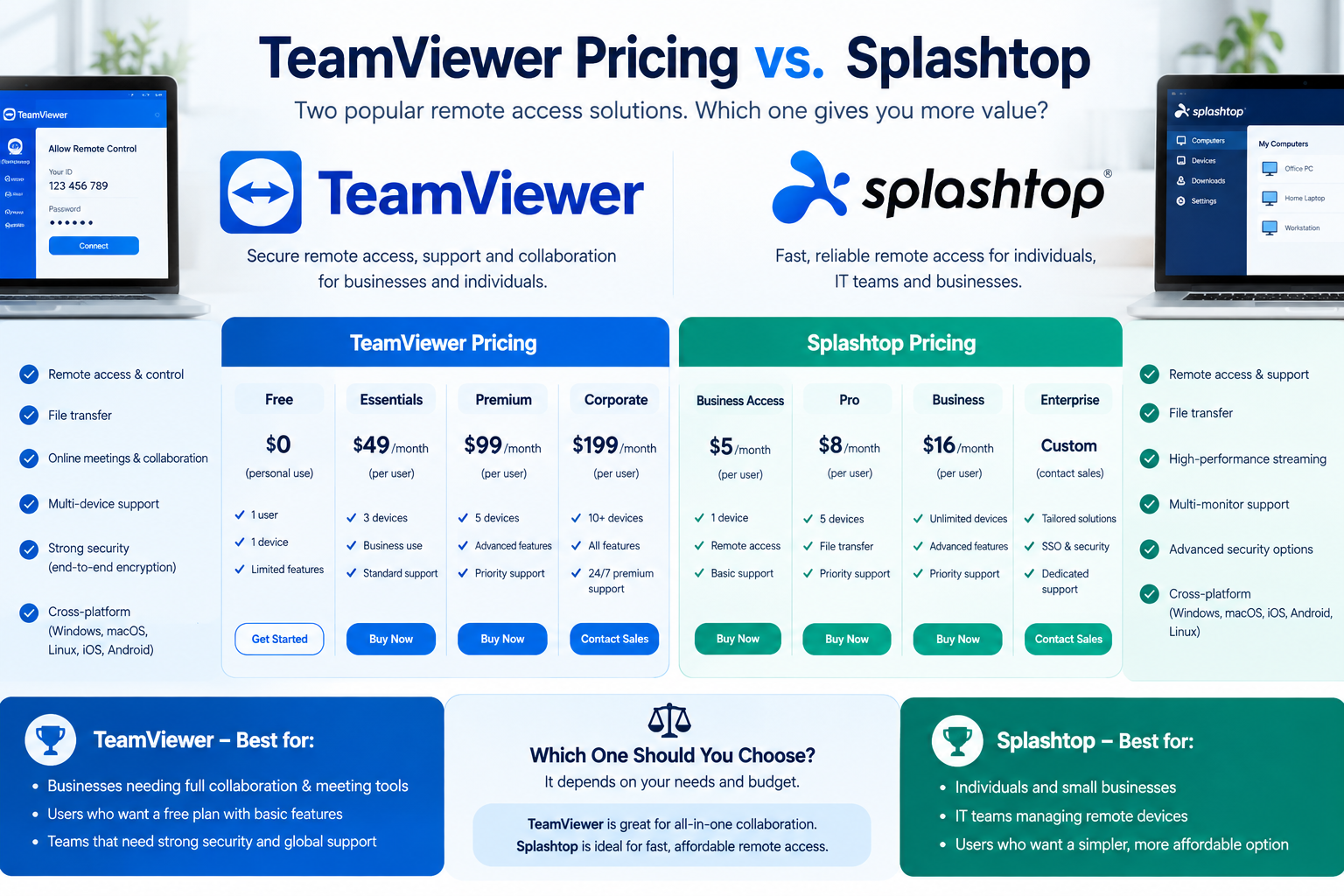
Choosing remote desktop software is about more than finding the lowest subscription price. When comparing TeamViewer Pricing vs. Splashtop, businesses need to consider licensing restrictions, remote support capabilities, security, device limits, and long-term operating costs.
Both platforms provide remote access and technical support solutions, but their pricing structures serve different priorities. TeamViewer offers an established remote connectivity ecosystem with extensive business and enterprise capabilities, while Splashtop emphasizes competitive pricing, straightforward remote access licensing, and specialized performance features.
The difference becomes especially important when several employees need access, IT technicians manage hundreds of devices, or an organization requires advanced security controls.
This guide examines official 2026 pricing, subscription tiers, licensing models, hidden expenses, and practical business scenarios to help you determine which solution offers better value.
TeamViewer Pricing vs. Splashtop: Quick Comparison
The biggest difference between the two services is their entry-level commercial pricing.
TeamViewer’s individual remote access plan starts at approximately $24.90 per month under annual billing, while Splashtop Remote Access Solo starts at $6 per month, billed annually. However, these entry-level plans do not include identical device allowances or support features.
| Comparison factor | TeamViewer | Splashtop |
|---|---|---|
| Starting commercial price | $24.90/month | $6/month |
| Entry-level annual cost | $298.80 | $72 |
| Billing structure | Annual subscription | Annual subscription |
| Free personal use | Yes, noncommercial use | Free trials; business plans paid |
| Unattended remote access | Yes | Yes |
| File transfer | Yes | Yes |
| Remote printing | Available | Available |
| Multi-monitor functionality | Plan-dependent | Available on Pro and higher |
| Remote IT support | Yes | Yes, with dedicated support plans |
| Enterprise licensing | TeamViewer Tensor | Splashtop Enterprise |
| Best fit | Broad remote support and enterprise deployments | Cost-conscious remote access and support |
Prices represent publicly advertised US starting rates as checked in October 2026. Taxes, add-ons, regional differences, discounts, and product configurations can change final costs.
Which Software Is More Affordable?
Splashtop generally offers the lower starting price for a person who needs remote access to their own computers.
For example, comparing the advertised TeamViewer Remote Access starting rate with Splashtop Solo produces an annual difference of $226.80.
That makes Splashtop’s entry-level subscription approximately 76% less expensive in this particular comparison.
However, lower cost does not automatically mean better value. An IT service provider requiring extensive attended support, advanced administration, and multiple simultaneous technicians needs to compare suitable support licenses rather than entry-level remote access plans.
TeamViewer Pricing Plans Explained for 2026
TeamViewer provides several licensing options for individuals, commercial users, IT departments, and large enterprises.
Its standard product lineup includes Remote Access, Business, Premium, and Corporate subscriptions. Larger organizations can explore TeamViewer Tensor for enterprise-level remote connectivity.
TeamViewer Remote Access
Starting price: approximately $24.90 per month, billed annually.
TeamViewer Remote Access is designed for individuals who need regular access to a limited number of remote computers.
According to TeamViewer’s licensing documentation, the standard Remote Access license supports one user and up to three designated remote devices.
Key characteristics include:
-
Unattended access to assigned computers.
-
Connections initiated from multiple devices.
-
Secure authentication and remote connectivity.
-
A single licensed user.
-
Ticket-based support rather than included telephone support.
This option is suitable for employees who routinely connect to a small collection of office or home computers.
Its biggest limitation is the number of designated remote endpoints. Someone responsible for many client computers may require a different subscription.
TeamViewer Business
Listed reference price: $50.90 per month, excluding tax.
TeamViewer Business targets individual professionals who need broader remote support capabilities.
The official TeamViewer quote page lists the Business plan with one licensed user, one concurrent connection, and 200 managed devices. Its licensing documentation also distinguishes managed devices from the wider range of endpoints that may be accessed through attended support.
Important features include:
-
Commercial remote control and assistance.
-
File transfer and session management.
-
Remote access to supported customer devices.
-
Managed-device functionality.
-
Business-oriented support capabilities.
This subscription makes more sense for independent IT consultants and technicians who regularly assist customers.
TeamViewer Premium
TeamViewer Premium is designed for teams requiring shared remote support capabilities and centralized administration.
Rather than focusing exclusively on one technician, the plan introduces multi-user licensing and collaboration features.
The official quote reference lists an allowance of up to 15 licensed users, 300 managed devices, and one concurrent connection, although current commercial offers may differ.
The distinction between licensed users and concurrent connections is critical.
A company might have several authorized technicians but only one permitted connection channel at a time. Therefore, purchasing a multi-user plan does not necessarily mean every technician can work simultaneously.
TeamViewer Corporate
TeamViewer Corporate addresses larger support departments that need increased concurrency, user management, and managed-device capacity.
The official quote reference includes:
-
Up to 30 licensed users.
-
Three concurrent connections.
-
Up to 500 managed devices.
-
Expanded administrative capabilities.
Organizations with multiple technicians should evaluate this plan against their expected peak support activity.
If five technicians routinely need separate simultaneous connections, a license providing three concurrent channels may not be sufficient.
TeamViewer Tensor
TeamViewer Tensor is the company’s enterprise remote connectivity platform.
It supports organizations requiring centralized governance, identity integration, auditability, and scalable deployment capabilities.
Potential enterprise requirements include single sign-on, advanced access management, deployment automation, and integration with existing business systems.
Tensor uses customized licensing, meaning companies generally need to request a quotation based on their deployment.
For official plan information, visit the TeamViewer pricing page.
Splashtop Pricing Plans Explained for 2026
Splashtop offers separate solutions for remote work, technical support, and enterprise IT management.
Its pricing structure is particularly attractive to individuals and small organizations that want commercial remote desktop functionality without committing to expensive multi-user support licenses.
According to the company’s official pricing page, Splashtop’s remote access subscriptions start at $72 annually, with additional plans for professional workflows and organizations.
Splashtop Remote Access Solo
Price: $6 per month, billed annually at $72.
Solo is designed for one person who needs unattended access to a limited number of computers.
The plan supports access to two remote computers and includes practical capabilities such as file transfer and remote printing.
It works particularly well for freelancers, remote employees, and small business owners accessing their primary workstations.
One important pricing detail: Splashtop increased its Solo subscription price from $5 to $6 per month effective March 1, 2026. Older comparisons quoting $60 annually are therefore outdated for new purchases and applicable renewals.
Splashtop Remote Access Pro
Price: $8.25 per user per month, billed annually at $99 per user.
Remote Access Pro expands functionality for professionals and smaller teams.
Features include:
-
Access to up to 10 remote computers per user license.
-
Multiple-monitor support.
-
Session recording.
-
Chat functionality.
-
User roles and access management.
-
Shared access capabilities for teams.
Pro offers a practical balance between affordability and functionality.
For example, a five-person company purchasing five licenses at the published base rate would spend $495 annually before taxes or applicable volume discounts.
Splashtop Remote Access Performance
Advertised price: $13 per user per month; listed annual billing amount: $149 per user.
Performance targets professionals who need advanced visual responsiveness and improved peripheral support.
Features include high-fidelity audio, 4:4:4 color accuracy, remote stylus functionality, USB passthrough, and support for high-frame-rate streaming under suitable conditions.
These capabilities are especially relevant to:
-
Graphic designers accessing powerful office workstations.
-
Video editors working with remote computers.
-
Animation and CAD professionals.
-
Creative teams requiring accurate visual output.
A small inconsistency appears in the published pricing: $13 multiplied by 12 equals $156, while Splashtop lists an annual charge of $149. Buyers should confirm the actual checkout total rather than relying solely on the displayed monthly equivalent.
Splashtop Remote Support SOS
Starting price: approximately $22 per month per concurrent technician license, billed annually.
Remote Support SOS is designed for IT professionals who troubleshoot customer and employee computers.
Unlike traditional personal remote access subscriptions, SOS supports attended assistance through session codes alongside managed unattended endpoints.
Its listed annual configurations include:
-
$259 per concurrent technician with 10 managed computers.
-
$399 per concurrent technician with 300 managed computers.
This structure can be attractive for independent support providers or organizations with a relatively small number of technicians.
However, managed endpoint capacity and concurrent technician requirements should be evaluated separately.
Splashtop Enterprise
Splashtop Enterprise provides customized licensing for larger organizations with advanced administration and security requirements.
Available enterprise capabilities include identity integration, granular access permissions, logging, API connectivity, and advanced deployment options.
Organizations can also evaluate supported on-premises configurations.
Enterprise subscriptions require customized quotations.
You can review current packages on the official Splashtop pricing page.
TeamViewer Pricing vs. Splashtop: Real Annual Cost Comparison
Monthly pricing can be misleading when business software requires annual payment.
A more useful approach is to calculate what an organization will actually spend over a complete subscription period.
| Subscription | Advertised monthly equivalent | Listed annual cost |
|---|---|---|
| TeamViewer Remote Access | $24.90 | $298.80 |
| TeamViewer Business | $50.90 | $610.80 |
| TeamViewer Premium | $112.90 | $1,354.80 |
| TeamViewer Corporate | $229.90 | $2,758.80 |
| Splashtop Solo | $6.00 | $72 |
| Splashtop Pro | $8.25 | $99/user |
| Splashtop Performance | $13.00 | $149/user |
| Splashtop Remote Support SOS | Approximately $22 | From $259/technician |
TeamViewer figures are based on the published starting rate and its official quotation reference. Splashtop figures come from official US pricing pages. These prices are reference points, not directly equivalent feature packages. Confirm any current promotional price, renewal quote, or regional charge before purchasing.
Example 1: A Freelancer Accessing Two Computers
Imagine a freelance accountant who works from a laptop but occasionally needs to access an office desktop and a second workstation.
TeamViewer Remote Access provides sufficient remote-device capacity, but Splashtop Solo also accommodates this particular requirement.
At the published starting prices:
-
TeamViewer: $298.80 annually.
-
Splashtop: $72 annually.
-
Difference: $226.80 annually.
For basic unattended access, Splashtop offers a substantial cost advantage.
Example 2: A Five-Person Remote Team
Consider a five-person business where each employee needs access to their own designated office workstation.
Five Splashtop Pro user licenses would cost $495 per year before possible volume discounts.
TeamViewer requires a closer examination of its multi-user licensing, connection channels, and device limits. A suitable TeamViewer team subscription could cost more, but its actual price and capacity must be confirmed for this specific arrangement.
The important lesson is that companies should not compare five individual user licenses against one shared team license without first checking what each allows.
Example 3: An IT Support Provider Managing 250 Computers
Now consider a technician supporting 250 managed endpoints.
Splashtop’s $399 annual SOS configuration supports up to 300 managed computers for one concurrent technician license.
TeamViewer Business lists 200 managed devices, so it would not provide the same managed-device allowance without further licensing consideration.
The correct choice depends on whether the technician requires persistent unattended access to all 250 devices, attended support, or both.
The cheapest headline subscription is not necessarily the least expensive compliant configuration.
Understanding Licensing: The Most Important Difference
One of the most overlooked factors in the TeamViewer Pricing vs. Splashtop debate is how each company defines users, devices, and connections.
These terms sound similar, but they control different parts of a remote access subscription.
Licensed Users vs. Concurrent Connections
A licensed user is a person authorized to use the software.
A concurrent connection or technician license determines how much remote support activity can occur simultaneously under a particular plan.
For example, a product might support 15 named technicians while permitting only one concurrent support connection.
If multiple technicians need simultaneous access throughout the working day, that restriction can become a costly operational bottleneck.
Attended vs. Unattended Access
Attended support usually requires a person at the remote device to initiate or approve a support session.
Unattended access enables authorized personnel to connect to a previously configured computer without someone physically accepting the connection.
Businesses supporting employees on demand may prioritize attended support.
Organizations maintaining office computers, servers, and distributed workstations often need unattended access.
Buying a personal remote access subscription for a full technical support department can therefore create licensing problems.
Managed Devices vs. Supported Devices
A managed endpoint is typically enrolled for ongoing administration or unattended access.
A supported device may instead receive occasional, temporary remote assistance.
Some plans allow unlimited on-demand support sessions across different customer devices while restricting how many computers can remain permanently managed.
Before purchasing, calculate both figures separately.
Feature Comparison: TeamViewer vs. Splashtop
Price matters, but the right software also needs to perform reliably under realistic working conditions.
Remote Access Performance
Both products support remote desktop connectivity, file transfer, and unattended access through compatible operating systems.
TeamViewer offers a broad remote connectivity environment suitable for everyday business support and complex enterprise operations.
Splashtop places particular emphasis on responsive desktop streaming and offers a dedicated Performance subscription for visually demanding work.
For standard office activities such as document editing, accounting, and administrative applications, either platform may be sufficient.
For color-sensitive graphics or specialized peripherals, Splashtop Performance deserves closer consideration.
Actual responsiveness depends on connection quality, available bandwidth, endpoint processing power, display configuration, and selected streaming settings.
Multi-Monitor Support
Remote professionals often use two or three monitors in their office environment.
Multi-monitor functionality can make a meaningful difference when someone needs simultaneous access to spreadsheets, design software, and communication tools.
TeamViewer supports multi-monitor workflows, with specific functionality depending on the subscription and environment.
Splashtop includes multi-monitor features in Pro and higher remote access plans.
Before purchasing, confirm whether your preferred package supports viewing multiple remote monitors simultaneously or only switching between displays.
Those experiences are not equivalent.
File Transfers and Remote Printing
Both platforms offer business-oriented file movement and printing features.
However, companies should test these capabilities under their actual security and operating-system policies.
For example, a remote printing function might work correctly during a standard user session but be restricted by device permissions or an organization’s endpoint configuration.
A free trial provides the best opportunity to identify these limitations.
Cross-Platform Compatibility
TeamViewer and Splashtop support common desktop operating systems and mobile client environments.
Specific capabilities can vary between Windows, macOS, Linux, Android, iOS, and browser-based access.
Mobile device screen viewing is also different from full interactive control.
Organizations supporting mobile workers should verify the exact device models, operating-system versions, and control permissions they require rather than assuming every platform provides identical functionality.
Security Comparison: Which Is Better for Businesses?
Remote access software can provide privileged access to sensitive company systems.
Consequently, security configuration is at least as important as subscription price.
Both TeamViewer and Splashtop offer encrypted remote connectivity and authentication controls, but advanced features differ by package.
Authentication and Access Controls
Businesses should prioritize multifactor authentication, individual user accounts, strong password policies, and restricted access permissions.
Avoid sharing a single administrator login among several technicians.
Individual accounts improve accountability and make it easier to revoke access when employees leave an organization.
Session Logging and Recording
Some companies need records of remote support activities for audits, internal reviews, or incident investigations.
TeamViewer provides session-related management capabilities across its commercial product range.
Splashtop Pro includes session recording, while enterprise options introduce additional administrative and logging capabilities.
Organizations should confirm recording retention periods, audit-log availability, and whether storage introduces extra charges.
Enterprise Security and Compliance
Advanced requirements may include:
-
Single sign-on integration.
-
Role-based access control.
-
IP restrictions.
-
Detailed audit records.
-
Centralized deployment policies.
-
Support for organizational compliance procedures.
TeamViewer Tensor and Splashtop Enterprise are more appropriate comparison points for these requirements than their respective entry-level subscriptions.
Neither product should be assumed to make an organization automatically compliant with HIPAA, GDPR, or other regulations.
Compliance depends on the service configuration, contractual arrangements, employee practices, and broader security program.
Hidden Costs to Consider Before Buying
Subscription prices are only one component of remote support software expenses.
The total cost of ownership may include several additional items.
1. Annual Billing Commitments
Both providers primarily advertise business subscriptions using monthly equivalents while charging annually.
TeamViewer’s subscription documentation states that its standard subscription packages are billed and renewed annually. Splashtop similarly confirms annual billing for its business subscriptions.
Check cancellation deadlines and renewal terms before committing.
2. Additional Technician Licenses
A growing IT department may need more support capacity than its original subscription includes.
Organizations should forecast how many technicians will be simultaneously active, not simply count employees.
3. Endpoint Management Add-Ons
Patch management, security monitoring, antivirus protection, and endpoint automation may be separate purchases.
Both companies offer additional management and security products.
Include these costs when comparing an entire IT operations platform.
4. Migration and Staff Training
Switching remote support providers takes effort.
IT teams may need to redeploy unattended agents, configure new access permissions, update customer documentation, and train support staff.
For organizations with hundreds of managed devices, deployment costs may outweigh short-term subscription savings.
5. Enterprise Integration Costs
SSO, service desk integrations, API capabilities, or custom reporting may require higher-priced licenses or implementation resources.
Ask vendors to identify every component required for the desired workflow.
How to Calculate the True Cost of Remote Access Software
A useful purchasing formula is:
Annual total cost = Base licenses + Additional seats or channels + Add-ons + Implementation costs + Support costs
For a longer-term comparison, include expected renewal pricing and planned business growth.
Consider this hypothetical scenario:
A small IT business purchases two Splashtop SOS technician licenses with the 300-managed-computer allowance.
At the listed $399 annual price per license, the base subscription expense would be $798 annually, before add-ons and taxes.
The business should then check whether two concurrent technician licenses and the associated endpoint capacity meet its actual requirements.
A competing TeamViewer quotation should be constructed around the same operating requirements.
Comparing subscription totals without aligning capacity is one of the most common purchasing mistakes.
TeamViewer vs. Splashtop: Pros and Cons
TeamViewer Advantages
-
Broad remote access and technical support functionality.
-
Established enterprise remote connectivity offerings.
-
Licensing options for different organizational sizes.
-
Integration possibilities across IT workflows.
-
Free usage option for qualifying personal, noncommercial use.
TeamViewer Limitations
-
Higher advertised starting prices for commercial remote access.
-
Connection channels may constrain simultaneous support work.
-
Licensing requirements can become complex.
-
Some management features require additional products or subscriptions.
Splashtop Advantages
-
Lower published entry-level remote access pricing.
-
Straightforward annual costs for individual users.
-
Specialized options for creative professionals.
-
Remote Support SOS configurations for IT technicians.
-
Dedicated enterprise access and management capabilities.
Splashtop Limitations
-
Remote Access Solo has a two-computer allowance.
-
Advanced enterprise capabilities require higher-tier licensing.
-
Creative performance features are not all included in entry-level plans.
-
Additional IT security and endpoint management tools can increase total spending.
Which Software Should You Choose?
The right answer depends primarily on your operational requirements.
| Business type | Recommended starting point | Main reason |
|---|---|---|
| Individual remote worker | Splashtop Solo | Low-cost access to two computers |
| Freelancer with several workstations | Splashtop Pro | More remote-device capacity |
| Creative professional | Splashtop Performance | Specialized visual and peripheral features |
| Independent IT technician | Splashtop SOS or TeamViewer Business | Dedicated commercial support capabilities |
| Growing help desk | Compare SOS and TeamViewer team plans | Licensing and concurrency matter |
| Large enterprise | TeamViewer Tensor or Splashtop Enterprise | Advanced administration and security |
Best for Freelancers
Splashtop Solo or Pro is often the more economical starting point.
Someone requiring access to only one or two remote computers may have little reason to purchase a more expensive support-oriented subscription.
Best for IT Technicians
The decision is more nuanced.
TeamViewer Business may appeal to technicians who prefer its tools and support environment.
Splashtop SOS may be more economical for technicians who need both attended troubleshooting and a defined number of managed endpoints.
Testing typical customer support cases is essential.
Best for Large Organizations
Enterprise buyers should request demonstrations and formal quotations from both providers.
TeamViewer Tensor and Splashtop Enterprise can meet complex remote access requirements, but the ideal solution depends on deployment architecture, compliance needs, device diversity, and existing IT integrations.
Enterprise purchase decisions should never rely solely on advertised starting prices.
Common Mistakes When Comparing TeamViewer and Splashtop
Even experienced buyers can make avoidable mistakes when choosing remote desktop software.
Comparing different license categories: A personal remote access license should not be treated as equivalent to a technician support license.
Ignoring concurrent connection limits: Ten named technicians do not necessarily mean ten simultaneous support sessions.
Overlooking renewal terms: Promotional prices and first-year costs may not reflect subsequent billing periods.
Assuming every feature is included: Remote monitoring, advanced security, and mobile support capabilities can vary considerably between tiers.
Skipping a practical trial: Remote access performance depends on the real devices and networks employees use.
A structured evaluation should test all critical workflows before purchase.
How to Test Both Platforms Before Committing
The most reliable comparison involves running a short pilot with representative users and devices.
Start by selecting a Windows workstation, a macOS device if relevant, and at least one computer located outside the corporate network.
Then test file transfer, remote printing, unattended login, multi-monitor functionality, and support-session setup.
Measure the time required to establish a connection and complete common tasks.
For IT teams, include situations such as remote rebooting, changing user permissions, reconnecting after network interruptions, and supporting devices with restricted privileges.
Document the outcomes in a simple scorecard.
| Evaluation criterion | Suggested weight |
|---|---|
| Required features | 30% |
| Security and administration | 25% |
| Total annual cost | 20% |
| Connection reliability | 15% |
| User experience and support | 10% |
These weights are an illustrative procurement framework, not vendor performance scores. Adjust them to your organization’s priorities.
Frequently Asked Questions
Is Splashtop cheaper than TeamViewer?
Yes, for basic commercial remote access, Splashtop currently advertises a substantially lower starting price.
Splashtop Solo costs $72 annually, compared with the approximately $298.80 annual starting cost referenced for TeamViewer Remote Access. Their device allowances and capabilities differ, so compare the correct plans for your needs.
Does TeamViewer offer a free version?
Yes. TeamViewer offers free access for qualifying personal, noncommercial use.
Businesses and professionals using the service for commercial purposes generally need an appropriate paid license.
Does Splashtop offer a free version?
Splashtop primarily offers paid business subscriptions with free trial opportunities.
Customers seeking ongoing commercial access should budget for the applicable subscription rather than assume a permanent free business tier.
Is Splashtop suitable for business IT support?
Yes. Splashtop Remote Support SOS is specifically designed for technicians and support teams.
It supports attended assistance and managed unattended endpoints, with allowances determined by the selected license configuration.
Can Splashtop replace TeamViewer?
For many standard remote desktop and support workflows, Splashtop may provide a practical alternative.
However, organizations should verify integration compatibility, device support, management requirements, and specialized capabilities before migration.
Which platform is better for remote work?
Splashtop is a strong option for price-sensitive remote workers, especially when only a few computers need to be accessed.
TeamViewer remains an option for users whose existing environment, operational preferences, or specific business requirements justify its subscription cost.
Are TeamViewer and Splashtop subscriptions billed monthly?
Their business pricing pages advertise monthly equivalents, but subscriptions are generally billed annually.
Customers should confirm the invoice total, renewal terms, and regional billing conditions before subscribing.
Which software is better for an enterprise?
Neither platform is universally better.
TeamViewer Tensor may suit organizations seeking its enterprise connectivity ecosystem, while Splashtop Enterprise may appeal to businesses prioritizing flexible remote access and support deployment.
A proof-of-concept evaluation provides better evidence than comparing product descriptions alone.
Final Verdict: TeamViewer Pricing vs. Splashtop in 2026
The TeamViewer Pricing vs. Splashtop comparison reveals a meaningful difference in starting subscription costs, but also highlights why licensing structure matters as much as headline pricing.
Splashtop offers compelling value for individuals, remote employees, freelancers, and budget-conscious organizations. Its lower entry-level costs and dedicated professional plans make it especially attractive when the required functionality is straightforward.
TeamViewer remains worth evaluating for commercial support operations and enterprises that value its remote connectivity ecosystem, established workflows, and administrative capabilities.
For most individual users prioritizing affordable remote access, Splashtop is the stronger starting recommendation. For organizations running complex support environments, the better choice depends on the number of technicians, managed endpoints, simultaneous sessions, required integrations, and security policies.

What Is Globalunpaid Com, and why are people searching for it? If you have recently encountered this website through Google, social media, or an unfamiliar link, you may be wondering what it offers, whether it is legitimate, and how trustworthy its information really is.
Globalunpaid.com appears to be a general-interest publishing website featuring articles about technology, business, finance, health, education, travel, and other everyday subjects. Despite its unusual name, available descriptions suggest that it operates more like an online magazine than a financial recovery service or payment platform.
However, understanding what a website publishes is only part of the story. Its credibility, editorial transparency, content quality, and security practices also matter.
This guide examines Globalunpaid.com, explains how its publishing model works, explores its potential advantages and limitations, and provides practical advice for evaluating the website safely.
What Is Globalunpaid Com?
Globalunpaid.com is a multi-topic informational website that publishes articles covering various industries, interests, and practical subjects.
Unlike specialized publications that concentrate exclusively on technology, healthcare, or personal finance, Globalunpaid.com appears to use a broader editorial approach. Its content is intended to attract readers with different information needs.
Independent reviews, including coverage from RankWithLinks and Media Clicks, describe the website as a general-interest blog rather than a debt collection platform.
Quick Overview of Globalunpaid.com
| Website detail | Available information |
|---|---|
| Website name | Globalunpaid.com |
| Website type | General-interest informational blog |
| Main purpose | Publishing articles and educational content |
| Content categories | Technology, finance, business, health, travel, education, and lifestyle |
| Target audience | General readers and online information seekers |
| Reading model | Articles appear publicly accessible |
| Domain registration | March 18, 2023, according to third-party reports |
| Financial recovery services | No reliable evidence of such services |
| Ownership transparency | Complete ownership details are not clearly established |
| Overall assessment | A broad publishing website requiring article-by-article credibility checks |
These details reflect publicly available descriptions as of October 2026. The website itself could not be independently accessed during this review, so its current functionality and editorial policies remain unverified.
Why Is Globalunpaid.com Attracting Attention?
The website’s name is one of its most distinctive characteristics.
The word “unpaid” naturally suggests missing wages, unpaid invoices, overdue accounts, or financial disputes. Someone encountering this domain might reasonably expect a service related to recovering money.
However, publicly available reviews describe a very different purpose.
An Unusual Domain Name
A website’s domain name does not always reflect its actual content.
For example, a publication may retain its original name while expanding into completely different subjects. Consequently, visitors should examine what a website currently publishes rather than make assumptions based on its address.
A Broad Range of Searchable Topics
Another possible reason for interest is the website’s varied content.
A publication covering several industries can appear in search results for unrelated questions. Someone researching technology may encounter the website just as easily as someone searching for travel tips or business information.
This approach creates multiple entry points for readers.
Questions About Website Credibility
People frequently search unfamiliar domain names before deciding whether to trust them.
Queries such as “Globalunpaid com review,” “Is Globalunpaid.com safe?” and “What does Globalunpaid.com do?” reflect a practical need to understand the identity of an unfamiliar website.
These searches do not automatically indicate that a website is dangerous. They often represent ordinary research before visiting or sharing information.
What Type of Content Does Globalunpaid.com Publish?
The website’s defining characteristic appears to be its multi-category publishing structure.
Rather than providing a single product or narrowly focused service, it brings together informational content across several subject areas.
1. Technology and Digital Information
Technology is one of the categories associated with Globalunpaid.com in independent reviews.
Topics within this category may include software, online tools, digital trends, internet services, and technology-related explanations.
Technology content can be useful for readers seeking introductory knowledge. However, software recommendations, security instructions, and technical claims should be checked against official documentation.
An article explaining a digital tool might provide helpful context, but the software developer’s official website remains the better source for installation requirements and security updates.
2. Business and Entrepreneurship
Business-related content is another reported part of the website’s publishing model.
Such material can help readers understand general business concepts, industry trends, entrepreneurship, and digital operations.
Business advice requires context, though. A strategy suitable for a small online store may not be appropriate for a manufacturing company or professional services provider.
Readers should prioritize articles that explain their assumptions, identify relevant markets, and distinguish established facts from general suggestions.
3. Finance and Personal Money Management
Financial subjects are also mentioned in descriptions of the website.
Readers may encounter information related to banking, money management, financial terminology, or broader economic topics.
Financial content deserves particular attention because inaccurate or outdated information can affect real decisions.
Before acting on financial advice, verify whether the article identifies its sources, explains applicable regulations, and provides a relevant publication or update date.
4. Health and Wellness
Health is another category associated with the platform.
General wellness articles can introduce readers to unfamiliar concepts, but they should not replace qualified medical guidance.
A trustworthy health article should distinguish between established medical evidence, preliminary research, and personal opinion.
Information about symptoms, treatment, medication, or diagnosis is best confirmed through authoritative medical sources or licensed healthcare professionals.
5. Education and Learning
Education-related content can appeal to students, professionals, and people developing new skills.
A broad informational website may be useful for understanding learning methods, career concepts, or educational terminology.
However, readers should independently confirm details about accredited qualifications, institutional recognition, admission requirements, and professional certifications.
6. Travel, Automotive, and Lifestyle
Available reviews also associate Globalunpaid.com with travel, cars, real estate, and general lifestyle topics.
These categories broaden its audience beyond business and technology readers.
Travel regulations, vehicle specifications, property laws, and prices can change frequently. Therefore, articles addressing these subjects should be treated as starting points rather than definitive current references.
How Does Globalunpaid.com Work?
To understand What Is Globalunpaid Com, it helps to examine the publishing model typically used by multi-topic websites.
The basic process is straightforward: publishers create informational articles, organize them into categories, and make them discoverable through search engines or internal navigation.
Content Discovery Through Search Engines
Many informational websites receive visitors who search for specific questions.
For example, a reader might search for an explanation of a technology concept, discover an article, and open the result.
This process allows a publication to reach people who may never have heard of its brand.
Search visibility, however, does not automatically establish accuracy or editorial authority.
Category-Based Website Navigation
Multi-topic publications commonly organize articles into separate sections.
This arrangement helps readers explore related content and allows a single website to serve different audiences.
Effective navigation should make it easy to find recent articles, identify subject categories, and return to important pages.
Article-Based Information Delivery
The main purpose of an informational publication is to answer readers’ questions.
Articles may contain explanations, examples, comparisons, tutorials, or practical suggestions.
Their actual value depends on how accurately they answer the question, whether the information is supported by evidence, and how clearly they communicate limitations.
Possible Publishing and Revenue Model
A third-party analysis by Tycoon Story describes Globalunpaid.com as a multi-niche digital publisher and reports a listing for paid publishing placements.
Such listings can indicate possible revenue opportunities through contributed or sponsored content. They do not prove the website’s precise revenue, advertising arrangements, or individual editorial decisions.
Readers should look for clear sponsorship disclosures whenever an article recommends a commercial service or product.
What Makes Globalunpaid.com Different From Specialized Websites?
The most important distinction is the website’s breadth.
A specialized publication concentrates on one industry and may develop expertise through consistent reporting, research, and experienced contributors.
A multi-topic publication attempts to address a wider variety of questions.
| Factor | Globalunpaid.com | Specialized website |
|---|---|---|
| Subject coverage | Multiple unrelated categories | One primary niche |
| Audience | Broad readership | Focused readership |
| Content approach | General informational publishing | Industry-specific coverage |
| Potential benefit | Convenient topic variety | Greater opportunity for specialized depth |
| Main limitation | Expertise may vary between subjects | Limited coverage outside its niche |
| Best use | Introductory research | Detailed subject-specific research |
Neither model is automatically superior.
A well-researched general-interest article can be more useful than a poorly written specialist article. What matters is the quality of the individual piece.
Is Globalunpaid.com Legitimate or a Scam?
One of the most important questions surrounding an unfamiliar website is whether it can be trusted.
There is not enough independently verified evidence to classify Globalunpaid.com definitively as either a scam or a fully trustworthy publication.
Available reviews consistently describe it as an informational website rather than a payment or debt-recovery service. However, those descriptions do not constitute a complete security audit.
Signs That Support Website Credibility
Readers can evaluate a website through several observable characteristics.
Useful trust indicators include:
-
Clearly identified authors and relevant professional experience.
-
An accessible About page explaining the publication’s purpose.
-
Working contact information and editorial policies.
-
Accurate articles supported by credible external references.
-
Transparent advertising or sponsored-content disclosures.
-
A privacy policy explaining how visitor information is handled.
-
Correct publication dates and meaningful content updates.
No single indicator guarantees reliability. Their combined presence provides a more useful picture.
Potential Warning Signs to Watch For
Certain behaviors deserve additional scrutiny.
Examples include requests for unnecessary personal information, unexplained payment demands, misleading advertisements, suspicious downloads, and claims of official authority without supporting evidence.
A website that asks users to reveal passwords, verification codes, or banking credentials without a legitimate reason presents a serious concern.
These are general warning signs, not confirmed allegations about Globalunpaid.com.
Does HTTPS Mean a Website Is Safe?
HTTPS encrypts information transmitted between a browser and a website when the connection is properly established.
That protection is important, but it does not establish that published claims are accurate or that the organization behind the website is trustworthy.
Fraudulent websites can also use valid HTTPS certificates.
Users should therefore evaluate both technical security and the credibility of the website’s content.
How to Check Globalunpaid.com Before Using It
Rather than relying entirely on online reviews, readers can perform several basic checks themselves.
Step 1: Confirm the Exact Website Address
Start by checking the domain carefully.
The address should match the website you intended to visit, without unexpected spelling changes, extra characters, or suspicious subdomains.
Similar-looking addresses can sometimes be used to impersonate legitimate websites.
Step 2: Examine the About and Contact Pages
Look for information identifying the publisher, editorial team, or company responsible for the website.
An About page should explain what the website does and who produces its content.
If contact information is unavailable or difficult to verify, take that limitation into account before sharing personal information.
Step 3: Review Article Quality
Open an article relevant to your interests.
Check whether the headline accurately represents the content, whether the article provides useful explanations, and whether important claims are supported by evidence.
Pay attention to factual errors, unexplained statistics, outdated details, and unsupported promises.
Step 4: Check the Website’s Reputation
Independent research can reveal additional information.
Google Safe Browsing provides a Site Status tool that allows users to check whether Google has identified certain security concerns associated with a website.
VirusTotal also provides a URL analysis tool that aggregates security-vendor assessments.
These tools are useful supplementary checks, but a clean result does not guarantee safety.
Step 5: Protect Sensitive Information
Avoid entering personal or financial information unless the website clearly needs it for a legitimate function.
For a publicly accessible article, providing bank account information, government identification numbers, or account passwords should generally be unnecessary.
Also avoid downloading unknown files or enabling browser notifications simply to read an article.
Can You Trust Information Published on Globalunpaid.com?
Trust should be evaluated at the article level rather than assigned automatically to an entire domain.
A website may publish helpful introductory explanations alongside articles that require additional verification.
Check the Author’s Expertise
The qualifications relevant to an article depend on its subject.
A general technology explanation may require practical technical knowledge, while medical advice demands appropriate healthcare expertise.
An article covering complex financial regulations should demonstrate familiarity with the relevant jurisdiction and authoritative sources.
Look for Reliable References
Credible articles should make important factual claims verifiable.
For example, healthcare claims can be compared with recognized public-health organizations, while software specifications can be checked against developer documentation.
References should directly support the claims being made rather than merely link to loosely related websites.
Understand Publication and Update Dates
A publication date is valuable, but it is not sufficient by itself.
An article about basic historical facts may remain useful for years. An article about software pricing, cybersecurity threats, or visa regulations can become outdated much more quickly.
A meaningful update should reflect actual changes to the information, not simply a revised date.
Separate Information From Promotion
Commercial content is not inherently unreliable.
However, readers should understand when a recommendation is sponsored, when a link may generate a commission, and whether relevant alternatives have been considered fairly.
Editorial transparency makes it easier to assess possible conflicts of interest.
What Are the Advantages and Limitations of Globalunpaid.com?
Based on the general publishing model described in available reviews, the website may provide certain conveniences while also presenting limitations.
Potential Advantages
-
Varied subject coverage: Readers interested in different industries may find articles within one website.
-
Accessible explanations: General-interest publishing can make unfamiliar topics easier to understand.
-
Convenient discovery: Search engines may direct readers to relevant articles without requiring prior knowledge of the publication.
-
Introductory research value: Broad articles can help establish basic concepts before more specialized research.
These benefits depend on the actual quality and accessibility of individual articles.
Potential Limitations
-
Unclear specialization: A publication covering many industries may not demonstrate equivalent expertise in every subject.
-
Limited ownership transparency: Public reviews do not establish a complete, independently verified picture of the website’s ownership.
-
Unverified editorial standards: Its current fact-checking procedures and contributor requirements have not been independently confirmed here.
-
Possible content inconsistency: Multi-author publishing can result in differences in depth, style, sourcing, and accuracy.
The most practical approach is to judge each article on its merits.
Who Should Use Globalunpaid.com?
The website’s reported content model may appeal to several reader groups.
Casual Readers
People exploring unfamiliar subjects may find general-interest publications convenient.
A broad overview can help identify important terms, introductory concepts, and questions worth researching further.
Students and Researchers
Students may use informational articles to develop an initial understanding of a topic.
However, academic assignments should rely on verifiable references, original research, and appropriately authoritative sources.
Business Professionals
Professionals researching unfamiliar business terminology or digital trends may benefit from introductory explanations.
Important financial, operational, or legal decisions still require current and reliable specialist information.
Content Creators
Writers and content researchers may examine multi-topic websites to understand how information is organized for general readers.
However, articles should not be copied or treated as authoritative merely because they appear in search results.
Original research, proper attribution, and independent fact-checking remain essential.
Is Globalunpaid.com Connected to Unpaid Wages or Debt Recovery?
Despite its name, available evidence does not identify Globalunpaid.com as an organization that recovers unpaid wages, collects debts, or resolves financial disputes.
Its reported role is primarily informational publishing.
This distinction matters because someone receiving an unexpected message containing the domain might assume that a payment problem has occurred.
A website address containing the word “unpaid” does not prove that you owe money or have an outstanding account.
If a message referencing Globalunpaid.com asks for payment, verify the sender and the alleged obligation independently.
Do not follow payment instructions solely because a message looks urgent or uses financial terminology.
What Should You Do If Globalunpaid.com Appears Unexpectedly?
Sometimes people discover unfamiliar domains through advertisements, redirects, email messages, or browser notifications.
The appropriate response depends on how the domain appeared.
If You Found It Through Google
Review the search result and determine whether the linked article relates to your original question.
You can assess the article’s content without creating an account or disclosing personal information.
If You Received a Suspicious Email
Check the sender’s address and the message’s context.
Avoid opening attachments or submitting information when the sender’s identity cannot be verified.
If the email claims to represent a bank, employer, or government agency, contact that organization through its independently verified official channel.
If You See Browser Notifications
A browser notification displaying a website’s name does not necessarily mean your device is infected.
If unwanted notifications appear, examine the browser’s website notification permissions and revoke access for unfamiliar domains.
In Chrome, for example, notification permissions can be reviewed through Settings, Privacy and security, Site settings, and Notifications.
If You Encounter an Unexpected Redirect
Close suspicious pages and avoid interacting with prompts that request downloads or immediate action.
If redirects occur repeatedly, review browser extensions, notification permissions, and device security settings.
Common Mistakes People Make When Evaluating Unfamiliar Websites
Several habits can lead to inaccurate assumptions.
One common mistake is treating a domain name as a complete description of an organization’s activities.
Another is assuming that high search rankings automatically indicate trustworthy content.
People also sometimes confuse website age with reliability. A domain may have existed for years without consistently publishing accurate information.
Similarly, a recent registration does not automatically mean that a website is fraudulent.
Perhaps the most consequential mistake is relying on one online review for a major financial, medical, or legal decision.
A stronger approach combines direct observation, independent verification, relevant subject expertise, and appropriate caution.
How Does Globalunpaid.com Compare With Authoritative Information Sources?
A general-interest publication and an official information source serve different purposes.
An introductory article may explain a complicated topic in accessible language. An authoritative institution can provide original documentation, formal guidance, or primary data.
For example, someone reading about cybersecurity could use a general article for background and then consult CISA or official software documentation for specific security guidance.
Similarly, someone researching medical subjects should prioritize qualified healthcare guidance and reputable health institutions when making decisions.
The strongest research process often involves using introductory content to understand a subject, then verifying important details against primary sources.
Frequently Asked Questions About Globalunpaid.com
What Is Globalunpaid Com in simple terms?
Globalunpaid.com appears to be a general-interest informational website covering technology, business, finance, health, travel, education, and other subjects. It resembles an online blog or magazine rather than a dedicated financial recovery platform.
Is Globalunpaid.com a legitimate website?
Publicly available reviews describe it as an informational publication. However, its current security condition, ownership details, and complete editorial practices have not been independently verified, so a definitive trustworthiness judgment would be premature.
Is Globalunpaid.com free to use?
Third-party reviews describe its articles as generally accessible without paid subscriptions. Its current access requirements should be confirmed directly on the website.
Who owns Globalunpaid.com?
Reliable publicly available information does not clearly establish the website’s complete ownership structure. Readers should consult its official About, Contact, and legal pages for current details.
Is Globalunpaid.com a debt collection agency?
No reliable evidence found in the reviewed sources identifies it as a debt collection agency. Available descriptions instead characterize it as a broad informational publication.
Does Globalunpaid.com provide online earning opportunities?
Its identity as a rewards or online earning platform is not supported by the stronger, consistent descriptions of its general-interest publishing activities. Readers should independently verify any offer promising earnings or financial rewards.
Can I trust financial or medical articles from Globalunpaid.com?
Such articles may provide introductory information, but significant claims should be verified against authoritative sources. Do not rely exclusively on an unverified general-interest article for medical treatment or financial decisions.
When was Globalunpaid.com created?
Several third-party reports identify March 18, 2023, as its domain registration date. Some reviews describe older content archives, but domain registration and article publication dates are not necessarily the same.
Can Globalunpaid.com be accessed on mobile devices?
It is a web-based publication, but its current mobile performance and compatibility were not independently verified during this review.
Should I share personal information with Globalunpaid.com?
Avoid providing unnecessary sensitive information. Before submitting any details, verify the website’s identity, the reason the information is requested, and its privacy practices.
Final Verdict: What Is Globalunpaid Com, and Is It Worth Visiting?
Understanding What Is Globalunpaid Com becomes easier once the unusual name is separated from the website’s reported purpose.
Available evidence points to a general-interest publishing platform covering multiple informational categories, including technology, business, finance, health, education, and lifestyle. There is no reliable evidence in the reviewed sources establishing it as an unpaid-wages recovery service, debt collector, or official financial institution.
Its potential value lies in offering accessible explanations across varied subjects. Nevertheless, broad coverage does not guarantee specialist expertise, and important claims should always be independently verified.
The sensible approach is to treat Globalunpaid.com as a possible starting point for research rather than an unquestionable authority.
Readers who want to explore the publication can visit Globalunpaid.com directly, examine its current articles and policies, and decide whether the information meets their needs. The website’s live availability was not confirmed during this review.
Ultimately, the best way to evaluate any unfamiliar publication is to look beyond its name and search visibility. Accuracy, evidence, transparency, and responsible handling of user information are what make online content genuinely trustworthy.


imageflings.com: What It Is, Website Status, Safety, and Everything You Should Know

TeamViewer Pricing vs. Splashtop: Complete 2026 Comparison Guide

What Is Globalunpaid Com? Complete Website Guide for 2026
-

 Fashion9 years ago
These ’90s fashion trends are making a comeback in 2017
-
Entertainment9 years ago
The final 6 ‘Game of Thrones’ episodes might feel like a full season
-
Fashion9 years ago
According to Dior Couture, this taboo fashion accessory is back
-
Business9 years ago
Uber and Lyft are finally available in all of New York State
-
Entertainment9 years ago
The old and New Edition cast comes together to perform
-
Sports9 years ago
Steph Curry finally got the contract he deserves from the Warriors
-
Sports9 years ago
Phillies’ Aaron Altherr makes mind-boggling barehanded play
-
Business9 years ago
The 9 worst mistakes you can ever make at work