
Game
consolemagazine com Review: What Readers Should Know


The search for consolemagazine com usually comes from readers trying to understand what the website covers, whether its information is useful, and how much confidence they should place in its articles. The site presents itself as an online publication focused primarily on gaming, consoles, hardware, digital entertainment, and technology.
At first glance, ConsoleMagazine.com appears to offer accessible content for casual gamers and readers who want straightforward explanations. However, its broad and sometimes inconsistent publishing approach means visitors should assess individual articles carefully rather than assuming every page follows the same editorial standard.
This guide examines the website’s content, usability, transparency, potential concerns, and practical value so readers can make an informed decision before relying on it.
consolemagazine com at a Glance
| Website feature | What readers may find |
|---|---|
| Primary focus | Gaming, consoles, technology and digital culture |
| Main content formats | News-style articles, reviews, guides and explainers |
| Intended audience | Casual gamers, beginners and technology readers |
| Content accessibility | Generally simple and easy to scan |
| Author transparency | Limited on several articles |
| Editorial consistency | Mixed across categories and published topics |
| Best use | General discovery and introductory reading |
| Recommended caution | Verify technical, purchasing and safety-related claims |
ConsoleMagazine.com describes itself as a platform for gaming news, console reviews, game guides, hardware information, technology trends and entertainment insights. Its stated mission is to make gaming and technology topics understandable for a broad international audience.
What Is consolemagazine com?
consolemagazine com is the search-friendly version of the domain name ConsoleMagazine.com. It functions as an online content website rather than a traditional printed gaming magazine or an official console-manufacturer publication.
The website publishes articles under categories such as:
- Gaming News and Updates
- Reviews and Guides
- Hardware and Accessories
- Culture and Tech Trends
According to the site’s About page, its goal is to help readers follow console releases, gaming developments, technology changes and digital entertainment trends.
The publication appears to target readers who prefer short explanations instead of highly technical reporting. Many articles use direct headings, brief paragraphs and basic definitions that are easy for beginners to follow.
What Type of Content Does ConsoleMagazine.com Publish?
Gaming news and industry developments
A central part of the website is gaming-related news and commentary. Topics may include new technology, artificial intelligence in games, cloud gaming, esports, virtual reality and changes in how people access interactive entertainment.
For example, one article discusses AI-powered gameplay, cloud streaming, virtual and augmented reality, esports and cross-platform gaming. The article provides a broad overview rather than detailed reporting supported by interviews, benchmarks or original research.
This style may suit readers who want a quick introduction to a trend. Readers looking for confirmed release dates, technical specifications or financial information should still compare the claims with official sources.
Console and hardware guides
The site positions hardware and accessories as one of its core categories. Readers may encounter content about consoles, gaming devices, controllers, performance considerations and related technology.
The usefulness of these guides depends heavily on the individual article. A strong hardware guide should identify the tested product, testing conditions, software version, price at the time of review and measurable results.
When these details are missing, the article should be treated as a general overview rather than a hands-on product review.
Reviews and beginner guides
ConsoleMagazine.com also publishes explanatory guides intended to simplify unfamiliar gaming and technology topics. This can be useful for readers who are learning basic terminology or comparing broad options.
Before following a guide, check whether it includes:
- A clear publication or update date
- A named writer with relevant experience
- Links to primary sources
- Screenshots or original testing evidence
- Specific advantages and disadvantages
- Clear disclosure of sponsored or affiliate relationships
A guide becomes more trustworthy when readers can understand how its conclusions were reached.
Technology and digital culture
Although the brand name suggests a focused gaming publication, the website also publishes broader lifestyle and technology content. Recent homepage listings have included articles on skin exfoliation, food tours and compact strollers alongside gaming coverage.
A broad editorial scope is not automatically a problem. However, it can make it harder for readers to identify the publication’s core expertise, especially when unrelated subjects appear within the same technology-oriented category.
Is consolemagazine com a Traditional Gaming Magazine?
Despite its name, consolemagazine com should be understood as a website rather than a conventional editorial magazine with clearly listed editors, issue numbers, staff writers and a documented review methodology.
Traditional specialist publications commonly provide detailed author biographies, editorial policies, correction procedures and testing standards. On ConsoleMagazine.com, several articles are attributed simply to “admin,” with limited information about the person’s experience or qualifications.
This does not prove that the information is incorrect. It means readers have fewer signals available for evaluating who produced the content and how it was reviewed.
Strengths of consolemagazine com
Simple language
The website’s articles are generally written in accessible language. Readers unfamiliar with cloud gaming, cross-platform play or emerging gaming technologies may find the explanations easy to understand.
The use of short sections also helps users locate the basic answer quickly.
Broad topic coverage
ConsoleMagazine.com covers several connected areas of digital entertainment. A single visitor may find introductory content on consoles, esports, artificial intelligence, gaming hardware and online culture.
This breadth can make the site useful for casual browsing and topic discovery.
Beginner-friendly structure
Many pages use descriptive headings and direct answers. This format can help readers who do not want lengthy technical analysis.
Some articles also include FAQ sections, which make basic definitions easier to find.
Visible policy pages
The site provides pages for its About information, privacy policy, terms, disclaimer, contact information and guest-post submissions. These pages give visitors at least some information about the website’s stated purpose and policies.
Potential Weaknesses and Concerns
Limited author information
A major limitation is the lack of detailed author credentials on several articles. A generic “admin” byline does not tell readers whether the writer tested the product, interviewed a developer or has professional experience in the subject.
For entertainment commentary, this may be less important. For purchasing advice, technical troubleshooting or account-security instructions, it matters considerably more.
Inconsistent topical focus
The website’s stated focus is gaming and technology, but its homepage has also displayed unrelated lifestyle, travel and consumer topics. Its recent-post sections have included trading, health insurance, betting-related content and other subjects outside the core gaming niche.
This inconsistency may indicate that articles are accepted from a wide range of contributors rather than produced according to one tightly controlled editorial strategy.
Guest-post and backlink emphasis
The website’s Write for Us page promotes guest contributions and mentions do-follow backlinks as a benefit for writers. The page also contains branding that refers to a different name, “Tech Hence,” rather than Console Magazine.
That mismatch may be a copied template or an editing oversight. Either way, it is a useful reminder to evaluate individual pages carefully.
Guest publishing is common across the web, but publications should maintain clear editorial standards so commercial submissions do not weaken accuracy or relevance.
Promotional and gambling-related links
Some articles and navigation areas include links or references connected to betting, casino-style games or promotional entertainment platforms. One cross-platform gaming article shifts from general gaming discussion into extended promotion of a betting-related service.
Readers should distinguish between independent editorial analysis and material written primarily to promote a third-party platform.
Do not create accounts, share identity documents or make payments based solely on a promotional article. Check local laws, licensing information, payment policies and independent user reports first.
Limited sourcing
Some trend articles make broad claims without linking to official announcements, academic research, market data or developer documentation. This reduces their usefulness for readers who need verifiable evidence.
For example, general statements about cloud gaming, artificial intelligence and the future of esports may be directionally reasonable, but strong reporting should still identify where the information came from.
Outdated or inaccurate references may appear
One cross-platform article mentions Google Stadia alongside active cloud-gaming services, even though Stadia was shut down in January 2023.
An outdated reference does not invalidate an entire article, but it shows why readers should verify time-sensitive information before acting on it.
Is consolemagazine com Legitimate?
The term “legitimate” can mean several different things.
ConsoleMagazine.com is an accessible website with published articles, contact details and policy pages. It clearly presents itself as an informational content platform.
However, legitimacy should not be confused with guaranteed accuracy, editorial independence or specialist authority. The website’s own disclaimer says its content is for informational purposes, may not always be complete or current, and should be independently verified before readers make purchasing or other important decisions.
A balanced conclusion is that the site can be used for general reading, but important claims should be confirmed elsewhere.
How to Evaluate an Article on ConsoleMagazine.com
Check the publication date
Gaming information becomes outdated quickly. Prices, subscriptions, hardware revisions, compatibility lists and game features can change after an article is published.
Give preference to recently updated pages, but do not rely on the date alone. A newly dated article can still contain old information.
Investigate the writer
Click the author name and look for:
- A real name
- A professional biography
- Previous subject-specific work
- Social or professional profiles
- Testing experience
- Contact information
An “admin” byline provides very little context, so the claims require more independent verification.
Identify the source of major claims
Look for links to official sources such as:
- PlayStation
- Xbox
- Nintendo
- Game publishers
- Hardware manufacturers
- Developer announcements
- Recognised testing organisations
- Original research
A claim becomes more credible when readers can trace it to its source.
Separate editorial content from promotion
Watch for sudden transitions from an educational discussion to repeated brand mentions, registration instructions or calls to deposit money.
Promotional content should ideally be labelled as sponsored, paid or contributed.
Verify downloads independently
Never download APK files, unofficial launchers, drivers, console modifications or software from an unfamiliar link without checking:
- The official developer’s website
- File reputation
- Digital signatures
- Required permissions
- Antivirus scan results
- Independent security reports
A gaming guide should never override basic device-security practices.
Compare product recommendations
Before buying a console, accessory or subscription, compare the recommendation with at least two independent sources.
Prioritise reviews that include original photographs, performance tests, long-term use observations and a clear explanation of how the product was evaluated.
When consolemagazine com May Be Useful
The website may be helpful when you want:
- A basic explanation of a gaming trend
- Ideas for topics to research further
- A beginner-level introduction
- General entertainment reading
- A quick overview before consulting specialist sources
Its simple language may be particularly useful for casual readers who find technical gaming websites difficult to follow.
When You Should Use a More Authoritative Source
Use official or specialist sources when researching:
- Console release dates
- Firmware updates
- Account suspensions
- Security vulnerabilities
- Warranty conditions
- Hardware specifications
- Game compatibility
- Subscription pricing
- Refund policies
- Financial or gambling platforms
- Software downloads
Official documentation is generally the strongest source for product-specific facts. Independent specialist reviews are more useful for performance, value and real-world experience.
consolemagazine com Versus Specialist Gaming Publications
| Evaluation area | consolemagazine com | Established specialist publication |
| Beginner accessibility | Often strong | Varies |
| Topic breadth | Very broad | Usually focused |
| Author biographies | Frequently limited | Commonly detailed |
| Original testing | Not consistently visible | Often documented |
| Primary-source links | Inconsistent | More common |
| Editorial identity | Limited | Usually established |
| Suitable for major purchases | Requires verification | Often more dependable |
| Best purpose | Discovery and basic reading | Research and decision-making |
This comparison does not mean every specialist publication is automatically trustworthy. Readers should apply the same standards to any website, particularly when money, personal data or device security is involved.
Common Mistakes Readers Should Avoid
Treating every article as a hands-on review
An article may use review-style language without showing that the writer actually used the product. Look for original testing evidence before accepting performance claims.
Assuming the newest date means the newest information
A recent date can appear on content that still includes outdated services, prices or examples. Verify the underlying facts.
Following promotional links immediately
External links can lead to websites with different privacy, payment and security policies. Research the destination before registering.
Ignoring regional differences
Console prices, warranties, streaming services, game availability and legal requirements differ between countries. Confirm that the advice applies to your location.
Using one source for a purchasing decision
No single article should determine an expensive purchase. Compare features, total ownership cost, repairability, game availability and long-term support.
Frequently Asked Questions
What is consolemagazine com used for?
ConsoleMagazine.com is primarily used for reading articles about gaming, consoles, hardware, technology trends, reviews and digital entertainment. The website also publishes some broader lifestyle and promotional content.
Is consolemagazine com an official console website?
No. It is an independent content website and is not presented as the official publication of PlayStation, Xbox, Nintendo or another console manufacturer.
Can I trust reviews on ConsoleMagazine.com?
Use them as a starting point rather than the only source for a decision. Check the author, evidence, publication date, external links and testing details before relying on a review.
Does ConsoleMagazine.com publish guest posts?
Yes. The website has a Write for Us page inviting external contributions and promoting backlink opportunities.
Is the website only about gaming?
No. Although gaming and technology are its stated focus, the site has published content on lifestyle, travel, finance, betting and other unrelated subjects.
Should I download software recommended by the website?
Only after confirming that the download comes from an official and secure source. Scan files, inspect permissions and avoid unofficial installers that request unnecessary access.
Is consolemagazine com safe for making purchases?
The website mainly publishes information rather than directly operating as a major gaming retailer. Any third-party purchasing or registration link should be assessed separately for security, reputation, refund terms and local legality.
Final Verdict on consolemagazine com
consolemagazine com is best viewed as a broad gaming and technology content website designed for casual browsing and introductory learning. Its readable format, simple explanations and wide topic selection may help beginners discover gaming concepts without becoming overwhelmed.
However, limited author transparency, inconsistent subject coverage, promotional links, guest-post activity and occasional outdated references reduce its reliability as a standalone authority. Readers should verify technical details, financial claims, downloads and purchasing recommendations through official documentation and established independent sources.
Used carefully, ConsoleMagazine.com can provide ideas and basic context. Used without verification, it may not offer enough evidence for important decisions. The smartest approach is to read it as one source among several rather than treating every published article as definitive.
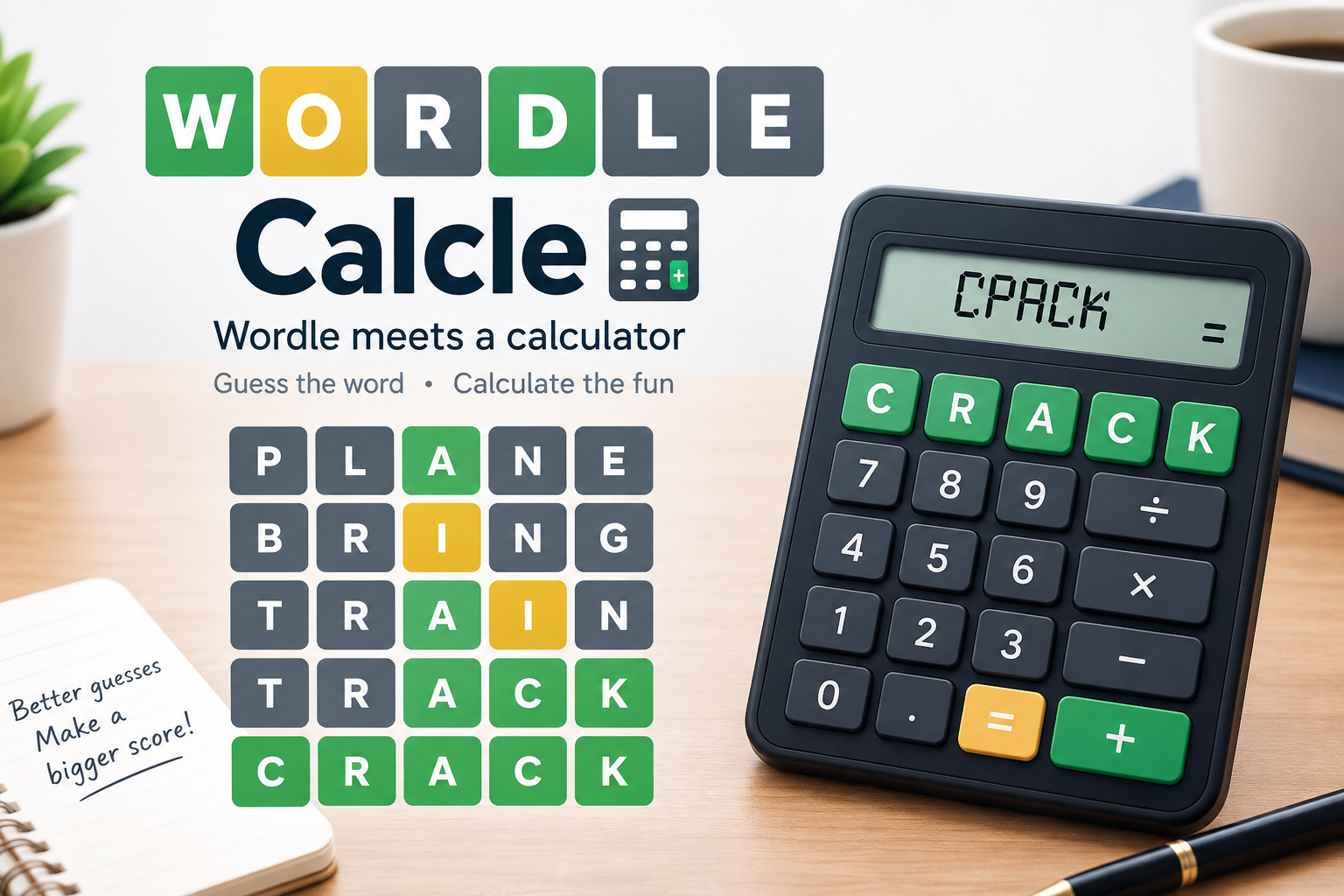
If you enjoy Wordle but want a puzzle that challenges your mathematical thinking, Wordle Calcle offers an interesting alternative. Instead of guessing a hidden five-letter word, you work with numbers, arithmetic operations, and logical clues to solve a mathematical equation.
The concept is straightforward, but finding the correct numbers within a limited number of attempts can be surprisingly challenging. Every guess provides valuable feedback, helping you eliminate incorrect possibilities and move closer to the solution.
Whether you’re playing for the first time or trying to improve your daily results, this guide explains how Calcle works, what the colored tiles mean, and which strategies can help you solve puzzles more efficiently.
What Is Wordle Calcle?
Wordle Calcle is a browser-based mathematical puzzle game inspired by the popular word-guessing game Wordle. It replaces letters with numbers and challenges players to complete a hidden arithmetic equation using deduction and mathematical reasoning.
In the commonly available daily version of Calcle, the arithmetic operators and target result are already displayed. Your task is to identify the missing numbers that make the equation correct, typically within five attempts.
Like Wordle, the game uses colored tiles to indicate whether your guesses contain correct elements.
Rather than testing your vocabulary, Calcle rewards your understanding of arithmetic, number relationships, and logical elimination.
Wordle Calcle at a Glance
| Feature | Details |
|---|---|
| Game type | Mathematical logic puzzle |
| Main objective | Find the missing numbers in an equation |
| Attempts allowed | Five in the standard daily version |
| Feedback system | Green, yellow, and gray tiles |
| Core skills | Arithmetic, deduction, and pattern recognition |
| Puzzle frequency | New daily challenge |
| Platform | Web browser |
| Cost | Free on commonly available versions |
| Difficulty | Depends on the equation and available clues |
Some websites offer different games under the Calcle name, including more advanced mathematical variations. This guide focuses on the daily arithmetic version in which players guess missing numbers.
How to Play Wordle Calcle: Step-by-Step Instructions
You don’t need advanced mathematics to begin playing. Understanding basic calculations and learning how to interpret the feedback are enough to get started.
Step 1: Open the Calcle Game
Access a browser-based version of Calcle, such as the one listed in the Calcle game directory.
The game displays a mathematical equation containing missing numbers, along with the operators and target result.
Before entering anything, examine the structure of the equation. Identify how many digits are missing and which operations you need to perform.
Step 2: Understand the Equation
Suppose a simplified puzzle shows:
_ _ + _ = 19
Your objective is to determine which numbers can fill the empty positions while making the equation mathematically correct.
Possible combinations include:
-
12 + 7 = 19
-
14 + 5 = 19
-
16 + 3 = 19
These examples demonstrate that several mathematically valid answers may exist.
The actual challenge is to identify the specific combination selected by the puzzle using the clues provided after each guess.
Step 3: Enter Your First Guess
Use the on-screen numeric keypad to enter the missing digits.
Your first attempt should be mathematically valid and, where possible, provide useful information about several different digits.
Avoid entering arbitrary numbers without checking whether they satisfy the equation. A thoughtful opening attempt can reveal more helpful clues than a guess chosen without any reasoning.
Step 4: Interpret the Colored Tiles
After submitting a guess, the game highlights the entered digits using its feedback system.
5
Green — Correct position
The digit belongs in the equation and occupies the correct position.
7
Yellow — Wrong position
The digit appears in the solution but belongs in a different position.
3
Gray — Not included
The digit is not part of the solution, subject to how repeated digits are handled.
The colors are more than visual indicators. They provide the information necessary to reduce the number of possible solutions.
Step 5: Refine Your Next Guess
Use the feedback to construct a better equation.
Keep green digits in their confirmed positions, reconsider the placement of yellow digits, and eliminate digits that the clues rule out.
Each attempt should narrow your choices rather than simply repeat a previous idea.
Step 6: Solve the Equation Within Five Attempts
Continue adjusting your guesses until the entire equation matches the hidden solution.
In the standard daily Calcle game, you have five attempts to find the correct answer.
If you succeed, you can share your result or return for the next daily challenge. If you use all five attempts without solving the equation, review the feedback to understand where your reasoning went wrong.
Understanding the Mathematical Logic Behind Calcle
The most important difference between Calcle and ordinary arithmetic exercises is that calculating the correct result isn’t always enough.
You must discover the particular numbers selected by the game.
Multiple Equations Can Produce the Same Result
Consider the following equation:
A + B = 15
Several combinations satisfy it:
| Value of A | Value of B | Result |
|---|---|---|
| 6 | 9 | 15 |
| 7 | 8 | 15 |
| 8 | 7 | 15 |
| 9 | 6 | 15 |
All four combinations are mathematically correct.
However, if the hidden solution is 8 + 7 = 15, only that arrangement will solve the puzzle.
This is where colored feedback becomes essential. It helps distinguish the selected answer from other valid equations.
Position Matters as Much as Value
A yellow digit tells you that the digit belongs somewhere in the solution, but not in the position where you placed it.
For example, imagine the hidden digits are 8 and 7, and you enter them in reverse order.
Both digits may receive yellow feedback because each digit exists in the solution but occupies the wrong position.
The logical next step is to exchange their positions, provided the resulting equation remains valid.
Arithmetic Constraints Reduce the Possibilities
Mathematical rules are powerful filters.
If a puzzle requires two positive numbers to add up to 20, the value of one number determines the other.
For instance:
20 - 13 = 7
Once you establish that one missing number is 13, the other must be 7.
Similar relationships apply to multiplication, subtraction, and division.
The strongest players combine these mathematical constraints with the color clues instead of treating the two types of information separately.
Best Wordle Calcle Strategies to Win More Often
Successful play is less about making calculations quickly and more about selecting guesses that provide useful information.
The following techniques can improve both accuracy and efficiency.
1. Start With Informative Digits
Your opening guess creates the foundation for the entire puzzle.
When several valid combinations are available, consider choosing one that tests a variety of digits instead of unnecessarily repeating the same digit.
A guess containing several distinct digits may help establish which numbers belong in the hidden equation.
However, the guess must still respect the game’s mathematical requirements. Testing different digits is useful only when the proposed equation is valid.
2. Solve the Arithmetic Before Guessing
Before submitting an answer, calculate the missing values and identify possible combinations.
For an equation involving addition, think in terms of complementary numbers.
For example, if the target is 24:
15 + 9 = 24
16 + 8 = 24
17 + 7 = 24
This immediately establishes several valid candidates.
You can then compare them against the digits and positions revealed by previous attempts.
3. Use Green Digits as Fixed Anchors
A green tile provides reliable positional information.
Once a digit is confirmed in a particular position, preserve it when constructing future guesses.
Changing confirmed values without a reason wastes information and can make the puzzle more confusing.
Instead, focus your attention on unresolved positions and determine which digits could realistically occupy them.
4. Treat Yellow Digits as Placement Problems
Yellow tiles identify digits you need but haven’t positioned correctly.
When you receive a yellow tile, ask two questions:
-
Which other positions could contain this digit?
-
Would moving it to those positions produce a valid equation?
Checking both conditions helps you avoid guesses that satisfy the color clues but violate arithmetic rules.
5. Respect the Order of Operations
Some mathematical puzzles include multiple arithmetic operations.
In such cases, standard order-of-operations rules become essential.
For example:
4 + 3 × 5 = 19
The multiplication occurs before the addition:
4 + 15 = 19
Calculating strictly from left to right would produce an incorrect result.
When parentheses are present, evaluate them first. Then apply multiplication and division before addition and subtraction, as appropriate.
6. Pay Attention to Repeated Digits
Repeated numbers can complicate color-based puzzles.
Suppose your guess contains two instances of the digit 4. One might receive positive feedback while the other does not, depending on the hidden solution and the game’s matching rules.
Don’t automatically assume that every occurrence of a digit is correct simply because one copy received a green or yellow tile.
Review both the number of repeated digits and their positions before making your next guess.
7. Prioritize Information Over Speed
Solving a puzzle quickly feels satisfying, but unnecessary rushing often increases mistakes.
Before submitting your next attempt, mentally check:
-
Does the equation produce the required result?
-
Have I preserved the confirmed positions?
-
Have I moved misplaced digits appropriately?
-
Does this guess provide useful information if it is incorrect?
That final question is particularly valuable. A guess that distinguishes between several competing possibilities may be more useful than one that merely looks close to the answer.
An Example of Solving a Calcle-Style Puzzle
To see how deduction works, consider a simplified two-digit puzzle.
Illustrative puzzle — not an actual daily Calcle result
Find the missing digits
_ + _ = 15
Guess 1: 6 + 9 = 15
6
+
9
= 15
Neither digit belongs in the hidden solution.
Guess 2: 7 + 8 = 15
7
+
8
= 15
Both digits appear, but each is in the wrong position.
Guess 3: 8 + 7 = 15
8
+
7
= 15
Correct solution in three guesses
This illustration demonstrates a useful principle: a mathematically valid guess can still be incorrect if it doesn’t match the hidden arrangement.
The second guess reveals both required digits. Because each receives yellow feedback, swapping their positions produces the solution.
Real Calcle puzzles may include longer number arrangements and more complex calculations, but the process of combining arithmetic with positional clues remains the same.
Advanced Techniques for Difficult Calcle Puzzles
Once you understand the basic rules, more systematic techniques can help with difficult equations.
Use Backward Calculation
Many players start by filling digits from left to right.
A more efficient approach is often to begin with the target result and work backward.
Suppose the structure is:
A × B = 36
Instead of trying arbitrary values, list the factor pairs:
-
4 × 9 = 36
-
6 × 6 = 36
-
3 × 12 = 36
-
2 × 18 = 36
The number of available digit positions determines which combinations are possible.
Once positional clues appear, you can eliminate incompatible factor pairs without making additional guesses.
Create a Mental Possibility List
After each guess, separate what you know from what you suspect.
For example, you may know that one digit is fixed, another digit belongs elsewhere, and two digits are excluded.
Use those facts to build a small list of possible solutions.
Avoid relying on memory alone when several candidates remain. Writing possibilities on paper can be useful for especially difficult puzzles.
Recognize Number Patterns
Familiarity with arithmetic patterns can dramatically reduce the amount of calculation needed.
Common patterns include:
-
Multiples of 5 usually end in 0 or 5 when dealing with whole numbers.
-
An even number multiplied by an integer produces an even result.
-
The sum of two odd numbers is even.
-
Multiplying any integer by 0 produces 0.
-
A number is divisible by 3 when the sum of its digits is divisible by 3.
These relationships allow you to eliminate impossible combinations before testing them.
For example, if two whole numbers multiply to produce an odd result, both numbers must be odd.
Track the Number of Remaining Possibilities
A strong guess should reduce uncertainty.
Suppose your existing clues leave four possible solutions. If a new guess could distinguish between those candidates, it is potentially valuable even if it doesn’t immediately solve the puzzle.
This approach is similar to the information-based strategies used in Wordle.
The objective is not simply to find an equation that works. It is to gain enough information to identify the exact hidden equation before your attempts run out.
Wordle Calcle vs. Wordle: What’s the Difference?
Although the games share a feedback-based guessing concept, they challenge different skills.
| Feature | Wordle | Calcle |
|---|---|---|
| Main challenge | Guess a hidden word | Guess missing equation digits |
| Subject | Language | Mathematics |
| Typical attempts | Six | Five in the standard daily version |
| Important skills | Vocabulary, spelling, letter patterns | Arithmetic, logic, number patterns |
| Feedback | Colored letter tiles | Colored number tiles |
| Winning condition | Identify the exact word | Identify the exact missing numbers |
| Daily play | Yes | Yes |
| Strategy focus | Letter frequency and placement | Mathematical constraints and digit placement |
Wordle primarily tests your ability to recognize words and use letter-frequency clues.
Calcle introduces arithmetic constraints, which can make some possibilities easier to eliminate mathematically while requiring more deliberate numerical reasoning.
Neither game is universally harder. The experience depends on your familiarity with vocabulary, calculations, and deduction.
Calcle vs. Nerdle vs. Mathler
Calcle isn’t the only Wordle-inspired mathematical puzzle.
Two other well-known options are Nerdle and Mathler.
| Game | Main objective | Key difference |
|---|---|---|
| Calcle | Find missing numbers in a displayed equation | Operators and result are supplied in the standard version |
| Nerdle | Guess a complete hidden mathematical equation | Numbers, operators, and their positions form the hidden answer |
| Mathler | Construct an equation matching a target number | Players work toward a given result using the game’s equation format |
Which Game Should You Choose?
Choose Calcle if you prefer arithmetic puzzles with a clearly defined equation structure and a limited number of attempts.
Try Nerdle if you enjoy discovering the entire equation, including the placement of operators.
Mathler may appeal to players who enjoy constructing calculations to reach a particular target.
All three reward mathematical reasoning, but their puzzle structures create different challenges.
Common Wordle Calcle Mistakes to Avoid
Even experienced players can lose attempts through small, preventable errors.
Guessing Without Checking the Equation
A guess may contain promising digits but still fail to satisfy the mathematical expression.
Always verify the arithmetic before submitting.
Ignoring Yellow Feedback
Yellow tiles provide confirmed information about digit presence.
Repeatedly entering those digits in the same incorrect positions wastes valuable attempts.
Changing Confirmed Digits
Once a green digit is correctly placed, changing it can undermine your progress.
Build subsequent guesses around the confirmed information.
Overlooking Repeated Numbers
A repeated digit may appear fewer times in the solution than in your guess.
Interpret the feedback carefully rather than treating every matching digit as an unlimited match.
Confusing Arithmetic Operations
Multiplication and division can produce significantly different results from addition and subtraction.
Read the displayed operators carefully, particularly when several operations appear in the same equation.
Using Too Many Similar Guesses
Trying several nearly identical combinations can provide little additional information.
When possible, choose a mathematically valid guess that tests a meaningfully different candidate or helps eliminate multiple possibilities.
Can Wordle Calcle Help Improve Math Skills?
Calcle can provide useful informal practice for arithmetic and logical reasoning.
While it isn’t a substitute for structured mathematics education, its puzzle format encourages players to work with numbers repeatedly and evaluate possible solutions.
Mental Arithmetic Practice
Frequent exposure to addition, subtraction, multiplication, and division can help players become more comfortable with everyday calculations.
The game creates a reason to practice these operations without relying on a traditional worksheet.
Logical Reasoning
Every colored tile provides a constraint.
Players must evaluate which conclusions follow from those constraints and which possibilities remain unproven.
This process encourages systematic deduction instead of random guessing.
Pattern Recognition
Repeated exposure to number combinations can make common mathematical relationships easier to recognize.
For example, players may become quicker at spotting factor pairs or complementary numbers that produce a particular target.
Error Analysis
One of the most valuable habits is reviewing incorrect guesses.
When a solution doesn’t work, consider whether the problem came from arithmetic, placement, or misinterpreting feedback.
This reflection can improve how you approach future puzzles.
How to Practice Calcle More Effectively
Improvement comes from developing a repeatable method rather than memorizing individual answers.
A useful routine is to begin each puzzle by identifying the equation’s structure and calculating several valid possibilities.
After your first attempt, use the colored feedback to eliminate incompatible candidates. Continue until only one arrangement remains.
If you’re trying to develop stronger mathematical reasoning, attempt the puzzle without a calculator first. Use one afterward to verify difficult calculations when necessary.
Another useful practice is to record how many guesses you needed and what caused any mistakes.
Over time, this can reveal whether you need to work on arithmetic accuracy, positional reasoning, or making more informative guesses.
Frequently Asked Questions About Wordle Calcle
Is Wordle Calcle free to play?
Yes. Commonly available browser versions of the daily Calcle game are free to play, and some do not require registration or downloads.
How many guesses do you get in Calcle?
The standard daily arithmetic version generally allows five attempts. Other games using the Calcle name may have different rules, including versions with six guesses.
Is Calcle the same as Wordle?
No. Calcle takes inspiration from Wordle’s guessing and colored-feedback mechanics but replaces word recognition with mathematical problem-solving.
Do you need to be good at math to play Calcle?
Not necessarily. Basic arithmetic is sufficient for the standard version, although familiarity with number relationships and logical deduction can make difficult puzzles easier.
Can you play Wordle Calcle on mobile?
Browser-based versions can be accessed from mobile devices through compatible web browsers. The layout and available controls depend on the site hosting the game.
Does Wordle Calcle have a new puzzle every day?
Yes. The standard version follows a daily challenge format. A new puzzle becomes available according to the game’s reset schedule.
Are there different versions of Calcle?
Yes. Some online games use the Calcle name for different mathematical challenges, including versions involving more advanced calculus concepts. The rules, equation formats, and permitted attempts may vary.
What is the best strategy for Calcle?
Start with a valid, informative guess, use green tiles as fixed positions, relocate yellow digits, and eliminate candidates using arithmetic rules.
The best strategy combines calculation with logical deduction rather than relying on trial and error.
Can I replay previous Calcle puzzles?
That depends on the version you’re using. Some daily Calcle pages focus on the current challenge and do not provide a visible archive of previous puzzles.
Is Calcle suitable for beginners?
Yes. The standard arithmetic version is approachable for players who understand basic mathematical operations. Beginners can improve gradually by learning the feedback system and practicing number patterns.
Final Thoughts: Master Wordle Calcle With Smarter Guessing
Wordle Calcle turns familiar arithmetic into a daily exercise in logic, deduction, and problem-solving. Its appeal comes from combining simple mathematical rules with the challenge of identifying one specific solution from several possible equations.
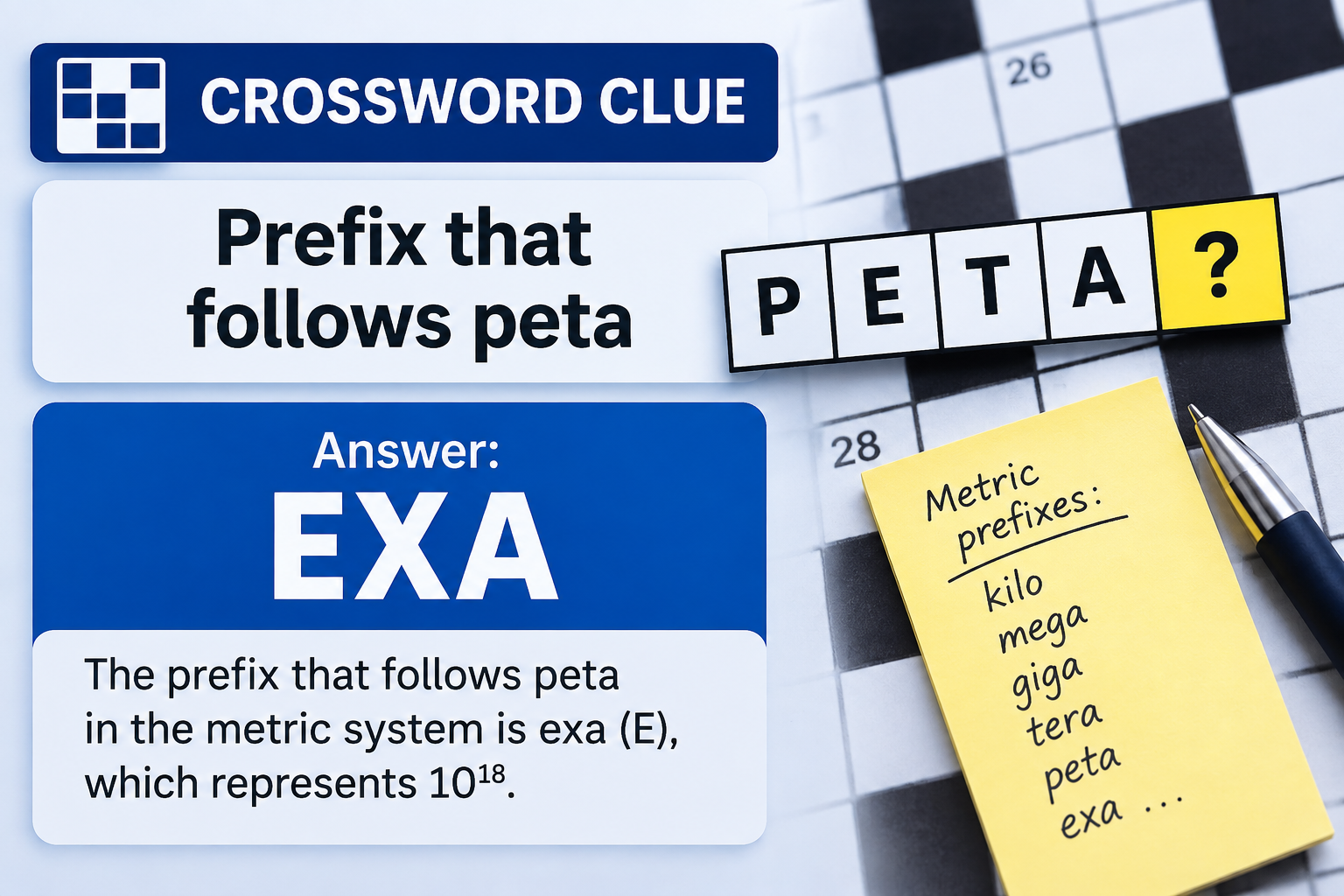
The answer to the prefix that follows peta crossword clue is EXA.
EXA is a three-letter SI metric prefix representing (10^{18}), or one quintillion. In the standard sequence of large metric prefixes, exa comes immediately after peta, making it the correct crossword answer. The clue has also appeared in published crossword databases with EXA as the solution.
Quick Answer
| Crossword Clue | Answer | Letters |
|---|---|---|
| Prefix that follows “peta-” | EXA | 3 |
| Prefix after peta | EXA | 3 |
| Metric prefix after peta | EXA | 3 |
Answer: EXA
If your puzzle requires a 3-letter answer, you can confidently enter E-X-A.
Why Is EXA the Correct Answer?
The clue refers to the order of prefixes used in the International System of Units (SI).
The relevant sequence is:
giga → tera → peta → exa → zetta → yotta
According to the International Bureau of Weights and Measures (BIPM), peta represents (10^{15}), while exa represents (10^{18}). Therefore, the prefix that follows peta is exa.
Peta vs. Exa
| Prefix | Symbol | Value |
|---|---|---|
| Tera | T | (10^{12}) |
| Peta | P | (10^{15}) |
| Exa | E | (10^{18}) |
| Zetta | Z | (10^{21}) |
| Yotta | Y | (10^{24}) |
Each of these large SI prefixes increases by a factor of 1,000 as you move up the sequence.
That pattern makes the clue easier to solve even when you do not immediately remember the word.
What Does Exa Mean?
Exa is an official SI prefix used to represent one quintillion, or:
1,000,000,000,000,000,000
Its official symbol is the uppercase letter E. BIPM lists exa as the (10^{18}) prefix, directly above peta at (10^{15}).
One familiar example is an exabyte, a unit used when discussing extremely large quantities of /
The prefix is not merely crossword vocabulary. It is part of the internationally recognized measurement system used in science, engineering, computing, and other technical fields.
How the Prefix Sequence Helps Solve the Crossword
Knowing a short section of the SI prefix sequence can make clues like this much easier.
Remember:
giga → tera → peta → exa → zetta
So when a crossword asks for the prefix that comes:
- after tera → PETA
- after peta → EXA
- after exa → ZETTA
- before exa → PETA
- between peta and zetta → EXA
This is particularly useful because crossword setters often reuse metric prefixes as short answers.
Is the Answer EXA or PETA?
The answer is EXA, not PETA.
The wording of the clue is important. It asks for the prefix that follows peta, meaning you need the next prefix in the sequence.
Think of it this way:
PETA → EXA
If the clue instead asked for the prefix that follows tera, then the answer would be PETA.
Does This Clue Refer to PETA the Organization?
No.
In this crossword clue, peta- refers to the metric prefix, not the acronym PETA associated with the animal-rights organization.
The hyphen in versions of the clue written as “peta-” is a useful hint that the setter is talking about a prefix attached to units of measurement.
That distinction can save time if your first thought is the well-known organization rather than the SI system.
Where Does Exa Fit in the Full SI Prefix Order?
For larger measurements, the modern SI sequence includes:
| Power | Prefix | Symbol |
|---|---|---|
| (10^9) | giga | G |
| (10^{12}) | tera | T |
| (10^{15}) | peta | P |
| (10^{18}) | exa | E |
| (10^{21}) | zetta | Z |
| (10^{24}) | yotta | Y |
| (10^{27}) | ronna | R |
| (10^{30}) | quetta | Q |
The BIPM recognizes these as official SI prefixes. Peta and exa were formally added to the SI system in 1975, while larger prefixes were added in later updates.
For the crossword clue, however, the only sequence you really need to remember is:
tera → peta → exa → zetta
Common Crossword Clues With EXA as the Answer
Crossword constructors can describe EXA in several ways. Similar clues may include:
- Prefix after peta
- Prefix that follows peta-
- Metric prefix after peta
- Prefix before zetta
- Prefix meaning one quintillion
- Prefix past tera and peta
- (10^{18}) prefix
- Prefix in “exabyte”
If the answer space contains three letters, EXA is a strong match for these clues.
How to Confirm EXA From Crossing Letters
Even when a clue appears obvious, crossing answers can provide useful confirmation.
For EXA, you should expect:
E _ _
then:
E X _
and finally:
E X A
The X is especially helpful because it is less common than many crossword letters. If your crossing answer gives an X in the middle position, that strongly supports EXA.
If your crossings produce a completely different pattern, recheck the neighboring clues before changing this answer.
Common Mistakes to Avoid
Choosing Zetta
Zetta comes after exa, not directly after peta.
The correct order is:
peta → exa → zetta
Entering Peta
Peta is already given in the clue. The puzzle wants the prefix that comes next.
Thinking of the PETA Acronym
The clue concerns SI measurement terminology. Reading peta- as a metric prefix makes the solution much clearer.
Ignoring the Letter Count
Most appearances of this clue require a 3-letter answer, which fits EXA perfectly.
A Simple Way to Remember Peta and Exa
Use the short sequence:
Tera, Peta, Exa, Zetta
or:
T → P → E → Z
You do not need to memorize every SI prefix to solve this type of crossword. Remembering those four large-unit prefixes will cover several common clue variations.
Frequently Asked Questions
What is the answer to the prefix that follows peta crossword clue?
The answer is EXA, a three-letter SI prefix representing (10^{18}).
How many letters are in the answer?
EXA has three letters.
What prefix comes directly after peta?
Exa comes directly after peta in the SI prefix sequence. BIPM lists peta as (10^{15}) and exa as (10^{18}).
What comes after exa?
The prefix following exa is zetta, which represents (10^{21}).
What comes before peta?
Tera comes before peta and represents (10^{12}).
What does exa stand for?
Exa is the SI prefix for a multiplication factor of (10^{18}), equal to one quintillion.
Is EXA a common crossword answer?
Yes. Its short three-letter form and distinctive X make it useful in crossword grids, and crossword databases record clues connecting EXA with the sequence following peta.
Final Answer: EXA
The solution to the prefix that follows peta crossword clue is EXA.
EXA — 3 letters
Remember the sequence tera → peta → exa → zetta, and you will be able to solve this clue and several similar metric-prefix crossword clues quickly.
Understanding the competitive edge theserpentrogue provides players and enthusiasts with a deeper look into how strategy, decision-making, and execution create long-term success. Whether you are exploring the mechanics, improving your performance, or studying advanced approaches, gaining a true advantage requires more than basic knowledge.
This guide breaks down the key elements behind building a competitive advantage, from resource management and tactical choices to common mistakes that prevent consistent progress.
Quick Facts About competitive edge theserpentrogue
| Element | Key Insight |
|---|---|
| Main Focus | Creating strategic advantages through smarter decisions |
| Skill Requirement | Planning, adaptability, and efficient execution |
| Best Improvement Area | Understanding systems rather than relying on luck |
| Long-Term Goal | Consistent performance and mastery |
Understanding the Core Competitive Edge
A competitive edge comes from identifying opportunities that others overlook. In any strategic environment, small advantages compound over time.
The strongest performers typically focus on:
- Better information gathering
- Faster adaptation to changing situations
- Efficient use of available resources
- Learning from previous decisions
- Creating repeatable strategies
The difference between an average approach and an expert approach is often the ability to recognize patterns before they become obvious.
Why Strategy Matters More Than Speed
Many players assume success comes from acting quickly, but speed without planning often creates unnecessary risks.
A stronger approach involves:
- Evaluating the current situation
- Predicting possible outcomes
- Choosing the highest-value action
- Adjusting based on new information
Strategic patience often creates opportunities that aggressive but unplanned actions miss.
Advanced Techniques to Improve Your Competitive Edge
Analyze Patterns and Opponent Behavior
One of the most valuable skills is recognizing repeated behaviors. Strong competitors do not only react; they anticipate.
Look for:
- Predictable choices
- Resource weaknesses
- Timing mistakes
- Inefficient strategies
Pattern recognition transforms random encounters into manageable situations.
Optimize Resource Management
Resources are not limited to physical items or currency. Time, positioning, information, and available options all influence outcomes.
Effective resource management includes:
- Avoiding unnecessary risks
- Prioritizing high-impact actions
- Saving advantages for critical moments
- Reducing wasted effort
Players who manage resources efficiently usually outperform those who focus only on immediate rewards.
Adapt Instead of Repeating Failed Strategies
A common mistake is repeating the same approach despite poor results.
Improvement requires:
- Reviewing what went wrong
- Identifying the exact weakness
- Testing alternative solutions
- Measuring the outcome
Adaptability is one of the biggest indicators of advanced skill.
Common Mistakes That Reduce Performance
Relying Too Much on Familiar Tactics
A strategy that works repeatedly can create overconfidence. Experienced competitors understand that successful methods eventually face new challenges.
Ignoring Small Advantages
Minor improvements often appear insignificant, but they create meaningful differences over time.
Examples include:
- Better timing
- Improved positioning
- More efficient choices
- Stronger preparation
Focusing Only on Short-Term Results
Winning a single encounter does not always represent true improvement. Sustainable success comes from building systems that work consistently.
Competitive Edge theserpentrogue: Beginner vs Advanced Approach
| Beginner Approach | Advanced Approach |
|---|---|
| Reacts to situations | Predicts future possibilities |
| Uses familiar strategies | Adjusts based on circumstances |
| Prioritizes immediate gains | Plans for long-term success |
| Learns after mistakes | Studies patterns before mistakes happen |
How to Develop a Stronger Competitive Mindset
A competitive mindset is built through continuous improvement rather than instant mastery.
Focus on:
1. Review Every Decision
After important moments, ask:
- Why did this choice work?
- What alternative options existed?
- What could be improved next time?
2. Build Consistent Habits
Skill development improves when learning becomes routine.
Useful habits include:
- Practicing specific weaknesses
- Studying successful strategies
- Tracking improvement areas
- Experimenting with new approaches
3. Balance Confidence With Flexibility
Confidence helps execution, but flexibility prevents stagnation.
The best competitors trust their abilities while remaining willing to change their methods.
Expert Tips for Maximizing Results
To strengthen your overall performance:
- Study successful examples instead of copying them blindly
- Develop multiple strategies for different situations
- Avoid predictable patterns
- Improve decision quality before increasing speed
- Treat mistakes as valuable feedback
The goal is not simply to find one winning method. The goal is to develop the ability to create advantages repeatedly.
Final Thoughts: Building Your competitive edge theserpentrogue Advantage
The competitive edge theserpentrogue comes from combining knowledge, strategy, adaptability, and disciplined execution. Real improvement happens when players move beyond basic actions and start understanding why certain decisions create better outcomes.
By analyzing patterns, managing resources wisely, and continuously refining your approach, you can develop a stronger and more reliable competitive advantage.


imageflings.com: What It Is, Website Status, Safety, and Everything You Should Know

TeamViewer Pricing vs. Splashtop: Complete 2026 Comparison Guide

What Is Globalunpaid Com? Complete Website Guide for 2026
-

 Fashion9 years ago
These ’90s fashion trends are making a comeback in 2017
-
Entertainment9 years ago
The final 6 ‘Game of Thrones’ episodes might feel like a full season
-
Fashion9 years ago
According to Dior Couture, this taboo fashion accessory is back
-
Business9 years ago
Uber and Lyft are finally available in all of New York State
-
Entertainment9 years ago
The old and New Edition cast comes together to perform
-
Sports9 years ago
Steph Curry finally got the contract he deserves from the Warriors
-
Sports9 years ago
Phillies’ Aaron Altherr makes mind-boggling barehanded play
-
Business9 years ago
The 9 worst mistakes you can ever make at work