
Lifestyle
AsiaTalks Website Review: Is It Safe and Worth It?

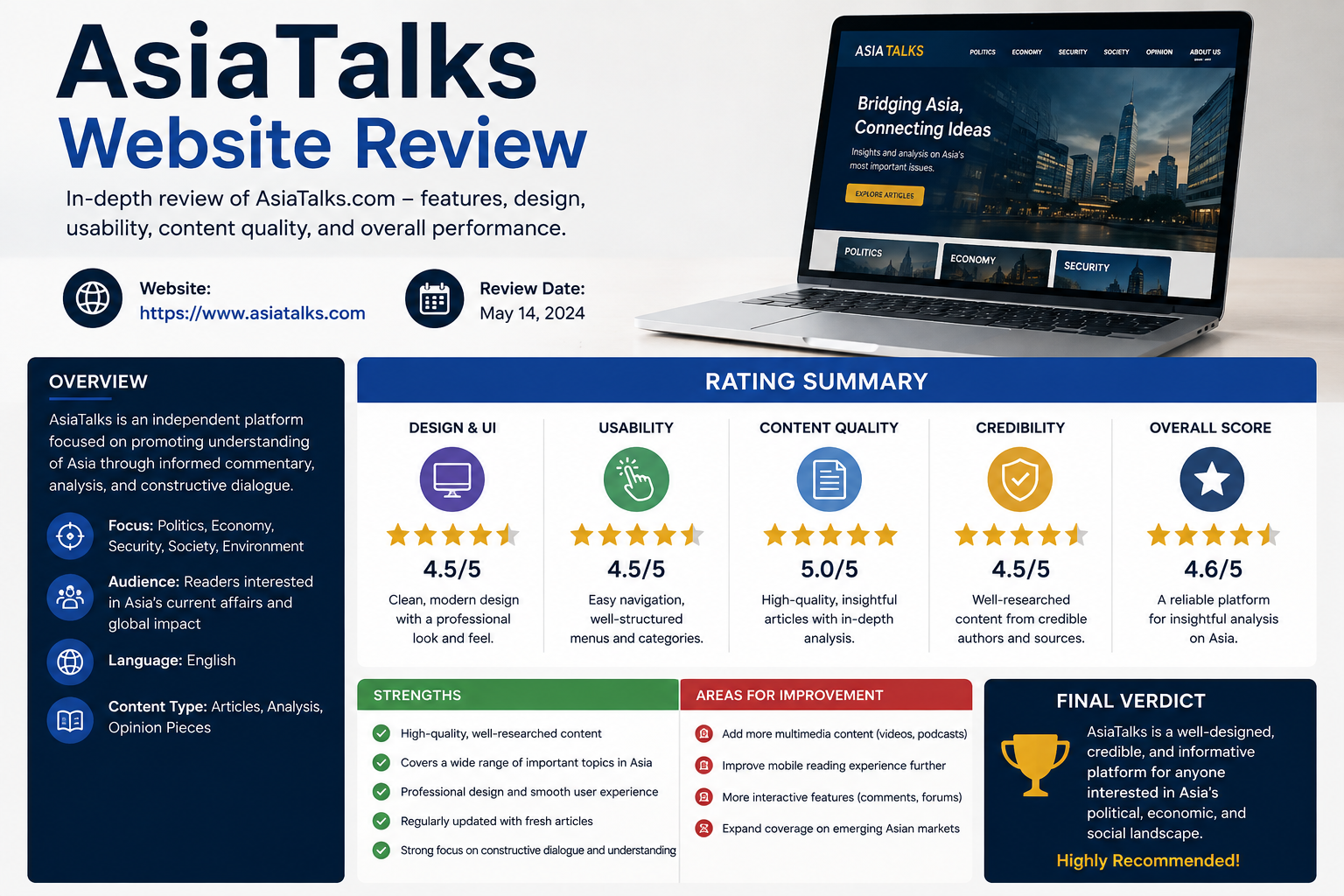
AsiaTalks is a browser-based communication platform designed for people who want to meet and chat with others online. This AsiaTalks Website Review examines how the platform works, what it may cost, its safety claims, public complaints, and whether purchasing credits offers reasonable value.
The site appears to be a functioning online service rather than an obvious fake webpage. However, that does not automatically mean every profile is genuine, every conversation will meet your expectations, or the credit-based model will suit your budget.
AsiaTalks Review at a Glance
| Review factor | Assessment |
|---|---|
| Platform type | Online social and communication platform |
| Registration | Free |
| Browsing | Basic access appears to be free |
| Communication model | Paid credits for certain interactive features |
| Access method | Web browser on desktop and mobile |
| Profile verification | Some profiles, particularly “Top Users,” are described as verified |
| Customer support | Email and telephone support details are publicly listed |
| Main concern | Communication costs can accumulate quickly |
| Overall verdict | Operational platform, but use cautiously and control spending |
What Is AsiaTalks?
AsiaTalks presents itself as an online space where users can create profiles, discover people, and have conversations. Its public homepage focuses on meaningful online interactions rather than promising marriages, guaranteed relationships, or immediate offline meetings.
The wording matters. AsiaTalks is better understood as a paid online communication platform than a traditional dating service with a predictable monthly subscription.
The homepage allows users to select their gender, choose whom they want to meet, provide a name and birthday, and create an account. It also states that registration begins without payment.
How AsiaTalks Works
The basic process is relatively simple:
- Create an account.
- Complete your profile.
- Browse suggested users.
- Receive or initiate conversations.
- Purchase credits when a paid action requires them.
AsiaTalks advertises free registration and basic access, while certain communication features require credits. The company has also confirmed this credit-based structure in responses to public reviews.
This means there may be no single monthly price covering unlimited use. Your actual expense depends on how many messages, photos, longer communications, or other paid features you use.
Main AsiaTalks Features
Profile Creation and Discovery
Users can create a personal profile and browse other members. The platform says adding information about yourself can help other users understand your interests before starting a conversation.
A company-provided description on Trustpilot also mentions personalized profiles, interactive messaging, and mobile-friendly browser access.
Online Messaging
Communication is the platform’s central feature. Members can interact through web-based messaging rather than downloading dedicated desktop software.
A sponsored overview of the platform describes chat, longer mail-style messages, media sharing, stickers, drafts, profile recommendations, and a social feed. Because that overview was sponsored by AsiaTalks, its feature descriptions are useful but should not be treated as independent evaluation.
Suggested Profiles
The service appears designed to keep profile discovery simple. Users may receive recommendations or see profiles that match their selected preferences.
Recommendations can make a platform easier to explore, but they should not be interpreted as evidence of personal compatibility or profile authenticity.
Support and Reporting
The official website links to a Safety Center, safety guides, transparency information, acceptable-use rules, privacy documents, payment terms, and an arbitration agreement.
Trustpilot lists a support email, a United States telephone number, and a company response pattern showing replies to a large percentage of negative reviews.
Is AsiaTalks Free?
Creating an account and accessing basic browsing features appears to be free. Meaningful interaction, however, may require purchased credits.
This distinction is essential:
- Free registration does not mean unlimited free communication.
- Browsing profiles may not cost anything.
- Messages, photos, media, or extended interactions may consume credits.
- A long conversation can require multiple purchases.
The website should therefore be evaluated as a pay-per-action service, not a completely free social network.
How Much Does AsiaTalks Cost?
AsiaTalks uses credits rather than relying solely on a flat subscription. Exact packages and action costs can change, so users should inspect the current checkout screen and payment policy before purchasing.
Recent public reviewers repeatedly identify pricing as their main complaint. Trustpilot’s automated review summary says customers frequently consider chatting, viewing content, and exchanging information expensive.
One detailed reviewer claimed that individual chats, emails, photos, videos, and audio files consumed different amounts of credits. AsiaTalks responded by confirming the general credit system but did not validate every price quoted in that review.
For that reason, third-party price lists should be treated as examples rather than guaranteed current rates.
How to Estimate Your Real Cost
Before purchasing credits, calculate the likely cost of a normal week:
- Check the price of the credit package.
- Record how many credits one message or action uses.
- Estimate how many actions you expect each day.
- Multiply that amount by seven.
- Convert the weekly credit total into real currency.
For example, a package may look inexpensive until you calculate the cost of maintaining several active conversations every day.
Common Pricing Mistake
The biggest mistake is evaluating only the initial credit package.
The more useful figure is your cost per meaningful conversation. If a short exchange consumes a large portion of your balance without improving the relationship, the service may provide poor value even when the first package seems affordable.
Is AsiaTalks Legit?
AsiaTalks appears to be an operational platform with an active website, account registration, payment options, published legal pages, customer-support details, and a substantial public review history. These are stronger legitimacy signals than those usually found on a temporary scam webpage.
However, “legit” can mean several different things:
- Is the website real and operational? It appears to be.
- Does it provide the credits or features purchased? Public evidence suggests it operates as a paid communication service.
- Is every profile guaranteed to be genuine? No public evidence establishes that.
- Will conversations lead to real relationships or meetings? There is no guarantee.
- Is it good value? That depends heavily on usage and spending.
A platform can be operational while still being expensive, unsuitable, or disappointing for some users.
Are AsiaTalks Profiles Real?
The AsiaTalks homepage says every “Top User” has passed its verification process. That wording does not necessarily mean every account on the platform has been identity-verified.
The company also states on Trustpilot that many users can be verified through a third-party identity-verification process. Again, “many” should not be interpreted as “all.”
Public feedback is mixed. Some reviewers describe enjoyable interactions, easy navigation, and responsive support. Others question whether particular conversations feel natural or whether some profiles are authentic. These are user allegations and personal experiences, not confirmed evidence that the entire platform uses fake accounts.
How to Check Whether a Profile Seems Genuine
Use a gradual verification process:
- Ask specific questions related to earlier messages.
- Notice whether replies address what you actually wrote.
- Look for consistency in age, location, occupation, and personal stories.
- Use reverse-image search when a profile photo appears unusually professional.
- Avoid assuming a verification badge guarantees honesty in every interaction.
- Do not send money, gift cards, cryptocurrency, or banking information.
- Report suspicious accounts through the platform.
Repeated generic replies, changing personal details, financial requests, emotional pressure, or excuses that prevent reasonable verification are warning signs.
What Do Customer Reviews Say?
As of August 6, 2026, AsiaTalks had a Trustpilot score of 3.8 out of 5 from more than 2,300 reviews. Approximately 54% were five-star reviews, while 20% were one-star reviews, showing a noticeably divided customer experience. Trustpilot also indicated that the company actively invites users to leave reviews.
Because ratings change, these numbers should be treated as a dated snapshot rather than permanent statistics.
Positive Themes
Favorable reviewers commonly mention:
- A straightforward interface
- Easy profile browsing
- Interesting conversations
- Helpful customer-service responses
- The ability to meet people from different backgrounds
Negative Themes
Critical reviews commonly focus on:
- Credits running out quickly
- High communication costs
- Charges for accessing certain content
- Difficulty moving conversations beyond the platform
- Doubts about individual profile authenticity
- Conversations that feel repetitive or generic
The most consistent concern is not whether the website loads or processes accounts. It is whether the value of paid communication justifies the ongoing cost.
AsiaTalks Pros and Cons
Pros
- Free account registration
- Browser-based access
- Simple onboarding process
- Profile discovery and messaging tools
- Published legal and privacy pages
- Safety and reporting resources
- Public customer-support contact information
- Some users may pass a verification process
Cons
- Credit-based communication can become expensive
- No fixed cost for highly active users
- Verification does not appear to cover every profile
- Public reviews include authenticity concerns
- Outcomes depend entirely on individual conversations
- Free registration may create an incomplete impression of total cost
- The platform may be unsuitable for users seeking quick offline meetings
Is AsiaTalks Safe?
AsiaTalks provides several standard trust and safety elements, including policies, reporting tools, support information, privacy documentation, and references to profile verification. The company says it monitors suspicious activity and allows users to report unacceptable behavior.
These protections are useful, but no social platform can remove every risk. Users remain responsible for protecting personal information and evaluating the people they contact.
Essential Safety Rules
- Use a separate email address for online social platforms.
- Create a unique password.
- Do not share passport, identification, or banking documents.
- Never send money to someone you have only met online.
- Avoid opening unknown links or files.
- Do not reveal your home address too early.
- Keep screenshots of suspicious messages and payment receipts.
- Contact support immediately if an account pressures or threatens you.
Who May Find AsiaTalks Useful?
AsiaTalks may suit people who:
- Prefer browser-based communication
- Enjoy meeting international users
- Are comfortable with credit-based payments
- Want casual conversations without immediate commitments
- Can maintain a strict entertainment budget
- Understand that online conversations may not lead to offline relationships
Who Should Avoid It?
The platform may not be suitable for people who:
- Want unlimited messaging for one monthly fee
- Have a limited budget
- Become emotionally invested very quickly
- Expect every profile to be fully identity-verified
- Want guaranteed video calls or in-person meetings
- Dislike paying separately for individual interactions
- Have previously overspent on credit-based platforms
Users seeking a serious relationship may prefer services with transparent subscriptions, clearly defined verification, built-in video calls, and practical options for progressing beyond text messages.
How to Use AsiaTalks Without Overspending
1. Browse Before Paying
Explore the free sections first. Do not purchase credits simply because you receive several immediate messages after registration.
2. Set a Fixed Limit
Decide on a weekly or monthly amount before making the first payment. Treat it as an entertainment budget that cannot be increased.
3. Focus on Fewer Conversations
Maintaining many conversations simultaneously can drain credits without producing meaningful results. Select one or two profiles that provide detailed, consistent replies.
4. Track Every Purchase
Keep a basic record containing:
- Purchase date
- Amount paid
- Credits received
- Credits used
- Conversations supported by the purchase
This reveals whether you are receiving reasonable value.
5. Stop When Progress Stalls
Do not continue purchasing credits simply because you have already spent money. Previous spending is not a reason to keep funding an unproductive conversation.
6. Read the Refund Policy First
Check whether credits are refundable, whether unused balances expire, and how unauthorized transactions are handled. Save a copy or screenshot of the policy visible when you purchase.
Common Mistakes to Avoid
Assuming Every Incoming Message Shows Genuine Interest
New users may receive attention quickly. Evaluate the quality and relevance of replies rather than the number of messages.
Confusing Verification With a Guarantee
Verification may confirm certain information, but it cannot guarantee someone’s intentions, honesty, compatibility, or future behavior.
Spending to Protect an Emotional Connection
A person who genuinely respects you should not pressure you to spend beyond your limits.
Ignoring the Cost of Small Actions
Credit systems make individual actions feel inexpensive. The cumulative cost is what matters.
Relying Only on Five-Star or One-Star Reviews
Very positive and very negative reviews can both lack context. Compare detailed reviews that explain how long the person used the service, what they purchased, and what outcome they expected.
What This Review Cannot Confirm
This AsiaTalks Website Review is based on the platform’s public pages, company statements, policy links, and recent third-party customer feedback.
It cannot independently confirm the identity of every member, verify private conversations, guarantee the accuracy of every customer allegation, or predict whether a particular user will form a genuine connection. Pricing and platform features may also change after publication.
Frequently Asked Questions
Is AsiaTalks a dating website?
AsiaTalks presents itself primarily as an online communication and social-interaction platform. Some users may approach it with dating or relationship goals, but the website does not guarantee romantic outcomes or offline meetings.
Can you use AsiaTalks for free?
Registration and basic browsing appear to be free. Certain communication tools and interactive features require purchased credits.
Is AsiaTalks a scam?
The website appears to be an active, operational service rather than a simple fake webpage. Nevertheless, users should carefully evaluate profile authenticity, pricing, refund rules, and the value received from paid conversations.
Are all AsiaTalks profiles verified?
The website says that “Top Users” pass verification, while company material says many users can be verified. This does not establish that every profile is identity-verified.
Why do people complain about AsiaTalks?
The most frequent complaints concern credit costs, rapid balance depletion, paid content, difficulty progressing beyond online chat, and doubts about individual profiles.
Can AsiaTalks lead to a real relationship?
It is possible for online communication to develop into a meaningful connection, but AsiaTalks cannot guarantee that outcome. Success depends on the individuals, their intentions, verification, communication quality, and willingness to progress safely.
Should I purchase AsiaTalks credits?
Purchase only after checking the current action costs and setting a firm spending limit. Start with the smallest practical amount and evaluate the value before buying more.
Final Verdict: Is AsiaTalks Worth It?
This AsiaTalks Website Review finds that the site is a functioning online communication platform with free registration, paid interaction features, support channels, safety resources, and a large but divided collection of public reviews.
Its biggest weakness is the credit model. Users who chat frequently may spend far more than they initially expect, while profile verification and meaningful relationship outcomes are not guaranteed.
Final recommendation: AsiaTalks may be acceptable for cautious, casual online conversations, provided you set a strict budget and verify people gradually. It is not the strongest choice for budget-conscious users or anyone seeking transparent unlimited messaging and a clear path toward real-world meetings.
Confidence level: High regarding the platform’s public structure and recurring customer-feedback patterns; medium regarding individual profile authenticity and real-world outcomes.

A supermarket is more than a place to buy groceries. It brings food, household products, personal care items, beverages, and everyday essentials together under one roof, making routine shopping faster and more convenient.
Modern supermarkets have also become highly organized retail businesses. Product placement, pricing, promotions, loyalty programs, inventory systems, and even store layouts are carefully planned to influence how people shop.
This guide explains how supermarkets work, what they sell, how they differ from other grocery stores, and how shoppers can get better value without buying things they do not need.
Supermarket Quick Facts
| Topic | Details |
|---|---|
| Main purpose | Selling food and everyday household products |
| Shopping model | Mostly self-service |
| Common departments | Produce, dairy, meat, bakery, frozen food, pantry, household |
| Store size | Usually larger than a traditional grocery store |
| Payment options | Cash, cards, digital payments, loyalty points |
| Pricing methods | Regular pricing, promotions, discounts, private labels |
| Main customer benefit | Convenience and wide product selection |
What Is a Supermarket?
A supermarket is a large self-service retail store that primarily sells groceries, fresh food, packaged food, beverages, cleaning products, toiletries, and household necessities.
Customers usually move through different aisles and departments, select their own products, and pay at staffed checkout counters or self-checkout stations.
Unlike small neighborhood grocery shops, supermarkets typically stock several brands and variations of the same product. A single cereal, cooking oil, coffee, or detergent category may contain dozens of choices.
That wider selection allows shoppers to compare:
- Prices
- Package sizes
- Ingredients
- Brands
- Nutritional information
- Promotions
- Quality
What Do Supermarkets Sell?
The exact product range differs by location and store size, but most supermarkets cover several core categories.
Fresh Produce
The produce department usually contains:
- Fruits
- Vegetables
- Herbs
- Salads
- Pre-cut produce
- Organic products
- Seasonal items
Fresh produce is often positioned close to the entrance because its colors and presentation can make the store feel fresh and inviting.
Meat, Poultry, and Seafood
Larger supermarkets may have dedicated counters for:
- Beef
- Chicken
- Lamb
- Fish
- Seafood
- Minced meat
- Marinated products
- Ready-to-cook meals
Some stores provide butcher services where customers can request particular cuts or quantities.
Dairy Products
A typical dairy section includes:
- Milk
- Yogurt
- Cheese
- Butter
- Cream
- Eggs
- Dairy-free alternatives
Plant-based alternatives made from oats, almonds, soy, coconut, and other ingredients have also become common.
Bakery Products
Supermarket bakeries may sell freshly prepared:
- Bread
- Rolls
- Cakes
- Muffins
- Pastries
- Cookies
- Pies
Some products are baked entirely in-store, while others arrive partly prepared and are finished on-site.
Packaged and Pantry Foods
These aisles generally contain long-life products such as:
- Rice
- Pasta
- Flour
- Sugar
- Canned food
- Sauces
- Spices
- Breakfast cereals
- Snacks
- Cooking oils
This part of the supermarket usually offers the greatest number of competing brands.
Frozen Foods
Frozen departments commonly stock:
- Vegetables
- Fruits
- Pizza
- Ice cream
- Ready meals
- Meat
- Seafood
- Desserts
Frozen food can be practical for households that want longer storage times and reduced food waste.
Household Products
Supermarkets also sell non-food essentials, including:
- Laundry detergent
- Dishwashing products
- Cleaning sprays
- Paper towels
- Tissues
- Garbage bags
- Storage products
Large stores may carry basic kitchenware, batteries, light bulbs, stationery, or seasonal household items.
Personal Care Products
Common personal care products include:
- Shampoo
- Soap
- Toothpaste
- Deodorant
- Skincare items
- Shaving products
- Feminine care products
- Baby products
Some supermarkets also operate pharmacy or health sections.
How Does a Supermarket Work?
A supermarket relies on a complex supply system that shoppers rarely see.
Products move from manufacturers, farms, wholesalers, distributors, and warehouses before reaching store shelves.
Purchasing and Supply
Supermarket buying teams negotiate with suppliers over:
- Product prices
- Quantities
- Delivery schedules
- Promotional offers
- Shelf placement
- Payment terms
Large supermarket chains may have stronger negotiating power because they purchase very large quantities.
Distribution
Many chains use centralized distribution centers.
Suppliers deliver products to a warehouse, where goods are sorted and then transported to individual stores.
Central distribution can help retailers control inventory and lower transportation costs.
Inventory Management
Supermarkets need enough inventory to meet demand without keeping excessive stock.
Modern inventory systems monitor sales and help stores determine when products should be reordered.
For perishable goods, inventory management is particularly important because unsold stock can quickly become waste.
Shelf Stocking
Products are arranged according to a planned shelf layout known as a planogram.
Retailers consider:
- Product popularity
- Profit margins
- Brand agreements
- Customer behavior
- Package size
- Promotional campaigns
The most visible position is not always occupied by the cheapest or best-value product.
How Supermarkets Influence Buying Decisions
Supermarket layouts are designed to make shopping convenient, but they can also encourage additional purchases.
Understanding these techniques helps consumers make more deliberate decisions.
Eye-Level Placement
Products positioned at eye level receive more attention.
Premium brands may occupy these positions, while cheaper alternatives can appear on higher or lower shelves.
Checking the full shelf rather than only the products directly in front of you can reveal better deals.
End-of-Aisle Displays
Products placed at the ends of aisles attract attention because shoppers naturally pass them.
However, an end-of-aisle display does not automatically mean the product is discounted.
Always compare its price with similar products in the main aisle.
Checkout Products
Checkout areas commonly contain inexpensive products that can trigger impulse purchases.
Examples include:
- Candy
- Gum
- Drinks
- Small snacks
- Batteries
- Travel-size products
Each item may seem inexpensive, but repeated impulse buying can significantly increase monthly grocery spending.
Larger Shopping Carts
Large carts make a small amount of shopping look less substantial.
This can subtly encourage customers to continue adding products.
Using a basket when buying only a few items can help limit unnecessary purchases.
Supermarket vs Grocery Store
The terms supermarket and grocery store are sometimes used interchangeably, but they can describe different retail formats.
| Feature | Supermarket | Traditional Grocery Store |
|---|---|---|
| Size | Medium to large | Usually smaller |
| Product range | Extensive | More limited |
| Departments | Multiple specialized sections | Fewer departments |
| Brand choice | Wide | Moderate |
| Self-service | Usually | Often |
| Non-food products | Common | Limited |
| Fresh food counters | Often available | Less common |
The distinction is becoming less clear because many smaller stores now carry supermarket-style product ranges.
Supermarket vs Hypermarket
A hypermarket is generally larger than a standard supermarket.
While a supermarket focuses heavily on groceries and household essentials, a hypermarket may also sell:
- Clothing
- Electronics
- Furniture
- Appliances
- Toys
- Automotive products
- Home improvement items
A hypermarket combines elements of a supermarket and a department store.
How Supermarkets Set Prices
Supermarket pricing is influenced by much more than the original cost of the product.
Retailers consider several factors before deciding what customers will pay.
Supplier Cost
The retailer first pays a supplier or distributor for the goods.
Larger retailers may negotiate lower prices by purchasing greater volumes.
Operating Expenses
Prices must also contribute toward expenses such as:
- Employee wages
- Rent
- Electricity
- Refrigeration
- Transportation
- Warehousing
- Insurance
- Technology
- Product losses
Fresh and frozen products can be particularly expensive to handle because they require temperature-controlled storage.
Competition
Supermarkets monitor competitors closely.
Stores may reduce prices on highly visible essentials to appear cheaper, even when other products carry higher margins.
Promotions
Temporary discounts may be funded by the retailer, the manufacturer, or both.
Common supermarket promotions include:
- Buy one, get one free
- Multi-buy deals
- Percentage discounts
- Loyalty-member prices
- Coupons
- Clearance pricing
A promotional label should not replace basic price comparison.
Why Unit Pricing Matters
One of the most useful supermarket shopping habits is comparing unit prices.
The largest package is not always the cheapest option.
For example, imagine two packages of rice:
- 1 kg for $4.50
- 2 kg for $8.20
The first costs $4.50 per kilogram.
The second costs $4.10 per kilogram.
In this case, the larger pack offers better value, assuming the household can use it before quality declines.
Unit prices may be displayed per:
- Kilogram
- Gram
- Liter
- Milliliter
- Item
- 100 grams
Comparing these figures gives a more accurate picture than comparing package prices alone.
Store Brands vs Name Brands
Many supermarkets sell products under their own private labels.
These products may be called:
- Store brands
- Private labels
- Own brands
- House brands
Private-label products are often cheaper because retailers can reduce branding and marketing expenses.
However, lower price does not automatically mean lower quality.
For basic products such as flour, sugar, canned vegetables, cleaning products, or spices, comparing ingredients and specifications may reveal little difference between store brands and more expensive alternatives.
How to Shop Smarter at a Supermarket
A few simple habits can reduce grocery spending without requiring extreme budgeting.
1. Check What You Already Have
Before shopping, inspect your:
- Refrigerator
- Freezer
- Pantry
- Cupboards
Buying products you already own can lead to unnecessary spending and food waste.
2. Make a Shopping List
A written list gives the shopping trip a clear purpose.
Organize it by department if possible:
- Produce
- Meat
- Dairy
- Pantry
- Frozen
- Household
This also reduces unnecessary movement through aisles where you may be tempted to buy additional products.
3. Plan Meals First
Instead of buying random ingredients and deciding what to cook later, choose several meals before visiting the supermarket.
Meal planning makes it easier to buy ingredients that work together.
4. Compare Unit Prices
Do not assume:
- Larger means cheaper.
- Discount signs mean better value.
- Premium brands mean better quality.
Check the actual cost per unit.
5. Look Beyond Eye Level
Scan high and low shelves.
Budget and store-brand products are frequently placed outside the easiest viewing area.
6. Be Careful With Multi-Buy Offers
A three-for-two offer only saves money if you actually need three units.
Buying additional food that expires before use is not a saving.
7. Check Expiration Dates
For products you will use slowly, choose an appropriate expiration date.
For something you plan to consume immediately, a shorter date may be acceptable, especially if the supermarket has reduced the price.
8. Understand Loyalty Programs
Loyalty programs may provide:
- Member discounts
- Coupons
- Reward points
- Cashback
- Personalized promotions
They can be useful, but customers should still compare the final price rather than buying something simply because points are available.
Common Supermarket Shopping Mistakes
Small shopping habits can have a surprisingly large effect over time.
Common mistakes include:
- Shopping without a list
- Shopping while hungry
- Assuming sale items are always cheaper
- Ignoring unit prices
- Buying oversized packages that go unused
- Choosing only familiar brands
- Buying products because of attractive packaging
- Ignoring food already available at home
- Buying too many perishable products
- Confusing convenience with value
The goal is not always to choose the lowest price. It is to choose the best combination of cost, quality, quantity, and usefulness.
Fresh, Frozen, or Canned: Which Is Better?
Each option has advantages.
Fresh Food
Fresh products work well when they will be eaten soon.
They can provide excellent quality and texture, but they often have shorter storage lives.
Frozen Food
Frozen products can remain usable much longer.
Frozen vegetables and fruits can also help households reduce waste because only the required quantity needs to be used.
Canned Food
Canned products offer long shelf life and convenience.
Consumers should check labels for added salt, sugar, or sauces when those factors matter to their diet.
No single format is automatically best. The right choice depends on intended use, storage space, nutrition, price, and how quickly the food will be consumed.
Online Supermarkets and Grocery Delivery
Supermarkets increasingly operate through websites and mobile apps.
Customers can browse products, select delivery times, or place orders for collection.
Online grocery shopping can make price tracking easier because shoppers can search and compare products without walking through multiple aisles.
It may also reduce impulse buying.
However, customers should consider:
- Delivery fees
- Minimum order requirements
- Product substitutions
- Fresh produce selection
- Service charges
- Delivery availability
For households making large planned purchases, online shopping can be convenient. For someone who needs a few items immediately, visiting a nearby store may still be faster.
Self-Checkout in Supermarkets
Self-checkout machines have become common in many supermarket formats.
They allow customers to scan products, bag purchases, and pay without using a traditional staffed checkout lane.
The main advantages include:
- Faster processing for small baskets
- More checkout options
- Greater customer control
- Reduced queues during some periods
However, age-restricted items, coupons, unexpected weight errors, or barcode problems may still require employee assistance.
Food Waste and Supermarkets
Food waste is a major operational issue for grocery retailers because fresh food has a limited shelf life.
Supermarkets may reduce waste through:
- Discounting products approaching their sell-by dates
- Donating suitable food
- Improving demand forecasting
- Selling imperfect produce
- Adjusting order quantities
- Reusing ingredients in prepared-food departments where regulations permit
Shoppers can contribute by buying discounted products when they know they will consume them quickly.
Sustainability in the Supermarket Industry
Environmental concerns are affecting packaging, logistics, energy use, sourcing, and food waste policies.
Some supermarkets are reducing environmental impact through:
- Energy-efficient refrigeration
- Reusable shopping bags
- Reduced plastic packaging
- Recycling programs
- Local sourcing
- Food donation programs
- Solar power
- Electric delivery vehicles
Sustainability claims should still be evaluated carefully.
Words such as “green,” “natural,” or “eco-friendly” can be vague unless the company provides specific evidence explaining what has changed.
How Technology Is Changing Supermarkets
Technology is becoming central to grocery retail.
Digital Price Labels
Electronic shelf labels allow retailers to update prices without replacing paper labels manually.
They can also help keep shelf prices aligned with checkout systems.
Smart Inventory Systems
Retailers increasingly use sales data and forecasting tools to estimate future demand.
Better forecasting can reduce both empty shelves and excess stock.
Personalized Promotions
Loyalty data allows retailers to offer promotions based on previous purchases.
This may make offers more relevant, although customers should understand how their shopping data is collected and used.
Checkout-Free Shopping
Some retail formats are testing systems that automatically detect which products shoppers take and charge them when they leave.
The technology may reduce checkout waiting times, although adoption depends on cost, reliability, consumer acceptance, and privacy considerations.
How to Choose a Good Supermarket
Price matters, but it should not be the only factor.
A useful supermarket should provide a good balance of:
- Competitive pricing
- Product quality
- Cleanliness
- Freshness
- Reliable stock
- Convenient location
- Helpful staff
- Clear pricing
- Reasonable checkout times
- Suitable opening hours
Someone buying mostly fresh produce may prefer one store, while a family buying large quantities of packaged goods may find another retailer more economical.
Tracking the cost of your regular basket can be more useful than relying on general claims that one supermarket is always cheaper.
Should You Shop at More Than One Supermarket?
Sometimes.
Different supermarkets may offer better value in different categories.
One retailer may have lower prices for produce, while another may offer better household products or private-label groceries.
However, traveling between several stores also costs time and money.
A small saving is not worthwhile if it requires substantial additional travel.
For most households, using one main supermarket and occasionally visiting another for specific high-value purchases provides a practical balance.
Frequently Asked Questions
What is the main purpose of a supermarket?
The main purpose of a supermarket is to provide food, groceries, household goods, and everyday essentials in one convenient self-service location.
What is the difference between a supermarket and a grocery store?
A supermarket is generally larger and carries a wider selection of food and non-food products. A grocery store may be smaller and offer fewer brands or departments.
Why are supermarket essentials sometimes placed far apart?
Store layouts encourage customers to move through more areas of the shop. This increases exposure to additional products and promotions.
Are supermarket own-brand products good?
Many are. Quality varies by product, but private-label goods can provide strong value because they often have lower marketing and branding costs.
Is buying in bulk always cheaper?
No. Compare the unit price first and consider whether the product can be used before it expires.
Why do supermarket prices change?
Prices can change because of supplier costs, transportation, seasonal availability, competition, promotions, currency movements, labor costs, and changes in demand.
Are supermarket promotions always worth using?
No. A promotion provides value only when the final price is competitive and you genuinely need the product.
How can I spend less at a supermarket?
Plan meals, make a list, compare unit prices, check store brands, avoid unnecessary multi-buy offers, and reduce food waste at home.
Final Thoughts
A supermarket offers convenience, variety, and access to most everyday household necessities in one place. But smart supermarket shopping involves more than finding products and putting them into a cart.
Understanding shelf placement, unit pricing, promotions, store brands, expiration dates, and shopping psychology makes it easier to separate genuine value from clever marketing.
Go in with a plan, compare products carefully, and buy quantities that fit your household’s actual needs. Those simple habits can make every supermarket trip more efficient while helping you control spending and reduce waste.

The BMW M5 Cs represents one of the most extreme interpretations of the modern performance sedan. Based on the F90-generation M5, the limited-production CS combined a 4.4-liter twin-turbocharged V8, substantial weight reduction, carbon-ceramic brakes, revised suspension and a four-seat cabin designed to feel noticeably more focused than the regular M5.
BMW launched the M5 CS in 2021, with production running from March 2021 until January 2022. BMW describes CS as Competition Sport, positioning the car above the M5 Competition in the F90 hierarchy. BMW M
What makes the car particularly interesting today is that its appeal extends beyond headline horsepower. The M5 CS combines supercar-level acceleration with four doors, usable luggage space and an unusually engaging chassis—a combination that has made well-preserved examples particularly desirable among BMW M enthusiasts.
BMW M5 CS Quick Facts
| Specification | BMW M5 CS |
|---|---|
| Generation | F90 |
| Engine | 4.4-liter twin-turbo V8 |
| Power | 635 PS / 627 hp |
| Torque | 750 Nm / 553 lb-ft |
| Transmission | 8-speed M Steptronic automatic |
| Drivetrain | M xDrive AWD with 2WD mode |
| 0–100 km/h | 3.0 seconds claimed |
| 0–60 mph | 2.6 seconds tested by Car and Driver |
| Top speed | 305 km/h / 190 mph |
| Seating | 4 |
| Wheels | 20-inch forged M wheels |
| Brakes | Carbon-ceramic |
| Production period | March 2021–January 2022 |
BMW rated the engine at 467 kW/635 PS and 750 Nm, while U.S. specifications list it at 627 hp and 553 lb-ft. BMW also electronically limited the top speed to 305 km/h, or approximately 190 mph. BMW M
What Does CS Mean on the BMW M5?
BMW states that CS stands for Competition Sport.
The badge is significant because a CS model is not simply an M car with additional trim. BMW typically uses the designation for lighter, more focused versions of existing M models.
For the F90 M5, the CS treatment included:
- More engine power
- Reduced vehicle weight
- Revised suspension tuning
- Standard carbon-ceramic brakes
- Track-focused tires
- Carbon-fiber exterior components
- Four individual seats
- CS-specific interior details
- Exclusive Gold Bronze styling elements
BMW had previously applied the CS philosophy to cars such as the M3 CS, M4 CS and M2 CS before creating the first M5 CS. BMW M
BMW M5 CS Engine and Performance
The heart of the car is BMW M’s familiar 4.4-liter twin-turbocharged V8.
In the M5 CS, output increased to 635 PS—10 PS more than the M5 Competition specification cited by BMW at launch. Torque remained a substantial 750 Nm. BMW Group PressClub
Power reaches the road through an eight-speed M Steptronic transmission and BMW’s M xDrive all-wheel-drive system.
The combination gives the M5 CS brutally effective acceleration without requiring the driver to carefully manage traction every time the accelerator is pressed.
How Fast Is the BMW M5 CS?
BMW claimed:
- 0–100 km/h: 3.0 seconds
- Top speed: 305 km/h
Independent testing demonstrated even more impressive acceleration.
Car and Driver recorded:
- 0–60 mph: 2.6 seconds
- 0–100 mph: 6.2 seconds
- Quarter-mile: 10.6 seconds at 130 mph
- 0–150 mph: 15.5 seconds
Those numbers place the M5 CS firmly in territory traditionally associated with dedicated sports cars and supercars rather than four-door executive sedans. Car and Driver
M xDrive Makes the Performance Usable
Huge power alone does not explain why the M5 CS accelerates so effectively.
BMW’s M xDrive all-wheel-drive system distributes power between the axles while working with an Active M Differential at the rear.
Drivers can configure the drivetrain according to the situation, including a rear-wheel-drive 2WD mode intended for environments where stability control intervention is not required.
BMW explicitly notes that the car retains both M xDrive and a pure rear-wheel-drive setting. BMW Group PressClub
For normal driving, all-wheel drive provides the traction necessary to exploit the V8’s output without constantly overwhelming the rear tires.
Weight Reduction Changed More Than the Acceleration
A major part of the CS transformation involved removing mass rather than simply adding horsepower.
BMW says the M5 CS weighs approximately 70 kg less than the M5 Competition. BMW M
Weight-saving components include extensive use of carbon-fiber-reinforced plastic, including parts of the exterior and interior.
BMW fitted:
- Carbon-fiber hood
- Carbon front splitter
- Carbon exterior mirror caps
- Carbon rear diffuser
- Carbon rear spoiler
- M Carbon front bucket seats
Removing weight improves more than straight-line performance. It benefits braking, direction changes and suspension response while reducing the amount of mass the tires must control during hard cornering.
That is one reason the CS can feel meaningfully different from an ordinary high-powered luxury sedan.
BMW M5 CS Suspension and Handling
BMW did not simply remove weight and increase engine output.
The chassis was specifically recalibrated for the CS.
BMW fitted retuned bearing springs at the front and rear axles along with revised damper control designed around the car’s lower weight and increased performance capability. BMW Group PressClub
Performance-oriented Pirelli P Zero Corsa tires were also specified, measuring:
- Front: 275/35 R20
- Rear: 285/35 R20
During independent testing, Car and Driver measured 1.02 g of skidpad grip, illustrating just how much mechanical grip the large sedan can generate. Car and Driver
Track Performance
At Car and Driver’s Lightning Lap, the M5 CS completed Virginia International Raceway’s Grand Course in 2:50.3.
For context, the publication had previously recorded 2:55.2 for the standard F90 M5 and 2:54.0 for the M5 Competition on the same event format. Differences in conditions and equipment mean lap times should never be treated as perfectly controlled comparisons, but the results demonstrate the capability of the CS package. Car and Driver
Carbon-Ceramic Brakes Come Standard
Stopping a car capable of 190 mph requires serious braking hardware.
BMW equipped the M5 CS with M Carbon ceramic brakes as standard, identifiable from the factory by red brake calipers on the launch specification. BMW Group PressClub
Car and Driver measured a 70-to-0 mph braking distance of 150 feet during testing. Car and Driver
Carbon-ceramic brakes offer several advantages during demanding driving:
- High resistance to brake fade
- Lower unsprung mass
- Strong repeated stopping performance
- Long rotor life when used appropriately
They can, however, be extremely expensive to replace. Anyone purchasing a used M5 CS should inspect the braking system carefully rather than assuming expensive components are automatically in good condition.
BMW M5 CS Interior: Why It Only Has Four Seats
One of the easiest ways to identify the CS cabin is its unusual seating arrangement.
Instead of the conventional three-seat rear bench, BMW installed two individual rear seats, making the M5 CS a four-seater.
The front uses M Carbon bucket seats, while the rear seats provide substantial lateral support compared with a conventional executive sedan. BMW described the individual rear-seat arrangement as a first for an M5. BMW M
Other CS-specific cabin details include:
- Alcantara-trimmed steering wheel
- Carbon shift paddles
- CS badging
- Lightweight carbon elements
- Dark aluminum-carbon trim
- Nürburgring graphics on the headrests
The result is more motorsport-inspired than the cabin of a normal M5 while still retaining the comfort and technology expected from a high-end BMW.
Exterior Design: Subtle but Distinctive
The M5 CS avoids oversized wings and extreme aerodynamic appendages. Instead, BMW used several distinctive details to separate it from an M5 Competition.
Perhaps the most recognizable feature is the Gold Bronze finish applied to elements such as:
- Kidney grille surround
- 20-inch forged wheels
- Model badges
Carbon-fiber parts are visible around the body, while the headlights use yellow illumination elements inspired by BMW motorsport applications. BMW Group PressClub
BMW also offered exclusive finishes including:
- Frozen Deep Green metallic
- Frozen Brands Hatch Grey metallic
A correctly specified green example with Gold Bronze wheels has consequently become one of the visual combinations most strongly associated with the model.
BMW M5 CS vs M5 Competition
The two cars share the same basic architecture, but their personalities are not identical.
| Feature | M5 CS | M5 Competition |
|---|---|---|
| Engine | 4.4L twin-turbo V8 | 4.4L twin-turbo V8 |
| Output at CS launch | 635 PS | 625 PS |
| Weight | Around 70 kg lighter | Heavier |
| Seating | 4 | 5 |
| Carbon bucket seats | Standard | Not CS specification |
| Carbon-ceramic brakes | Standard | Equipment varies by market/spec |
| Suspension | CS-specific tuning | Competition tuning |
| Character | Track-focused special edition | High-performance luxury sedan |
BMW’s own launch information states that the CS gained 10 PS and lost approximately 70 kg relative to the M5 Competition. BMW Group PressClub
The biggest difference is therefore not raw power. It is how the complete package—weight, seats, tires, brakes and chassis tuning—changes the car’s behavior.
How Does It Compare With the Current BMW M5?
The M5 has changed dramatically since the F90 CS.
The current generation uses a plug-in-hybrid powertrain combining a twin-turbo V8 with an electric motor. Car and Driver lists the 2026 model at 717 hp and a curb weight of 5,251 lb in its tested specification. Car and Driver
The older M5 CS was measured by the same publication at 4,096 lb. Car and Driver
That roughly 1,150-pound difference highlights why the F90 CS occupies such an interesting place in M5 history.
The newer car offers considerably more electrification, technology and combined system output. The CS represents a different philosophy: reducing mass while refining a conventional V8 performance platform.
Is the BMW M5 CS Practical?
Surprisingly, yes—within reason.
It remains a full-size four-door sedan with:
- Four usable seats
- A 14-cubic-foot trunk in U.S. testing
- Automatic transmission
- All-wheel drive
- Modern infotainment
- Climate control
- Driver-assistance technology
Car and Driver also measured just 66 decibels at 70 mph, demonstrating that BMW did not turn the CS into a stripped-out race car. Car and Driver
Its limitation is the four-seat configuration. Families that regularly need a middle rear seat may find a conventional M5 more practical.
BMW M5 CS Fuel Economy
Efficiency is clearly not the car’s primary objective.
U.S. EPA figures cited by Car and Driver were:
- 15 mpg city
- 21 mpg highway
- 17 mpg combined
Car and Driver recorded 18 mpg during its own testing. Car and Driver
Actual consumption can vary substantially depending on driving style. Frequent use of the V8’s performance will predictably increase fuel consumption.
What Did the BMW M5 CS Cost New?
The 2022 BMW M5 CS carried a U.S. base price of approximately $143,995 including destination in Car and Driver’s tested specification.
Its test vehicle reached $148,995 after adding Frozen Brands Hatch Grey paint. Car and Driver
That placed the CS significantly above the standard M5 range when new, but its limited production period and special specification mean used values do not necessarily follow the depreciation pattern of an ordinary executive sedan.
What to Check Before Buying a Used BMW M5 CS
Buying the cheapest available example is rarely the best strategy with a high-performance limited-production car.
A thorough pre-purchase inspection is strongly recommended.
1. Verify Its Service History
Look for regular documented maintenance rather than relying solely on mileage.
A low-mileage car that has spent years receiving minimal maintenance is not automatically preferable to a properly serviced example with slightly higher mileage.
2. Inspect the Carbon-Ceramic Brakes
Carbon-ceramic brake components can be expensive.
Check for:
- Rotor damage
- Chips around edges
- Abnormal wear
- Warning messages
- Replacement history
A specialist familiar with BMW M carbon-ceramic systems can provide a more meaningful assessment than a general visual inspection.
3. Examine the Wheels and Tires
The Gold Bronze wheels are a major part of the car’s identity.
Check them for:
- Cracks
- Bends
- Poor refinishing
- Curb damage
Also verify that the fitted tires are appropriate for the car’s performance.
4. Inspect Carbon-Fiber Body Parts
Look closely at the splitter, diffuser, spoiler, mirror caps and other carbon components.
Damage that appears cosmetic can become costly when the affected part is a model-specific carbon component.
5. Look for Track-Abuse Indicators
Taking an M5 CS to a circuit is not inherently a problem—it was engineered to perform there.
Poor maintenance after repeated hard use is the concern.
Possible clues include:
- Excessive tire wear
- Heavily worn brakes
- Heat discoloration
- Frequent wheel replacements
- Repeated alignment work
- Undocumented modifications
6. Check for Modifications
The twin-turbo V8 responds readily to tuning, which means used examples may have received software modifications.
Ask whether the car has had:
- ECU tuning
- Transmission software changes
- Downpipes
- Exhaust modifications
- Suspension alterations
- Non-standard intake systems
A professionally modified vehicle can be excellent, but buyers should understand exactly what has been changed.
7. Confirm Original Equipment
Collector-oriented buyers may place significant value on originality.
Verify that CS-specific items such as the seats, wheels, trim and carbon components remain with the car.
Common BMW M5 CS Buying Mistakes
Buying Based Only on Mileage
Condition, service documentation and ownership history often reveal more than the odometer alone.
Ignoring Consumables
Performance tires and specialty brakes can turn an apparently attractive purchase into an expensive one shortly after delivery.
Assuming Every CS Is Collector Quality
Limited production does not guarantee perfect condition.
Cars may have been modified, repainted, tracked or repaired.
Skipping a Specialist Inspection
A conventional used-car inspection may not adequately assess CS-specific carbon components, drivetrain behavior or carbon-ceramic braking hardware.
Paying Extra Without Checking Provenance
When comparing two cars, examine:
- Factory specification
- Paint history
- Accident records
- Service invoices
- Number of owners
- Original parts
- Modifications
Documentation can significantly affect desirability in the enthusiast market.
BMW M5 CS Pros and Cons
Pros
- Exceptionally powerful twin-turbo V8
- Supercar-level acceleration
- Approximately 70 kg lighter than the M5 Competition
- Excellent all-wheel-drive traction
- Rear-wheel-drive mode
- Standard carbon-ceramic brakes
- Special four-seat interior
- Distinctive CS styling
- Genuine everyday usability
- Historically significant as the first M5 CS
Cons
- Four seats instead of five
- Expensive specialist components
- High fuel consumption
- Performance tires can be costly
- Carbon parts can be expensive to repair
- Used examples require careful history checks
- Limited supply can make finding the right specification difficult
Is the BMW M5 CS Rare?
BMW describes the model as a limited-run special edition, and its production period was relatively short—from March 2021 until January 2022. BMW M
However, rarity should be discussed carefully because production availability varied by market, and BMW’s public materials cited here do not establish one universally applicable global production total.
For buyers, condition and provenance are therefore more useful than relying on unsupported claims about exact rarity.
Why the BMW M5 CS Is Important in M History
The M5 has traditionally balanced three roles:
- Luxury executive sedan
- Long-distance high-speed car
- Serious performance machine
The CS shifted that balance further toward the third category without abandoning the first two.
More importantly, it arrived near the end of an era in which BMW could create its ultimate M5 primarily through a familiar formula: a large twin-turbo V8, reduced weight, aggressive chassis tuning and clever all-wheel drive.
The modern M5 has moved into plug-in-hybrid territory. That does not make one approach inherently superior, but it makes the F90 M5 CS technologically distinct within the M5 timeline.
Frequently Asked Questions
How much horsepower does the BMW M5 CS have?
BMW rates the M5 CS at 635 PS, while the U.S. figure is 627 hp. It also produces 750 Nm, or 553 lb-ft, of torque. BMW M
What engine is in the BMW M5 CS?
It uses a 4.4-liter M TwinPower Turbo V8.
Is the BMW M5 CS all-wheel drive?
Yes. It uses BMW’s M xDrive all-wheel-drive system with an Active M Differential.
Can the BMW M5 CS be rear-wheel drive?
Yes. Its M xDrive system includes a 2WD mode that sends power to the rear wheels. BMW Group PressClub
How fast is the BMW M5 CS?
BMW states that it reaches 100 km/h in 3.0 seconds and has an electronically limited top speed of 305 km/h (190 mph). Car and Driver independently recorded 0–60 mph in 2.6 seconds. BMW M
How many seats does the M5 CS have?
It has four seats—two M Carbon bucket seats at the front and two individual rear seats.
What does CS stand for?
BMW says CS stands for Competition Sport. BMW M
Is the M5 CS lighter than the M5 Competition?
Yes. BMW states that the CS is approximately 70 kg lighter. BMW Group PressClub
Does the M5 CS have carbon-ceramic brakes?
Yes. M Carbon ceramic brakes were fitted as standard. BMW Group PressClub
What is the top speed of the M5 CS?
The electronically limited maximum speed is 305 km/h, approximately 190 mph.
Conclusion
The BMW M5 Cs is memorable because BMW did more than increase the output of an already fast sedan. Engineers reduced weight, revised the chassis, fitted serious tires and carbon-ceramic brakes, redesigned the seating arrangement and gave the car a distinctive visual identity.
Its 635 PS twin-turbo V8, M xDrive system and independently tested 2.6-second 0–60 mph performance make the numbers impressive, but the broader package explains why the M5 CS remains so compelling. BMW M
For anyone considering a used example, specification and rarity should not overshadow fundamentals. A documented service history, healthy carbon-ceramic brakes, original CS components and a professional pre-purchase inspection matter enormously. Find the right car, and the BMW M5 Cs offers a combination increasingly difficult to replicate: genuine four-door practicality wrapped around one of the most focused V8-powered M sedans BMW has produced.

Antarvafna is an emerging online term commonly associated with inner awareness, self-reflection, emotional conflict, and the process of examining one’s thoughts and feelings. People searching for the word are often trying to understand its meaning, origin, and whether it describes a genuine philosophical or spiritual practice.
There is an important distinction to make from the beginning: Antarvafna does not appear to have a clearly established definition in major dictionaries or widely recognized classical references. Recent online sources use the term in different ways, ranging from “inner awareness” to “inner conflict.” The Roman Magazine
That uncertainty makes understanding the term more interesting—not less. Rather than assigning it a questionable ancient history, the most useful approach is to examine how Antarvafna is actually being used today and what ideas it represents.
What Is Antarvafna?
In current online usage, Antarvafna generally refers to looking inward and becoming more conscious of thoughts, emotions, motivations, desires, and internal conflicts.
It can describe moments such as:
- Questioning why you reacted strongly to something
- Recognizing conflicting feelings about a decision
- Examining whether your actions match your values
- Becoming aware of recurring emotional patterns
- Taking quiet time before making an important choice
- Observing thoughts without immediately acting on them
Some sources define Antarvafna primarily as inward awareness or conscious self-observation. Others associate it more strongly with the tension that occurs when competing desires, responsibilities, or values pull a person in different directions. The Roman Magazine
Both interpretations share one central idea: attention is directed toward the inner experience rather than solely toward external circumstances.
Antarvafna Quick Facts
| Aspect | Practical Explanation |
|---|---|
| Common meaning | Inner awareness or self-reflection |
| Alternative interpretation | Internal conflict or competing desires |
| Typical context | Personal growth, mindfulness and introspection |
| Established dictionary term? | Not clearly documented |
| Confirmed ancient practice? | Evidence is unclear |
| Closely related ideas | Introspection, mindfulness, self-inquiry |
| Main purpose | Understanding thoughts, emotions and motivations |
Where Does the Word Antarvafna Come From?
The origin of Antarvafna requires caution because many websites make confident linguistic claims without providing authoritative references.
The first component, antar, is recognizable in Sanskrit-derived vocabulary and is commonly associated with concepts such as “inner,” “inside,” or “within.” The difficulty lies with vafna.
Different websites assign dramatically different meanings to the second part. It has variously been described as awareness, observation, conflict, connection, flow, and even weaving. Those contradictory interpretations are a strong reason not to present any single etymology as established fact. My Blog
One source specifically questions whether “vafna” has a legitimate Sanskrit or Hindi linguistic basis at all and suggests that Antarvafna may be a modern coinage, variation, or misspelling. Individuals Magazine
Is Antarvafna Really a Sanskrit Word?
Claims that Antarvafna is an ancient Sanskrit term should therefore be treated cautiously unless supported by recognized dictionaries, manuscripts, or academic linguistic references.
Several contemporary articles describe it as Sanskrit-derived, but their proposed translations disagree substantially. My Blog
The safest conclusion is that Antarvafna is currently better understood as a modern online concept associated with inward reflection than as a historically verified Sanskrit philosophical term.
That distinction improves accuracy without reducing the usefulness of the idea itself.
The Core Idea Behind Antarvafna
Regardless of its uncertain linguistic history, the modern interpretation of Antarvafna addresses a familiar human experience.
People constantly receive external information:
- Messages
- Opinions
- Work demands
- News
- Social media
- Family expectations
- Financial pressures
- Relationship concerns
When attention remains permanently directed outward, it becomes difficult to notice what is happening internally.
Antarvafna represents the opposite movement: turning attention inward long enough to understand what you actually think and feel.
Antarvafna and Self-Awareness
Self-awareness means recognizing your thoughts, feelings, motivations, strengths, habits, and behavioral patterns.
Antarvafna can be treated as a practical framework for developing this awareness.
Imagine that someone criticizes your work and you immediately become defensive. An outward-focused reaction might concentrate entirely on whether the other person was rude.
An inward-focused response asks additional questions:
- Why did that criticism affect me so strongly?
- Was part of it accurate?
- Did I feel embarrassed, threatened or misunderstood?
- Am I reacting to this person or to an older insecurity?
- What response would actually serve me best?
That type of questioning captures the practical value commonly associated with Antarvafna.
Antarvafna and Inner Conflict
Another useful interpretation concerns internal conflict.
Human decisions rarely involve one motivation. A person might want career advancement while also wanting more family time. Someone may want financial security but dislike their current job.
These competing priorities create psychological tension.
For example:
“I want to accept this opportunity, but I don’t want to leave my family.”
Both desires can be genuine.
Antarvafna, understood as inward examination, does not automatically eliminate the conflict. Instead, it helps identify what is actually competing inside you.
Antarvafna vs Mindfulness vs Introspection
These concepts overlap, but they are not necessarily identical.
| Concept | Main Focus | Typical Question |
|---|---|---|
| Antarvafna | Inner awareness and reflection | What is happening within me? |
| Mindfulness | Present-moment awareness | What am I experiencing right now? |
| Introspection | Examining thoughts and feelings | Why am I thinking or feeling this? |
| Self-inquiry | Exploring identity and beliefs | What assumptions are shaping me? |
| Reflection | Reviewing experiences | What can I learn from what happened? |
Because Antarvafna lacks a standardized formal definition, it is reasonable to view it as an umbrella-style idea rather than a rigid psychological technique.
Why Antarvafna Feels Relevant Today
Modern life creates unprecedented competition for attention.
Phones, notifications, short-form videos, emails and constant digital communication make it possible to remain occupied almost every waking minute.
The problem is not technology itself. The problem arises when continuous stimulation eliminates opportunities for reflection.
Without reflection, people may repeatedly experience the same:
- Relationship conflicts
- Impulsive decisions
- Emotional reactions
- Unproductive habits
- Unclear goals
- Stress patterns
A deliberate inward practice creates space between experience and response.
That space can be valuable.
How to Practice Antarvafna
Because Antarvafna does not have a universally established traditional method, there is no need to follow elaborate rituals.
A practical approach can be built around observation, questioning and reflection.
1. Create Five Minutes of Quiet
Sit somewhere without entertainment or notifications.
You do not need to force your mind to become empty.
Instead, notice what appears.
You might recognize:
- Worry
- Excitement
- Anger
- Mental planning
- Regret
- Physical tension
- Repeated memories
The objective is initially to observe rather than correct.
2. Name What You Are Feeling
Emotions become easier to understand when they are described accurately.
Instead of saying:
“I feel bad.”
Try distinguishing between:
- Disappointed
- Anxious
- Frustrated
- Embarrassed
- Lonely
- Overwhelmed
- Jealous
- Uncertain
Precision creates clarity.
3. Separate the Event From Your Interpretation
Suppose someone does not reply to your message.
Event: No reply has arrived.
Interpretation: “They are ignoring me.”
Those statements are not identical.
The first is observable. The second is an interpretation.
This simple distinction prevents assumptions from automatically becoming facts.
4. Ask What Is Driving the Reaction
Useful questions include:
- What exactly am I feeling?
- What triggered this feeling?
- What am I afraid might happen?
- What outcome am I hoping for?
- Is there another explanation?
- What part of this situation can I control?
- Does my intended response align with my values?
Avoid turning reflection into interrogation.
The objective is understanding, not self-punishment.
5. Identify Conflicting Needs
When a decision feels unusually difficult, write down what each side represents.
For example:
Option A: Accept a new job
Offers:
- Higher income
- Career progression
- New experience
Costs:
- Relocation
- Less family contact
- Greater uncertainty
Option B: Stay
Offers:
- Familiarity
- Stability
- Family proximity
Costs:
- Slower career progress
- Lower salary
- Possible regret
Seeing both sides makes the internal conflict more concrete.
6. Write Without Editing Yourself
Journaling can reveal patterns that are difficult to recognize while thoughts remain unstructured.
Try finishing these sentences:
- Right now I am feeling…
- I keep thinking about…
- What bothers me most is…
- What I haven’t admitted is…
- What I actually want is…
- What I can control is…
- My next reasonable step is…
Writing does not need to be elegant. It only needs to be truthful.
7. Choose One Action
Reflection becomes less useful when it never changes behavior.
After considering the issue, identify one realistic action.
It might be:
- Having a conversation
- Waiting before responding
- Setting a boundary
- Asking for clarification
- Changing a habit
- Gathering more information
- Admitting a mistake
- Seeking professional support
The goal is not to solve your entire life during one reflection session.
A Simple 10-Minute Antarvafna Routine
A structured routine can make the practice easier.
Minutes 1–2: Become Quiet
Put away distractions and notice your breathing, body and immediate thoughts.
Minutes 3–4: Identify Your Current State
Ask:
What am I feeling right now?
Use specific words.
Minutes 5–6: Find the Trigger
Ask:
What happened that may have created this reaction?
Separate observable facts from assumptions.
Minutes 7–8: Look Deeper
Ask:
What need, fear, expectation or value is underneath this?
Do not force an answer.
Minutes 9–10: Select a Response
Ask:
What is one constructive thing I can do next?
Write it down.
Practical Example of Antarvafna
Imagine you discover that a colleague has received a promotion.
Your immediate thought is:
“They didn’t deserve it.”
Instead of accepting that judgment automatically, inward reflection might reveal several layers.
Surface reaction: Anger.
Deeper emotion: Disappointment.
Underlying concern: Fear that your own career is not progressing.
Hidden comparison: Their success makes you question your own achievement.
Actual need: Greater clarity about your career path.
The colleague’s promotion may still raise legitimate concerns. But self-examination helps separate those concerns from emotions created by comparison.
The resulting response becomes more thoughtful:
“I need to understand what skills or achievements would qualify me for advancement.”
That is a very different outcome from resentment alone.
Potential Benefits of Antarvafna
When understood as structured self-reflection rather than a mystical cure, Antarvafna may contribute to several useful personal skills.
Greater Emotional Awareness
Recognizing emotions early can make it easier to decide how to respond to them.
Clearer Decision-Making
Many difficult decisions become confusing because several competing priorities remain mixed together.
Reflection separates them.
Better Communication
Understanding what you actually feel can make conversations more precise.
Instead of saying:
“You always annoy me.”
You may discover that the real message is:
“I feel excluded when decisions affecting me are made without discussing them with me.”
Specific communication is easier to address.
Recognition of Patterns
Repeated reflection may reveal patterns such as:
- Avoiding confrontation
- Seeking approval
- Procrastinating when afraid of failure
- Becoming defensive around criticism
- Comparing yourself with others
Recognizing a pattern does not automatically fix it, but change is difficult without awareness.
Stronger Alignment With Personal Values
People sometimes behave according to social expectations without consciously deciding whether those expectations match their priorities.
Reflection provides an opportunity to ask:
Is this actually what I want?
Common Mistakes When Practicing Antarvafna
Self-reflection is useful only when practiced constructively.
Mistake 1: Turning Reflection Into Rumination
Reflection asks:
“What can I understand from this?”
Rumination repeatedly asks:
“Why did this happen?”
without reaching new insight.
If you are repeatedly revisiting the same thoughts without learning or acting, the process may no longer be productive.
Mistake 2: Believing Every Thought
Thinking something does not make it true.
“I will fail.”
“Nobody respects me.”
“They intentionally embarrassed me.”
These are thoughts or interpretations, not necessarily established facts.
Mistake 3: Looking Only for Personal Fault
Healthy introspection is not automatically self-blame.
Sometimes another person behaved unfairly. Sometimes circumstances genuinely are difficult.
The purpose is to understand your role accurately, not assume responsibility for everything.
Mistake 4: Waiting for Complete Certainty
Reflection can improve decisions, but it cannot eliminate all uncertainty.
At some point, action may be necessary despite incomplete information.
Mistake 5: Treating Antarvafna as Medical Treatment
Self-reflection may complement emotional well-being, but it should not be presented as a replacement for professional mental-health care.
Persistent anxiety, depression, trauma symptoms, self-harm thoughts or severe emotional distress deserve qualified professional attention.
Questions to Use for Deeper Antarvafna
A few carefully chosen prompts can make inward reflection more useful.
For Difficult Decisions
- What do I genuinely want?
- What am I afraid of losing?
- Which choice matches my long-term priorities?
- Am I deciding from fear or evidence?
- What information am I still missing?
For Emotional Reactions
- What emotion appeared first?
- What did I assume?
- What evidence supports that assumption?
- What alternative explanation exists?
- What do I need right now?
For Relationships
- What am I expecting from this person?
- Have I clearly communicated that expectation?
- What part of the conflict belongs to me?
- What boundary may be necessary?
- What conversation am I avoiding?
For Personal Growth
- Which behavior keeps repeating?
- What situations trigger it?
- What reward do I receive from maintaining it?
- What would changing it require?
- What small action can I take today?
Antarvafna in Everyday Life
You do not need a dedicated meditation room or lengthy spiritual routine.
Inner observation can happen during ordinary situations.
At Work
Before responding to criticism, ask whether your reaction comes from the feedback itself or from feeling threatened.
In Relationships
Before escalating an argument, identify whether you need reassurance, respect, space, acknowledgment or something else.
When Making Purchases
Ask whether you actually need the item or whether boredom, status, emotion or social influence is driving the purchase.
Before Posting Online
Ask:
What am I hoping to receive from posting this?
The answer could reveal a desire for connection, validation, debate, attention or genuine sharing.
None is automatically wrong. Awareness simply makes the action more deliberate.
Can Antarvafna Become a Daily Habit?
Yes, if it is treated as a simple reflection practice rather than something that requires perfect conditions.
Try attaching it to an existing routine.
For example:
- Five minutes after waking
- During an evening walk
- Before sleeping
- After an emotionally significant event
- Before a major decision
- Once a week during journaling
Consistency matters more than duration.
Five thoughtful minutes can be more useful than an hour spent endlessly analyzing the same issue.
How to Know Whether Antarvafna Is Helping
Look for changes in behavior rather than dramatic internal experiences.
Useful indicators include:
- You recognize emotions sooner.
- You react less impulsively.
- You can explain why something bothers you.
- You distinguish assumptions from facts.
- You notice recurring behavioral patterns.
- Your decisions reflect clearer priorities.
- Difficult conversations become more specific.
- Reflection increasingly produces action.
Progress does not mean becoming emotionless.
It means understanding your internal experience well enough to respond with greater intention.
Frequently Asked Questions About Antarvafna
What does Antarvafna mean?
Antarvafna is currently used online to describe inner awareness, introspection, self-observation or internal conflict. There is no universally established definition, so its meaning varies between sources. The Roman Magazine
Is Antarvafna a Sanskrit word?
Some websites describe it as Sanskrit-derived, particularly because “antar” is associated with “inner” or “within.” However, explanations of “vafna” differ significantly, and reliable evidence for Antarvafna as an established classical Sanskrit term is unclear. My Blog
Is Antarvafna a form of meditation?
It can involve quiet observation similar to meditation, but the term is more broadly used for self-reflection and inward awareness. It does not appear to have one standardized meditation method.
Is Antarvafna the same as mindfulness?
Not exactly. Mindfulness generally emphasizes nonjudgmental awareness of present experience. Antarvafna, as commonly described online, can include deeper examination of motives, conflicts, emotions and personal patterns.
Can beginners practice Antarvafna?
Yes. If understood simply as structured self-reflection, beginners can start with five or ten quiet minutes and a few questions about their current thoughts and emotions.
How often should you practice it?
There is no formal requirement. Short daily or several-times-per-week reflection sessions are usually more practical than infrequent, lengthy sessions.
Can Antarvafna help with difficult decisions?
It may help clarify the competing fears, values, desires and priorities behind a decision. It cannot guarantee the correct outcome, but greater self-awareness can make the reasoning process clearer.
Is Antarvafna scientifically proven?
Antarvafna itself is not an established scientific intervention with a standardized definition or research protocol. Its component ideas—such as self-reflection, emotional awareness and mindful observation—overlap with subjects that are studied independently in psychology.
Final Thoughts on Antarvafna
Antarvafna is best approached with both curiosity and accuracy. Online sources frequently describe it as inner awareness, introspection or the examination of internal conflict, but claims about a precise ancient origin or universally accepted Sanskrit definition remain difficult to verify. The Roman Magazine
Its practical message, however, is easy to understand: pay attention to what is happening inside you before automatically reacting to what is happening around you.
Used in that sense, Antarvafna can become a straightforward habit of observing thoughts, identifying emotions, questioning assumptions, clarifying competing priorities and choosing more deliberate responses. The value does not depend on presenting the term as something ancient or mysterious. It comes from learning to understand your inner world with greater clarity.


imageflings.com: What It Is, Website Status, Safety, and Everything You Should Know

TeamViewer Pricing vs. Splashtop: Complete 2026 Comparison Guide

What Is Globalunpaid Com? Complete Website Guide for 2026
-

 Fashion9 years ago
These ’90s fashion trends are making a comeback in 2017
-
Entertainment9 years ago
The final 6 ‘Game of Thrones’ episodes might feel like a full season
-
Fashion9 years ago
According to Dior Couture, this taboo fashion accessory is back
-
Business9 years ago
Uber and Lyft are finally available in all of New York State
-
Entertainment9 years ago
The old and New Edition cast comes together to perform
-
Sports9 years ago
Steph Curry finally got the contract he deserves from the Warriors
-
Sports9 years ago
Phillies’ Aaron Altherr makes mind-boggling barehanded play
-
Entertainment9 years ago
Disney’s live-action Aladdin finally finds its stars