
Business
glorvix com online site: Services, Features & Guide


The glorvix com online site is the official digital platform for Glorvix, a business-focused website offering SEO, digital marketing, content creation, advertising, design, web-related, and eCommerce services.
For someone searching for Glorvix.com, the main goal is usually simple: understand what the website does, what services are available, whether those services fit their business, and how to contact the team.
Glorvix describes its focus as helping businesses improve online visibility, attract relevant visitors, strengthen their digital presence, and create opportunities for long-term growth. Its current website highlights services ranging from SEO and content writing to Google Ads, social media marketing, graphic design, Shopify support, and web development.
Quick Facts About Glorvix.com
Website: Glorvix.com
Primary focus: Digital marketing and online business growth
Core services: SEO, content writing, social media, Google Ads, graphic design, Shopify and web solutions
Market location listed: New York, United States
Contact email listed: admin@glorvix.com
What Is the glorvix com online site?
Glorvix.com is structured primarily as a digital services website for businesses that want to strengthen their online presence.
The homepage presents Glorvix as a professional business partner offering SEO, digital marketing and website-related solutions. It specifically highlights SEO, digital marketing, local SEO and web development among its main capabilities.
The website also has dedicated service pages for:
- SEO services
- Content writing
- Social media marketing
- Google Ads management
- Graphic design
- Shopify services
- Local SEO
- Web-related solutions
This structure makes Glorvix.com more than a simple company profile. Visitors can explore individual marketing disciplines and decide which type of support best matches their business goals.
What Services Does Glorvix.com Offer?
1. SEO Services
SEO is one of the most prominent services on Glorvix.com.
The Glorvix SEO service covers multiple areas of search engine optimization, including on-page SEO, technical SEO, off-page optimization, local SEO, eCommerce SEO and SEO migration.
The stated goal is not simply to generate rankings. Glorvix describes its approach as attracting relevant visitors who have a greater chance of becoming leads or customers.
Key areas include:
- Keyword research
- Search-intent analysis
- Title and meta optimization
- Content optimization
- Technical website audits
- Crawl and indexing improvements
- Internal linking
- Website speed improvements
- Mobile usability
- Local search optimization
- Backlink development
- SEO migration support
- Competitive research
Glorvix also states that its SEO workflow may use tools such as Google Search Console, Ahrefs and Semrush to identify performance issues, keyword opportunities and competitor activity.
Who May Benefit From Glorvix SEO?
SEO services can be particularly relevant for:
- Local service businesses
- Small and medium-sized companies
- eCommerce stores
- Professional service companies
- SaaS businesses
- Publishers and blogs
- Companies redesigning or migrating websites
- Businesses relying heavily on Google for customer acquisition
The important question is not simply whether your business “needs SEO.” It is whether organic search can put your company in front of people who already have relevant purchase or research intent.
2. Content Writing Services
Publishing more content does not automatically generate more leads.
The Glorvix content writing service emphasizes the relationship between search intent, audience requirements, business objectives and conversions rather than treating content production as a volume exercise.
Available content types described on the website include:
- SEO blog posts
- Homepage content
- About Us pages
- Service pages
- Industry pages
- Landing pages
- Service-area pages
- Technical content
- Conversion-focused website copy
Glorvix says its content process considers keyword research, audience analysis, competitive gaps, search intent and conversion objectives before content is produced.
Why This Matters
A page can attract thousands of visitors and still generate almost no business.
A smaller service page attracting only highly relevant prospects may produce substantially more commercial value. That is why businesses should judge content by metrics such as qualified traffic, engagement, inquiries, conversions and revenue—not pageviews alone.
3. Social Media Marketing
Glorvix.com also provides a dedicated social media marketing service.
Social media and SEO solve different parts of the customer-acquisition problem.
SEO captures people actively searching for information, products or services. Social media can help a business build awareness, maintain audience relationships and reach potential customers before they make a direct search.
An integrated strategy can therefore support:
- Brand awareness
- Audience engagement
- Content distribution
- Customer communication
- Website traffic
- Lead generation
- Remarketing opportunities
- Brand consistency
Businesses considering social media management should ask exactly which platforms, content formats, posting frequencies and performance metrics will be included before starting a campaign.
4. Google Ads Management
Businesses that need faster search visibility may also consider paid search.
Glorvix has a dedicated Google Ads service for businesses seeking professional advertising campaign management.
Google Ads can be particularly useful when:
- You need traffic quickly
- You are launching a new service
- Organic rankings are still developing
- You want to target high-intent commercial searches
- You need measurable lead-generation campaigns
- You want to test which keywords convert before investing heavily in SEO
SEO and PPC should not automatically be treated as competitors.
A strong acquisition strategy can use paid advertising for immediate demand capture while building organic visibility that may reduce long-term dependence on paid clicks.
5. Graphic Design and Branding
Marketing performance is influenced by more than traffic.
Visitors also judge a business through its visual identity, website presentation, advertisements and branded content.
Glorvix.com has a dedicated graphic design offering focused on branding and creative design services.
Design support may be useful for companies that need consistent visuals for:
- Website assets
- Digital advertising
- Social media
- Business branding
- Marketing campaigns
- Promotional graphics
A useful design brief should define the target audience, intended platform, required dimensions, brand guidelines and conversion objective before production begins.
6. Shopify Services
For online retailers, Glorvix also maintains a dedicated Shopify services page.
Shopify support is especially relevant when marketing and website development need to work together.
An eCommerce store needs more than attractive product pages. Search visibility, site architecture, mobile usability, product discoverability, checkout experience and conversion optimization can all affect commercial performance.
Before hiring any Shopify provider, clarify whether the project covers:
- Store setup
- Theme customization
- Product configuration
- Technical troubleshooting
- SEO
- Conversion optimization
- Speed optimization
- App integration
- Ongoing maintenance
The more precisely the project scope is defined, the easier it becomes to evaluate results.
Glorvix.com Services at a Glance
| Service | Best Suited For | Primary Goal |
|---|---|---|
| SEO | Businesses seeking organic visibility | Rankings, qualified traffic and leads |
| Local SEO | Location-based companies | Local and Maps visibility |
| Content Writing | Brands building search authority | Traffic, trust and conversions |
| Social Media Marketing | Audience-driven brands | Awareness and engagement |
| Google Ads | Businesses needing faster traffic | Paid leads and conversions |
| Graphic Design | Brands needing stronger visuals | Professional brand presentation |
| Shopify Services | eCommerce businesses | Better online-store performance |
| Web Development | Businesses building or improving sites | Usability and online growth |
The Glorvix homepage currently presents several of these capabilities directly, while additional services are accessible through dedicated pages in the site’s service navigation.
How Glorvix Approaches SEO
One of the more useful concepts explained on the Glorvix website is that SEO should not be reduced to rankings.
A #1 ranking has little commercial value if the keyword brings visitors who have no interest in buying, contacting or engaging with the business.
Glorvix describes a broader workflow that begins with understanding the business, audience and competitors before moving into keyword research, technical SEO, content improvement, on-page optimization and authority building.
A Better Way to Measure SEO
Instead of asking only:
“Did my rankings increase?”
Businesses should also ask:
- Is qualified organic traffic increasing?
- Are the right pages attracting visitors?
- Are visitors becoming leads?
- Which keywords generate revenue?
- Are important pages properly indexed?
- Is organic conversion rate improving?
- Is branded search demand increasing?
- Are visitors finding the information they need?
- Is the website technically healthier than before?
These questions connect SEO performance with business performance.
SEO vs Google Ads: Which Glorvix Service Should You Choose?
The answer depends on your objective.
Choose SEO When:
- You want sustainable organic traffic.
- Customers regularly search for your services.
- You can invest over a longer time horizon.
- You want to build topical authority.
- You want valuable website assets that continue working over time.
Choose Google Ads When:
- You need visibility immediately.
- You have a defined advertising budget.
- You want to test a new offer.
- You are targeting high-commercial-intent keywords.
- You can accurately track leads or purchases.
Consider Both When:
You want immediate acquisition and long-term organic growth.
Paid search can capture existing demand today, while SEO develops an organic acquisition channel for the future.
SEO and Content Writing Work Better Together
One mistake businesses often make is treating SEO and content as unrelated services.
SEO identifies what people search for and how a website should be structured. Content provides the useful information necessary to satisfy those searches.
For example, a company could have perfect technical SEO but thin service pages that fail to answer customers’ questions.
Alternatively, it could have outstanding articles sitting on a technically weak website that search engines struggle to crawl.
The strongest strategy aligns:
Technical SEO + keyword research + search intent + useful content + internal linking + authority + conversion optimization.
Glorvix’s SEO and content service descriptions both reflect this broader relationship between visibility, useful information and business outcomes.
How to Use the Glorvix.com Website
If you arrive at the glorvix com online site while researching a marketing provider, use the website systematically rather than contacting the company immediately.
Step 1: Identify Your Main Problem
Start with the business outcome you need.
For example:
- Low Google visibility
- Poor website traffic
- Few local leads
- Expensive paid campaigns
- Weak website content
- Low social engagement
- Outdated branding
- Shopify performance issues
Knowing the actual problem prevents you from purchasing a service simply because its name sounds relevant.
Step 2: Review the Relevant Service Page
Read the dedicated Glorvix service page rather than relying only on the homepage.
Check what the service includes, how the process works and whether the approach addresses your specific problem.
Step 3: Define Your Success Metric
Before speaking with any marketing provider, decide what success means.
It could be:
- More qualified leads
- More product sales
- Higher organic traffic
- Better local visibility
- Lower cost per acquisition
- More calls
- More quote requests
- Increased conversion rate
Avoid vague objectives such as “I want better marketing.”
Step 4: Contact Glorvix With Specific Information
The Glorvix website currently lists admin@glorvix.com as a contact email and identifies its location as New York, United States.
A useful initial inquiry should include:
- Your website URL
- Business type
- Target location
- Primary problem
- Current marketing activities
- Desired outcome
- Approximate timeline
- Service you are considering
Providing these details can make an initial consultation far more productive.
What Should You Check Before Hiring a Digital Marketing Agency?
This is an important step regardless of whether you choose Glorvix or another provider.
Do not evaluate an agency only by promises of “more traffic” or “higher rankings.”
Ask for a Defined Scope of Work
You should know exactly what will be delivered.
For SEO, that might include:
- Initial audit
- Keyword research
- Competitor analysis
- On-page optimization
- Technical fixes
- Content creation
- Backlink activity
- Reporting
- Meetings
- Tracking setup
Ask How Results Will Be Measured
Good reporting should connect marketing activity with meaningful outcomes.
Depending on the project, important metrics can include:
- Organic clicks
- Search impressions
- Keyword visibility
- Qualified leads
- Calls
- Form submissions
- Purchases
- Conversion rate
- Cost per lead
- Revenue
Ask About Ownership
Make sure you understand who owns:
- Website files
- Written content
- Google Ads accounts
- Analytics properties
- Search Console
- Creative assets
- Domains
- Social media accounts
Your business should not become unnecessarily dependent on an agency simply to access its own digital assets.
Ask About Communication
Clarify:
- Who manages your project?
- How often will reports arrive?
- How frequently will meetings occur?
- How are urgent issues handled?
- What information will the agency need from you?
These operational details often affect client satisfaction as much as the marketing work itself.
Is Glorvix.com Legit?
People researching an unfamiliar company online often want to establish trust before making contact or spending money.
The Glorvix website currently provides an About Us section, contact information and links to policy pages including Privacy Policy, Terms and Conditions, and Disclaimer pages.
Those are useful transparency signals, but visitors should still perform their own due diligence before purchasing professional services.
For any digital agency, sensible checks include:
- Request a written proposal.
- Confirm deliverables and pricing.
- Ask how performance will be tracked.
- Review contractual and cancellation terms.
- Verify account and asset ownership.
- Ask for relevant work examples where appropriate.
- Avoid anyone guaranteeing a specific Google ranking.
- Confirm how reporting and communication will work.
No individual website element should be treated as proof of business performance. Trust should come from a combination of transparency, clear agreements, communication and verifiable work.
Common Mistakes Businesses Should Avoid
Buying SEO Without Tracking Conversions
Traffic alone does not pay the bills.
Configure analytics, forms, phone-call tracking and other relevant conversion measurements before judging an SEO campaign.
Targeting Only High-Volume Keywords
A keyword receiving 20,000 searches may be commercially weaker than a phrase receiving 200 searches from people ready to buy.
Prioritize relevance and intent, not volume alone.
Publishing Content Without a Strategy
Randomly publishing five articles every week can create a large website without creating meaningful authority.
Build content clusters around the problems, questions and buying decisions of your actual customers.
Ignoring Existing Content
Businesses frequently commission new content while older pages already have impressions, backlinks or rankings.
Updating promising existing pages can sometimes be more valuable than continually adding new URLs.
Separating SEO From Conversion Optimization
Ranking is only the first half of the journey.
Visitors still need a strong value proposition, easy navigation, credible information, clear calls to action and a frictionless way to contact or buy from you.
Who Is Glorvix.com Most Relevant For?
Based on its current service offering, Glorvix.com is particularly relevant to businesses looking for several digital capabilities from one provider.
That could include:
- Small businesses wanting stronger Google visibility
- Local companies seeking more nearby customers
- Service businesses generating leads online
- eCommerce businesses using Shopify
- Companies needing website content
- Brands building social media visibility
- Businesses running Google Ads
- Companies needing branding or design support
- Organizations improving existing websites
The right service depends on the bottleneck preventing growth.
A company already receiving significant traffic but generating few inquiries may need conversion and content improvements rather than simply more SEO.
A business with a strong website but almost no visibility may need SEO or paid acquisition.
Diagnose first. Purchase second.
Frequently Asked Questions
What is the glorvix com online site?
The glorvix com online site refers to Glorvix.com, a website offering business-focused digital services including SEO, content writing, social media marketing, Google Ads, graphic design, Shopify support and web-related solutions.
What does Glorvix do?
Glorvix describes its business as helping companies grow their online presence through SEO, digital marketing, content and website-related services.
Does Glorvix offer SEO services?
Yes. Its dedicated SEO service covers areas including on-page SEO, technical SEO, off-page SEO, local SEO, eCommerce SEO and SEO migration.
Does Glorvix provide content writing?
Yes. Glorvix offers SEO blog writing and website content for homepages, service pages, landing pages, industry pages and other business content.
Does Glorvix manage Google Ads?
Glorvix currently has a dedicated Google Ads management service listed on its website.
Does Glorvix provide social media marketing?
Yes. Social media marketing is listed among the dedicated services available through Glorvix.com.
Does Glorvix work with Shopify?
Yes. The website currently includes a dedicated Shopify services section for businesses using the eCommerce platform.
Where is Glorvix located?
The current Glorvix website lists its location as United States of America, NY.
How can I contact Glorvix?
The website lists admin@glorvix.com as its contact email and also provides a dedicated Contact Us page.
Should I choose SEO or paid advertising first?
It depends on your objectives. SEO generally suits businesses building sustainable organic visibility, while paid advertising can provide faster exposure. Businesses with sufficient resources may use both strategically.
Final Thoughts
The glorvix com online site brings together several services that businesses commonly need to grow online, including SEO, content writing, social media marketing, Google Ads, graphic design, Shopify support and broader website solutions.
The most effective way to use Glorvix.com is not to choose a service based solely on its name. First identify the business problem, establish measurable goals, review the relevant service carefully, and clarify deliverables before beginning any project.
When SEO, useful content, technical performance, advertising, design and conversion strategy are aligned around real customer needs, a website stops being just an online presence and becomes a measurable business-growth channel.
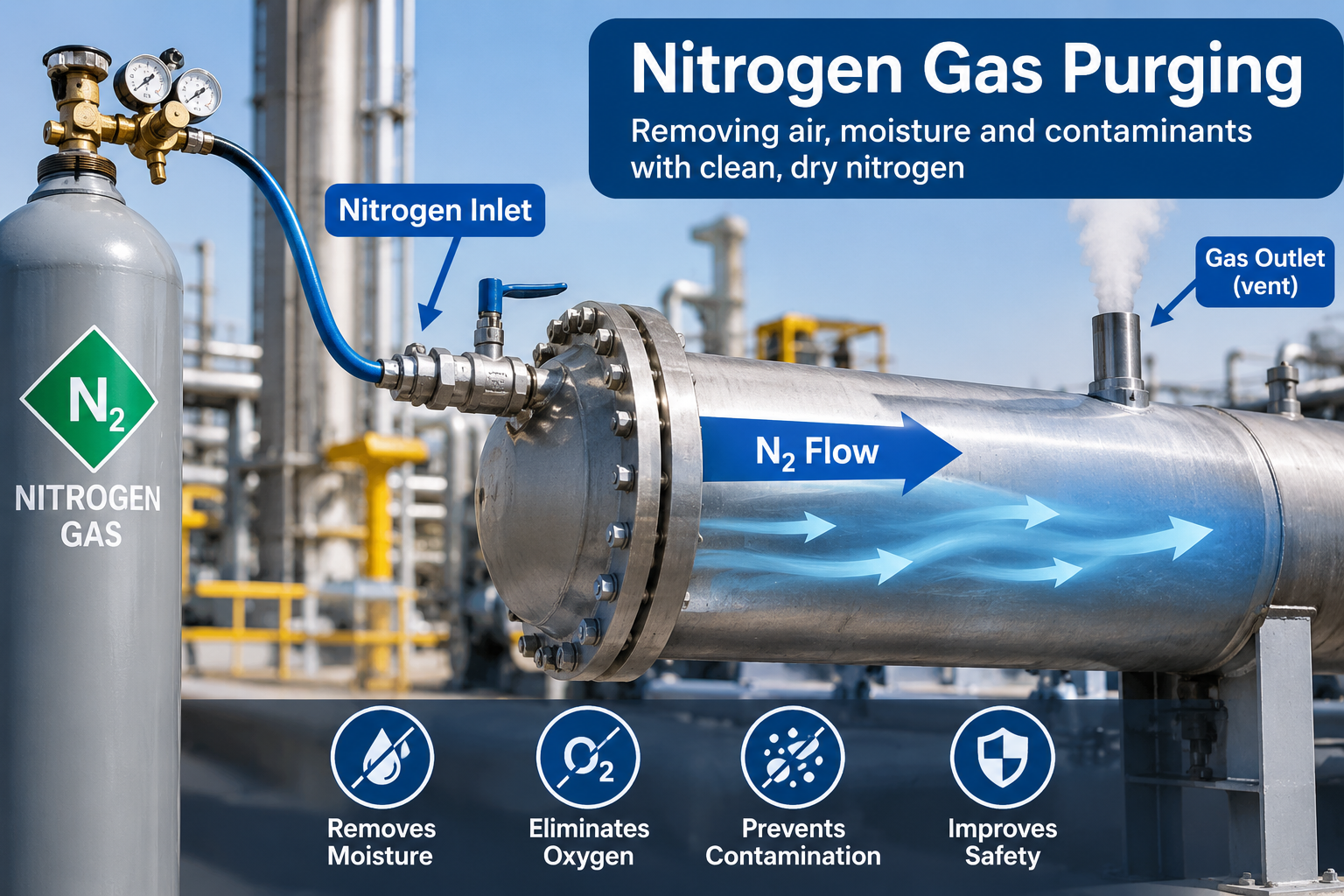
Nitrogen gas purging is an industrial process used to remove oxygen, moisture, flammable vapors, process gases, or other unwanted contaminants from pipelines, tanks, vessels, reactors, and process equipment. By introducing dry nitrogen into a system, operators can replace the existing atmosphere with a more stable, non-combustible environment.
The process is widely used during commissioning, shutdowns, maintenance, product changeovers, storage, and startup of chemical, oil and gas, pharmaceutical, food-processing, and manufacturing systems. Although the principle sounds straightforward, successful purging depends heavily on equipment geometry, flow conditions, pressure limits, vent locations, monitoring, and clearly defined acceptance criteria. Linde Gas
What Is Nitrogen Gas Purging?
Nitrogen gas purging is the controlled introduction of nitrogen into equipment to displace or dilute an unwanted internal atmosphere.
The material being removed may include:
- Oxygen
- Moisture and water vapor
- Hydrocarbon vapors
- Combustible gases
- Toxic process gases
- Reactive gases
- Residual process contaminants
Nitrogen is particularly useful because it is relatively inert under many industrial operating conditions, dry when supplied appropriately, widely available, and economical compared with gases such as argon or helium. Linde
The objective is not necessarily to physically clean dirt, scale, rust, or debris from equipment. Purging primarily changes the gas composition inside the system.
Quick Facts About Nitrogen Gas Purging
| Factor | Typical Purpose |
|---|---|
| Primary purge gas | Nitrogen (N₂) |
| Main objective | Replace or dilute unwanted gases |
| Common contaminants | Oxygen, moisture, hydrocarbons, toxic vapors |
| Typical equipment | Pipelines, tanks, vessels, reactors |
| Common methods | Displacement, dilution, pressure-cycle, vacuum, sweep |
| Verification | Oxygen, gas concentration, moisture or dew-point testing |
| Major hazard | Oxygen-deficient atmosphere |
| Common industries | Oil & gas, chemical, pharma, food, manufacturing |
Why Is Nitrogen Used for Purging?
Nitrogen makes up most of Earth’s atmosphere, but industrial purging uses a controlled nitrogen supply rather than simply introducing ambient air.
Several properties make it suitable.
Low Chemical Reactivity
Nitrogen does not readily react with many process materials under normal industrial conditions. Replacing oxygen-rich air with nitrogen can therefore help prevent oxidation and unwanted reactions.
Non-Combustible Atmosphere
Nitrogen does not support combustion.
When appropriately applied, it can reduce oxygen concentration sufficiently to prevent a flammable material from encountering enough oxidizer to sustain combustion. The required oxygen concentration depends on the process material and operating conditions rather than one universal percentage.
Low Moisture Content
Industrial nitrogen can be supplied very dry.
This makes nitrogen gas purging useful when equipment needs protection from moisture-related problems such as:
- Internal corrosion
- Product contamination
- Hydrate formation
- Process instability
- Moisture-sensitive reactions
Availability and Cost
Nitrogen is generally easier and less expensive to obtain in industrial quantities than argon or helium.
For that reason, nitrogen is commonly the preferred inert gas for large pipelines, storage systems, reactors, and process facilities. Linde
How Nitrogen Gas Purging Works
The basic concept involves introducing nitrogen at one location while removing the original atmosphere through another path.
A simplified process is:
Nitrogen supply → pressure/flow control → equipment → displaced gas → controlled vent or recovery system
What happens inside the equipment depends on the selected purging method.
Some methods attempt to push the original gas out with minimum mixing. Others deliberately mix nitrogen with the existing gas and progressively reduce its concentration.
The purge continues until measurements confirm that the predefined endpoint has been reached.
Main Nitrogen Gas Purging Methods
There is no single purging technique suitable for every system. Equipment geometry, pressure rating, process hazards, nitrogen availability, vent arrangements, and required final concentration all influence method selection.
Common approaches include displacement, dilution, pressure-cycle, vacuum, and sweeping purges. Presscon
1. Displacement Purging
Displacement purging introduces nitrogen from one side of a system while allowing the original gas to leave through another opening.
Ideally, nitrogen forms a moving interface that pushes the existing atmosphere ahead of it with limited mixing.
Best suited for:
- Long pipelines
- Relatively simple pipe runs
- Tall vessels
- Systems with well-positioned inlet and vent points
Advantages
- Potentially low nitrogen consumption
- Simple operating principle
- Efficient when good plug-flow behavior occurs
Limitations
Complex geometry can create:
- Dead legs
- Gas pockets
- Recirculation zones
- Short-circuiting
- Excessive mixing
If these occur, the apparent outlet concentration may not represent every part of the system.
Gas density and purge velocity must also be considered because poor flow conditions can lead to stratification rather than effective displacement. IGEM
2. Dilution Purging
Dilution purging intentionally mixes nitrogen with the existing internal atmosphere.
As nitrogen continuously enters and the mixed gas leaves, the concentration of oxygen or another unwanted constituent progressively decreases.
It is often used where maintaining a clean gas-to-gas interface is impractical.
Advantages
- Works with more complicated geometries
- Suitable for many vessels
- Relatively straightforward to operate
Limitations
Because mixing occurs, significantly more than one equipment volume of nitrogen may be required.
Poor outlet positioning can also produce short-circuit flow, where nitrogen travels directly from the inlet to the vent while stagnant regions remain insufficiently purged. JMS Consultants
3. Pressure-Cycle Purging
Pressure-cycle purging is commonly used for closed systems capable of safely accepting pressure.
The basic sequence is:
- Introduce nitrogen and raise system pressure.
- Allow sufficient time for mixing if required.
- Depressurize through an approved vent route.
- Repeat the cycle.
- Test the atmosphere.
- Continue until the required endpoint is achieved.
Each cycle removes part of the remaining original atmosphere.
This method can be highly effective for vessels and closed piping sections because the concentration reduction can be estimated mathematically.
However, nitrogen pressure must always remain within the engineering limits of the weakest component in the system.
4. Vacuum Purging
Vacuum purging begins by removing part of the existing atmosphere with a vacuum system.
Nitrogen is then introduced to refill the evacuated space.
The sequence may be repeated several times:
Evacuate → nitrogen backfill → evacuate → nitrogen backfill
Vacuum purging can significantly reduce nitrogen consumption in suitable equipment because much of the original gas is physically removed before nitrogen enters.
It is particularly useful where equipment is specifically designed to tolerate vacuum conditions. Linde Gas
Not every vessel can safely withstand an internal vacuum, so equipment design pressure must be verified before using this technique.
5. Sweep Purging
Sweep purging uses a continuous, usually low-pressure nitrogen flow through the system.
Nitrogen enters one location while gas continuously exits through another.
It can be useful for:
- Storage systems
- Flare-related equipment
- Small process vessels
- Maintaining low oxygen conditions
- Preventing atmospheric ingress during standby
Unlike a one-time purge, sweeping can also be maintained for extended periods. Presscon
Comparison of Nitrogen Purging Methods
| Method | Principle | Nitrogen Use | Suitable Equipment | Key Concern |
|---|---|---|---|---|
| Displacement | Pushes existing gas out | Low to moderate | Pipelines, simple vessels | Mixing and stratification |
| Dilution | Mixes and progressively dilutes | Moderate to high | Complex vessels | Dead zones |
| Pressure-cycle | Pressurize and vent repeatedly | Moderate | Closed pressure-rated systems | Pressure limits |
| Vacuum | Evacuate then backfill | Potentially low | Vacuum-rated vessels | Collapse risk |
| Sweep | Continuous nitrogen flow | Continuous | Tanks, piping, standby systems | Ventilation and nitrogen usage |
Step-by-Step Nitrogen Gas Purging Procedure
Actual procedures must be developed for the specific plant and equipment. A typical engineering workflow includes the following stages.
Step 1: Define the Purging Objective
Before introducing nitrogen, determine exactly what must be accomplished.
Examples include:
- Reducing oxygen before introducing hydrocarbons
- Removing hydrocarbon vapor before maintenance
- Drying a pipeline
- Removing moisture before startup
- Protecting equipment from oxidation
- Creating an inert atmosphere for storage
A purge without a measurable endpoint is difficult to verify.
Step 2: Establish Acceptance Criteria
Define what constitutes successful completion.
Possible criteria include:
- Maximum oxygen concentration
- Maximum hydrocarbon concentration
- Minimum nitrogen concentration
- Required dew point
- Maximum moisture content
- Required contaminant concentration
The correct value depends on the process, material involved, applicable engineering standards, and operating procedure.
Do not assume that a generic oxygen percentage is safe for every combustible material.
Step 3: Determine Internal Volume
Calculate the internal volume of:
- Pipes
- Vessels
- Tanks
- Filters
- Heat exchangers
- Connected equipment
- Dead legs and branches
Accurate system volume is essential for estimating nitrogen requirements.
Step 4: Review the System Configuration
Confirm:
- Nitrogen injection point
- Vent location
- Isolation boundaries
- Valve positions
- Pressure relief protection
- Instrument connections
- Sample points
- Check valves
- Drains
- Dead legs
- Temporary hoses and fittings
An overlooked branch may remain filled with air even when the main system appears adequately purged.
Step 5: Select the Purging Method
Choose the technique that fits the system.
For example:
- Long simple pipe → displacement may be efficient.
- Complex vessel → dilution may be more reliable.
- Closed pressure-rated vessel → pressure cycling may work well.
- Vacuum-rated reactor → evacuation/backfill may minimize nitrogen.
- Standby vessel → continuous sweep may be appropriate.
Step 6: Connect and Control the Nitrogen Supply
Nitrogen may be supplied from:
- Cylinders
- Cylinder bundles
- Liquid-nitrogen vaporizers
- Bulk nitrogen tanks
- Nitrogen generators
Pressure regulators and flow-control equipment must be correctly sized.
Introducing nitrogen too rapidly can create excessive pressure, turbulence, static effects, temperature changes, or ineffective gas distribution.
Step 7: Establish a Safe Vent Route
Displaced gases must go somewhere.
Depending on what is being removed, vent gas may need to be directed to:
- A flare
- Vapor recovery
- Scrubbing equipment
- Treatment equipment
- A designated outdoor discharge point
Never assume venting is harmless simply because nitrogen is being introduced. The outgoing gas may contain flammable, toxic, corrosive, or oxygen-deficient mixtures.
Step 8: Start Nitrogen Flow
Begin according to the approved procedure.
Operators should monitor relevant parameters such as:
- Nitrogen pressure
- Flow rate
- System pressure
- Vent behavior
- Oxygen concentration
- Process-gas concentration
Any abnormal pressure rise should be investigated immediately.
Step 9: Sample at Representative Locations
Outlet concentration is important, but a single sample can be misleading.
Where practical, sample locations should account for:
- High points
- Low points
- Long branches
- Dead legs
- Remote ends
- Large-volume components
This is particularly important in complicated piping networks.
Step 10: Confirm the Endpoint
Purging should stop only when measured results meet the predefined criteria.
Measurement is safer and more reliable than simply assuming that a certain amount of nitrogen guarantees completion.
How Much Nitrogen Is Required for Purging?
Nitrogen consumption depends strongly on the selected method.
For an idealized perfectly mixed dilution purge, contaminant concentration approximately follows:
\[ C = C_0 e^{-N} \]Where:
- \(C\) = final concentration
- \(C_0\) = initial concentration
- \(N\) = number of system-volume exchanges
Rearranging:
\[ N = \ln\left(\frac{C_0}{C}\right) \]Suppose the initial oxygen concentration is approximately 20.9% and the target is 1%.
\[ N = \ln(20.9/1) \]\[ N \approx 3.04 \]Under ideal complete-mixing assumptions, roughly three system volumes would theoretically be required.
Real systems are not ideal.
Dead legs, imperfect mixing, equipment internals, nitrogen purity, leaks, sampling position, pressure, temperature, and flow behavior usually require an engineering margin and actual concentration verification.
Pressure-Cycle Purging Calculation
Pressure purging can also be estimated mathematically.
Assuming complete mixing and absolute pressures, the remaining concentration after each pressurization and vent cycle can be approximated using the pressure ratio.
A simplified relationship is:
\[ C_n = C_0\left(\frac{P_L}{P_H}\right)^n \]Where:
- \(C_n\) = concentration after \(n\) cycles
- \(C_0\) = initial concentration
- \(P_L\) = lower absolute pressure
- \(P_H\) = upper absolute pressure
- \(n\) = number of cycles
Using absolute pressure, rather than gauge pressure, is essential in this type of calculation.
Calculations should support field measurements rather than replace them.
Nitrogen Purging vs Nitrogen Blanketing
These terms are related but describe different operations.
Nitrogen Purging
Purging generally removes or replaces the existing atmosphere.
It is frequently performed during:
- Commissioning
- Startup
- Shutdown
- Maintenance preparation
- Product changeover
Nitrogen Blanketing
Blanketing maintains an inert atmosphere after the required internal condition has already been established.
For example, nitrogen may be continuously supplied to a storage tank headspace as liquid is withdrawn so outside air does not enter.
Linde describes purging as the replacement of the vessel atmosphere and blanketing as maintaining the protective inert atmosphere afterward. Linde Gas
Nitrogen Purging vs Inerting
Inerting is the broader objective of creating an atmosphere that minimizes unwanted reactions or combustion.
Nitrogen purging is one technique used to achieve that objective.
In simple terms:
Purging = the operation.
Inerting = the condition or safety objective.
Nitrogen Purging vs Flushing
Purging and flushing are also frequently confused.
Purging primarily changes the gas atmosphere.
Flushing generally uses gas or liquid velocity to remove physical contaminants such as:
- Dirt
- Construction debris
- Loose rust
- Scale
- Residual chemicals
A commissioning program may therefore include cleaning, flushing, drying, and nitrogen purging as separate operations.
Major Applications of Nitrogen Gas Purging
Oil and Gas Pipelines
Pipelines may be nitrogen purged before introducing natural gas or hydrocarbons.
During shutdown, nitrogen can also provide an inert intermediate atmosphere while hydrocarbons are removed.
This helps prevent direct formation of a combustible hydrocarbon-air mixture within the system.
Chemical Processing
Reactors, vessels, piping, and storage tanks often require purging before:
- Startup
- Shutdown
- Catalyst handling
- Maintenance
- Product transitions
Reducing oxygen can help prevent unwanted oxidation and combustion. Linde
Refineries and Petrochemical Plants
Nitrogen is commonly used during turnaround and commissioning work involving:
- Process columns
- Reactors
- Separators
- Compressors
- Storage systems
- Transfer piping
Pharmaceutical Manufacturing
Pharmaceutical processes may use nitrogen to control:
- Oxygen exposure
- Moisture
- Oxidation
- Product contamination
Purging may also be applied to reactors and process equipment containing oxygen-sensitive substances. Linde
Food and Beverage Processing
Nitrogen can help limit oxygen exposure that contributes to:
- Oxidation
- Flavor deterioration
- Color changes
- Product degradation
Welding and Fabrication
Nitrogen or another inert gas may be used in suitable applications to protect the opposite side of certain welds from atmospheric exposure.
Gas selection must match the metallurgy and welding procedure because nitrogen is not suitable for every alloy.
Electronics and Semiconductor Manufacturing
Low-oxygen, low-moisture environments are important in various precision manufacturing operations.
Very high-purity nitrogen may therefore be used for controlled process atmospheres and equipment purging.
Why Oxygen Concentration Matters
Many industrial purges are performed to reduce oxygen before introducing a combustible material.
However, the appropriate limit should be determined from the limiting oxidant concentration (LOC) or another engineering criterion relevant to the actual combustible material.
LOC varies with factors including:
- Fuel composition
- Temperature
- Pressure
- Inert gas
- Process conditions
For that reason, rules such as “below X% oxygen is always safe” should not be treated as universal.
Nitrogen Gas Purging Safety Hazards
Nitrogen is useful because it displaces oxygen.
That same property makes it dangerous to people.
Oxygen Deficiency
Nitrogen is colorless and odorless. A worker usually cannot detect an oxygen-deficient atmosphere by smell or sight.
OSHA identifies nitrogen as a simple asphyxiant and warns that improper workplace use can cause serious injury or death. OSHA
Dangerous nitrogen accumulation can occur around:
- Tanks
- Vessels
- Trenches
- Pits
- Buildings
- Pipe racks
- Temporary enclosures
- Poorly ventilated process areas
Never Use Human Senses as a Detector
You cannot reliably smell nitrogen enrichment.
Atmospheric monitoring should be used where an oxygen-deficiency hazard may exist.
Vent Location Matters
A poorly selected vent can discharge large quantities of oxygen-deficient gas into a work area.
Vent points should therefore be selected through a hazard assessment rather than simply choosing the closest available opening.
Pressure Hazards
Nitrogen systems can generate substantial pressure.
Possible consequences include:
- Hose failure
- Fitting failure
- Vessel overpressure
- Pipe movement
- Equipment damage
Pressure relief and regulation must be suitable for the maximum possible nitrogen supply pressure.
Cryogenic Nitrogen Hazards
Where liquid nitrogen is vaporized to produce gaseous nitrogen, additional hazards include extremely low temperatures.
Direct contact can cause serious cold burns, and liquid-to-gas expansion can generate very large gas volumes.
Confined Space Hazards
Nitrogen purging and confined-space entry require extremely careful coordination.
A vessel deliberately made oxygen-deficient for inerting is obviously incompatible with normal human entry unless it has subsequently been safely prepared and verified under the facility’s entry procedures.
Essential Safety Controls
A professional nitrogen gas purging plan commonly addresses:
- Approved written procedure
- Job hazard analysis
- Isolation and lockout/tagout
- Pressure limits
- Pressure relief
- Nitrogen regulator capacity
- Flow-control requirements
- Secure hose connections
- Gas-detection equipment
- Oxygen monitoring
- Vent routing
- Restricted access zones
- Warning signs
- Communication arrangements
- Emergency response
- Required personal protective equipment
Workers must also understand that nitrogen itself may present no smell or irritation before unconsciousness from oxygen deprivation occurs.
Common Nitrogen Purging Mistakes
Assuming One System Volume Is Enough
One internal volume of nitrogen does not automatically equal a complete purge.
Mixing and stagnant zones can leave significant contaminants behind.
Relying Only on Time
“Purged for 30 minutes” is not a meaningful acceptance criterion unless flow, system volume, configuration, and measured concentration are also understood.
Sampling Too Close to the Outlet
Nitrogen may find a preferential flow path from inlet to outlet.
The outlet could therefore show a good reading while remote branches still contain air.
Ignoring Dead Legs
Closed branches and instrument connections are frequent sources of trapped atmosphere.
They should be included in the purge plan.
Using Gauge Pressure in Purge Calculations
Pressure-ratio calculations require absolute pressures.
Using gauge pressure can significantly distort the predicted number of purge cycles.
Excessively High Flow
More nitrogen flow does not always mean better purging.
High velocity may increase turbulence and mixing during a displacement purge, making the operation less efficient.
No Defined Completion Criterion
Operators need a measurable endpoint before starting.
Otherwise, nitrogen may be wasted or the purge may be stopped prematurely.
How to Improve Nitrogen Purging Efficiency
Position Inlet and Outlet Strategically
Good purge performance begins with gas-flow design.
The inlet and outlet should encourage nitrogen to travel through the full internal volume rather than directly short-circuiting between two nearby connections.
Minimize Unnecessary Mixing
For displacement purging, maintain conditions that preserve a relatively stable interface.
Excessive turbulence increases nitrogen consumption.
Segment Large Systems
Instead of purging an enormous piping network simultaneously, dividing it into controlled sections may produce:
- Better flow control
- Faster verification
- Lower nitrogen consumption
- Easier troubleshooting
Monitor Instead of Guessing
Portable or fixed instrumentation can greatly improve purge reliability.
Depending on the objective, useful measurements include:
- Oxygen concentration
- Hydrocarbon concentration
- Moisture
- Dew point
- Specific process contaminants
Check for Rebound
When drying equipment, a low outlet moisture reading does not always prove the entire system is dry.
Moisture trapped in internal surfaces or dead legs may later desorb and increase the reading again. Holding and retesting can reveal this type of rebound. Front End Engineering Consultancy
Choosing a Nitrogen Supply
The appropriate nitrogen source depends on system volume, required flow rate, purity, duration, and site logistics.
Nitrogen Cylinders
Suitable for:
- Small equipment
- Laboratory systems
- Small piping volumes
They become inefficient when very large quantities are required.
Cylinder Bundles
Provide more capacity than individual cylinders while remaining relatively portable.
Liquid Nitrogen and Vaporizer
Large projects often use liquid nitrogen that is converted into gaseous nitrogen through a vaporizer.
This configuration can provide high flow rates for major pipelines and vessels.
On-Site Nitrogen Generation
Membrane or pressure-swing adsorption systems can produce nitrogen continuously where the required purity and capacity are compatible with the application.
Generation can be economical for facilities with frequent nitrogen demand.
What Nitrogen Purity Is Needed?
Not every purge requires ultra-high-purity nitrogen.
The required purity depends on:
- Target oxygen concentration
- Product sensitivity
- Moisture requirements
- Process chemistry
- Contaminant tolerance
- Safety objective
Using unnecessarily high purity can increase cost without improving the outcome.
Conversely, insufficient nitrogen purity may prevent the desired endpoint from ever being reached.
Environmental and Cost Considerations
Nitrogen itself is a major natural component of the atmosphere, but purging can still have environmental and operating impacts.
The displaced gas may contain:
- Hydrocarbons
- Volatile organic compounds
- Toxic substances
- Greenhouse gases
- Process chemicals
Consequently, the environmental concern may relate more to what is being vented than to the nitrogen.
Efficient purge design can also reduce:
- Nitrogen consumption
- Vaporizer capacity requirements
- Truck deliveries
- Purging time
- Vent emissions
- Overall commissioning costs
Frequently Asked Questions
What is nitrogen gas purging used for?
Nitrogen gas purging is used to remove oxygen, moisture, hydrocarbons, toxic gases, or other unwanted atmospheres from piping, tanks, vessels, reactors, and similar equipment.
Does nitrogen remove oxygen?
Nitrogen does not chemically destroy oxygen during normal purging. It physically displaces or dilutes oxygen until the concentration reaches the required level.
How long does nitrogen purging take?
There is no universal duration.
Purge time depends on equipment volume, nitrogen flow, pressure, geometry, purge method, initial concentration, and target concentration.
How many volumes of nitrogen are needed?
Displacement purging may approach relatively low volume requirements under ideal conditions, while dilution purging often requires several volume exchanges.
The correct requirement should be calculated and confirmed by measurement.
Is nitrogen gas dangerous?
Nitrogen is non-toxic, but concentrated nitrogen can displace breathable oxygen and create a potentially fatal asphyxiation hazard. OSHA specifically identifies this workplace risk. OSHA
What oxygen level should be reached during nitrogen purging?
The required oxygen concentration depends on the purpose of the purge.
For combustible systems, the target should be established from relevant process safety criteria such as the applicable limiting oxidant concentration, engineering standard, or approved operating procedure rather than an arbitrary universal value.
Can nitrogen purging remove moisture?
Yes. Dry nitrogen can remove water vapor and help dry piping or vessels, although liquid water may first require draining, blowing, heating, vacuum drying, or another dedicated drying method.
Is nitrogen purging the same as nitrogen blanketing?
No. Purging replaces an unwanted atmosphere, while blanketing generally maintains an inert atmosphere after it has been established.
Conclusion
Nitrogen gas purging is one of the most versatile techniques for controlling internal atmospheres in industrial piping, tanks, reactors, and process equipment. When properly engineered, it can remove oxygen, moisture, hydrocarbons, and other unwanted gases while preparing equipment for startup, shutdown, maintenance, storage, or product introduction.
Successful nitrogen gas purging depends on more than simply connecting a nitrogen supply and opening a valve. The purge method must match the equipment geometry, nitrogen flow and pressure must remain controlled, dead legs and vent routes must be considered, and completion should be confirmed using appropriate gas or moisture measurements. Most importantly, nitrogen’s ability to displace oxygen makes atmospheric monitoring, ventilation, controlled venting, and worker protection essential parts of every professional purging operation.

The EIBC conference is an international academic event focused on economics, international business, and cross-cultural communication. Hosted by the Faculty of Economics and Business Administration at Alexandru Ioan Cuza University of Iași, Romania, it brings together researchers, academics, practitioners, doctoral candidates, and students interested in sharing research and building international collaborations.
The sixth edition, EIBC 2026, took place from June 11–13, 2026, in Iași, Romania. The organizers positioned the event not only as a place to present academic work, but also as a platform for developing research and teaching cooperation between participants from Romania and other countries.
If you’re considering a future edition, this guide explains what the EIBC conference is, who should attend, how submissions work, what publication opportunities may be available, and how to get more value from participating.
EIBC Conference Quick Facts
| Detail | EIBC 2026 Information |
|---|---|
| Full name | International Conference Economics, International Business and Cross-Cultural Communication |
| Common abbreviation | EIBC |
| 2026 edition | Sixth edition |
| Dates | June 11–13, 2026 |
| Location | Iași, Romania |
| Host | Alexandru Ioan Cuza University of Iași |
| Faculty | Faculty of Economics and Business Administration |
| Main audience | Academics, researchers, practitioners, PhD candidates and students |
| Student session | Yes |
| Conference proceedings | Available as a publication route |
| Proceedings ISSN | 2810-4625 |
| 2026 abstract/paper deadline | May 17, 2026 |
| 2026 author registration deadline | May 31, 2026 |
The 2026 dates have already passed, so prospective participants should verify the official conference website for announcements concerning a subsequent edition rather than assuming the same deadlines will apply again.
What Is the EIBC Conference?
EIBC stands for Economics, International Business and Cross-Cultural Communication.
The conference is organized by the Department of Economics and International Relations within the Faculty of Economics and Business Administration at Alexandru Ioan Cuza University of Iași. Its purpose is to connect scholars with overlapping research interests and create opportunities for further cooperation in research and teaching.
That interdisciplinary focus is important. Modern economic and business questions rarely exist within a single academic silo.
International trade, multinational management, migration, digitalization, consumer behavior, sustainability, economic policy, cultural differences, and global communication frequently overlap. A conference built around economics, international business, and cross-cultural communication provides space for examining those connections.
Who Should Attend the EIBC Conference?
The EIBC conference is especially relevant for people working in economics, business, international relations, management, communication, and related social-science fields.
Potential participants include:
- University researchers and teaching staff
- Economics and business scholars
- PhD candidates
- Master’s and undergraduate students
- International-business researchers
- Cross-cultural communication specialists
- Practitioners interested in academic discussion
- Early-career researchers seeking presentation experience
- Scholars looking for international research collaborators
The 2026 program also included a dedicated student session and a debate, broadening the event beyond traditional research-paper presentations.
Is It Suitable for PhD Students?
Yes.
For a doctoral researcher, a conference like EIBC can serve several purposes at once. You can test an argument before submitting it to a journal, receive questions from people outside your immediate research group, and meet academics working on related problems.
Presenting also forces you to explain your research concisely. That skill becomes valuable when defending a dissertation, writing abstracts, applying for grants, interviewing for academic positions, or discussing research with interdisciplinary audiences.
Is It Suitable for Master’s and Undergraduate Students?
Potentially, especially where a dedicated student session is offered.
For the 2026 edition, undergraduate and master’s students participating in the student session could attend without a conference fee.
Students should still treat participation professionally. A student presentation can become an early piece of academic experience for a CV, but the greatest value often comes from learning how research is discussed, questioned, defended, and improved.
Main Academic Areas Covered by EIBC
The conference’s title identifies three broad pillars.
Economics
Research may address economic systems, public policy, development, markets, finance, labor, institutions, regional economies, European economic issues, or other questions connected to economic behavior and policy.
A strong submission usually goes beyond describing an economic trend. It should identify a clear research question and explain why the evidence contributes something useful to the existing literature.
International Business
International-business research can explore issues such as:
- Internationalization
- Foreign investment
- Export strategies
- Multinational enterprises
- Global supply chains
- International entrepreneurship
- Business competitiveness
- Market entry
- Global management
- Institutional differences between markets
This area naturally overlaps with economics because international business decisions are shaped by exchange rates, regulation, market conditions, trade policy, labor availability, technology, and political risk.
Cross-Cultural Communication
Cross-cultural research examines what happens when people, firms, institutions, or consumers operate across cultural environments.
Potential areas include international negotiation, workplace communication, intercultural management, consumer behavior, organizational culture, global teams, education, migration, and communication across linguistic or social contexts.
The strongest studies usually avoid treating culture as a vague explanation. Instead, they define cultural variables clearly and connect them to observable behaviors, decisions, or outcomes.
Why Researchers Attend Conferences Like EIBC
Publishing a paper is only one possible benefit of academic conference participation.
Get Feedback Before Journal Submission
A presentation exposes your research to questions that may reveal weak assumptions, unclear explanations, missing literature, or alternative interpretations.
That feedback can be particularly valuable before submitting a manuscript to peer review.
Build an International Academic Network
EIBC specifically emphasizes cooperation among academic peers from Romania and abroad.
Conferences make it easier to identify researchers working on similar questions. A conversation after a session can eventually develop into a joint paper, research proposal, visiting opportunity, workshop, or teaching collaboration.
Improve Research Communication
Writing a 7,000-word paper and explaining the same study in a short presentation are completely different skills.
Conference presentations teach researchers to identify the core message:
What problem did you investigate, what did you find, and why should anyone care?
That discipline often improves the eventual paper as well.
Discover New Research Questions
Some of the most useful ideas at a conference come from sessions outside your immediate specialization.
A researcher studying international trade, for example, might discover a cross-cultural variable that improves the theoretical explanation of observed business behavior.
EIBC Conference Submission Process
For EIBC 2026, authors could submit an extended abstract or full paper by May 17, 2026. Acceptance notifications were scheduled for May 24, followed by author registration and fee payment by May 31.
The conference itself took place from June 11–13, while full papers intended for publication were due by July 20, 2026. The organizers also specified a maximum of two papers per author.
Because those deadlines applied specifically to the 2026 edition, future applicants should not reuse them when planning for another year.
2026 Submission Timeline
| Stage | Deadline |
|---|---|
| Extended abstract or full-paper submission | May 17, 2026 |
| Acceptance notification | May 24, 2026 |
| Author registration and payment | May 31, 2026 |
| Conference | June 11–13, 2026 |
| Full paper for publication | July 20, 2026 |
How to Prepare a Strong EIBC Submission
Getting the topic right is only the beginning.
1. Start With a Precise Research Problem
Avoid beginning with an enormous subject such as:
“Digitalization and international business.”
Narrow it into a researchable question.
For example, you might investigate how a particular form of digital adoption affects export performance within a defined industry, country group, or type of company.
2. Explain the Research Gap Early
A conference reviewer should not have to reach the final page to understand why your study matters.
Your introduction should quickly establish:
- What researchers already know
- What remains uncertain
- Why that uncertainty matters
- How your study addresses it
3. Match the Method to the Question
Do not choose a complicated method simply because it appears sophisticated.
A clear regression model answering a meaningful question is usually stronger than an unnecessarily complex model that the author cannot justify.
Qualitative research needs the same discipline. Explain participant selection, data collection, coding, analytical procedures, and limitations clearly.
4. Make the Contribution Explicit
A useful test is whether you can complete this sentence:
“This study contributes to existing research by…”
If completing that sentence is difficult, your contribution probably needs more work.
5. Edit the Abstract Aggressively
The abstract may be the first substantive part reviewers examine.
Remove background material that doesn’t directly support the research problem. Give more space to the objective, methodology, results, and contribution.
A Practical Abstract Structure
Researchers can use this structure when preparing an academic conference abstract:
- Context: Introduce the specific problem.
- Gap: Identify what remains unresolved.
- Objective: State exactly what the study investigates.
- Method: Explain data, sample, variables, or analytical approach.
- Results: Report the main finding where the research is complete.
- Contribution: Explain what the finding adds.
- Implication: State why it matters academically or practically.
A common mistake is spending half the abstract explaining the topic and only one sentence discussing the actual research.
Reverse that balance.
Publication Opportunities Connected With EIBC
Publication can be an important consideration for researchers choosing a conference.
For the 2026 edition, organizers listed several possible publication outlets, including:
- CES Working Papers
- Review of Economic and Business Studies
- Scientific Annals of Economics and Business
- Virgil Madgearu Review of Economic Studies and Research
- The USV Annals of Economics and Public Administration
- Conference Proceedings: Economics, International Business and Cross-Cultural Communication
The conference proceedings are published by Alexandru Ioan Cuza University Press and carry ISSN 2810-4625.
Importantly, presentation at the conference does not automatically guarantee journal publication. The official information states that submissions intended for the listed journals undergo the regular review process of the selected publication.
Conference Presentation vs. Journal Publication
These should be treated as separate stages.
| Conference Presentation | Journal Publication |
|---|---|
| Presents research to attendees | Produces a formal scholarly publication |
| Usually shorter and more conversational | Requires a complete manuscript |
| Provides direct feedback | Usually involves formal peer review |
| Helps refine arguments | Requires responses to reviewer comments |
| Good for networking | Important for academic publication records |
The best strategy is often to use conference feedback to strengthen the manuscript before journal review.
EIBC Conference Fees
For EIBC 2026, registration fees were:
- Researchers, academics and practitioners: 450 Romanian lei
- PhD students: 300 Romanian lei
- Undergraduate and master’s students attending the student session: Free
The reduced PhD fee applied when all authors were doctoral students.
According to the organizer, the fee covered access to conference sessions, a certificate of attendance, the conference kit, printed program, coffee breaks, and meals.
Future editions may use different prices, so these figures should be treated as historical 2026 information rather than permanent fees.
How to Prepare Your EIBC Conference Presentation
An accepted paper is only half the job. The next challenge is explaining it well.
Build the Presentation Around One Main Argument
Do not attempt to reproduce your entire manuscript on slides.
Most research presentations can be organized around:
- Problem
- Research question
- Data or methodology
- Two or three main findings
- Interpretation
- Contribution
- Implications
Everything else is supporting material.
Show Results Visually
Dense statistical tables are difficult to absorb during a live talk.
Where possible, convert the central findings into:
- Simple charts
- Coefficient plots
- Diagrams
- Comparison tables
- Conceptual frameworks
Keep detailed robustness results available as backup slides.
Prepare for Questions
Before presenting, write down the five questions you would least like somebody to ask.
Then prepare answers.
Questions often involve:
- Sample selection
- Causality
- Generalizability
- Variable definitions
- Model specification
- Missing literature
- Alternative explanations
- Practical implications
Preparing for difficult questions usually improves the paper itself.
How to Network Effectively at EIBC
Networking should not mean collecting the largest possible number of business cards or LinkedIn connections.
A better target is three to five meaningful academic conversations.
Before the Conference
Review the program when it becomes available and identify researchers whose work genuinely overlaps with yours.
Read at least one recent publication from the people you most want to meet.
That makes the opening conversation much easier:
“I’ve been working on a related question, and your research on X gave me a different way of thinking about Y.”
That is significantly better than simply asking someone what they research.
During the Conference
Ask specific questions after presentations.
Instead of:
“Interesting presentation. Can you tell me more?”
Try:
“You found a stronger effect among smaller firms. Do you think financing constraints could explain part of that difference?”
Specific questions create real academic conversations.
After the Conference
Follow up within several days.
Mention what you discussed rather than sending a generic networking message. If you agreed to share a paper, dataset reference, or other resource, send it promptly.
Common Mistakes to Avoid
Researchers can improve their conference experience simply by avoiding predictable errors.
Submitting a Topic Instead of a Study
“Artificial intelligence in international business” is a topic.
A conference contribution needs a research problem, question, methodology, evidence, or defensible conceptual argument.
Ignoring the Conference Scope
A technically excellent paper can still be a poor submission if the connection with economics, international business, or cross-cultural communication is unclear.
Explain the fit explicitly.
Assuming Acceptance Means Publication
Conference acceptance and journal publication are different processes.
EIBC’s official information makes clear that papers submitted to associated journals are subject to those journals’ normal review procedures.
Reading Slides Word for Word
Audiences can read faster than speakers can talk.
Slides should support your explanation rather than become your script.
Waiting Until the Conference to Network
Some of the best conversations can be prepared before arrival by studying the program and identifying relevant scholars.
Trying to Promote Yourself to Everyone
Academic networking works best when it begins with shared research interests rather than self-promotion.
How to Decide Whether the EIBC Conference Is Worth Attending
Before registering for a future EIBC edition, evaluate it against your actual goals.
Ask yourself:
- Does my research fit economics, international business, or cross-cultural communication?
- Are relevant researchers likely to attend?
- Do I need feedback on a working paper?
- Would presenting strengthen my academic development?
- Am I interested in one of the available publication pathways?
- Can my university or research project cover travel and registration?
- Could the conference support future research collaboration?
If the answer to several of these questions is yes, EIBC may offer more value than simply adding another conference presentation to your CV.
How Early Should You Start Preparing?
Ideally, preparation should begin several months before the submission deadline.
Three to Six Months Before Submission
Develop the research question, literature review, methodology, and data strategy.
One to Two Months Before Submission
Complete the main analysis and begin drafting the paper or extended abstract.
Two Weeks Before Submission
Edit the argument, verify references, check tables and figures, and ask a supervisor or colleague to review the abstract.
After Acceptance
Build the presentation and revise the manuscript using any weaknesses you noticed while preparing the talk.
This approach prevents a common academic problem: submitting unfinished research simply because a deadline suddenly appears.
What Makes EIBC Different From a Generic Business Conference?
EIBC should primarily be understood as an academic and research-oriented conference, not a large commercial exhibition or general networking event.
Its value comes from the intersection of three connected fields: economics, international business, and cross-cultural communication.
That creates opportunities for interdisciplinary research.
For example, a study about foreign-market entry may begin as an international-business question but also require economic analysis and consideration of cultural differences. EIBC’s structure gives such work a natural setting.
Questions to Ask Before Registering for a Future Edition
Conference details can change from year to year. Before paying or booking travel, confirm:
- Current conference dates
- Submission deadline
- Abstract format
- Full-paper requirements
- Presentation format
- Conference language
- Registration fee
- Student fee or waiver
- Publication options
- Journal review conditions
- Venue
- Accommodation recommendations
- Online or hybrid participation options
- Visa documentation, if required
Use the current official conference announcement rather than relying on an older call for papers.
Frequently Asked Questions About the EIBC Conference
What does EIBC conference stand for?
In this academic context, EIBC refers to the International Conference Economics, International Business and Cross-Cultural Communication organized by Alexandru Ioan Cuza University of Iași.
Where is the EIBC conference held?
The 2026 edition was held at the Faculty of Economics and Business Administration of Alexandru Ioan Cuza University in Iași, Romania, from June 11–13, 2026.
Is EIBC an international conference?
Yes. The organizers describe the event as an international conference intended to connect academic peers from Romania and abroad.
Can PhD students attend?
Yes. The 2026 edition offered a specific registration category for PhD students.
Can undergraduate and master’s students participate?
Yes. EIBC 2026 included a students’ session, and undergraduate and master’s students participating in that session were eligible for free registration.
Does EIBC offer publication opportunities?
Yes. The organizers listed several academic outlets as potential publication routes, along with dedicated conference proceedings. Journal submissions remain subject to the normal review process of the selected publication.
Are EIBC conference proceedings published?
The organizers state that papers may be published in the Conference Proceedings Economics, International Business and Cross-Cultural Communication, published by Alexandru Ioan Cuza University Press with ISSN 2810-4625.
Has the EIBC Conference 2026 already taken place?
Yes. EIBC 2026 ran from June 11 through June 13, 2026, so that edition has concluded. Researchers interested in attending should look for the announcement and deadlines for the next edition.
Final Thoughts on the EIBC Conference
The EIBC conference offers researchers a focused environment for discussing work across economics, international business, and cross-cultural communication. Its combination of research presentations, student participation, academic discussion, networking, and potential publication routes makes it particularly relevant for scholars whose work crosses disciplinary or international boundaries.
The best reason to attend, however, isn’t simply to collect another certificate. Use the conference strategically: bring a strong research question, seek difficult feedback, meet scholars working on related problems, and turn what you learn into a better manuscript.
EIBC 2026 has already concluded, but researchers considering a future edition should monitor official announcements for new dates, submission requirements, fees, and publication options before making travel or submission plans.

The eMetrics Summit was one of the formative conferences in web, digital, and marketing analytics. Created by analytics pioneer Jim Sterne, the event began in 2002 when organizations were still trying to answer a deceptively difficult question: how do you determine whether a website is actually successful? Data Driven Business
Over time, that question became much bigger. Businesses needed to connect website behavior with search, email, advertising, social media, customer experience, revenue, and eventually artificial intelligence. The conference expanded with the discipline itself and ultimately evolved into the Marketing Analytics Summit. Marketing Analytics Summit
For marketers and analysts researching the eMetrics Summit today, understanding that evolution is particularly useful. The event provides a window into how digital measurement moved from counting pageviews to supporting complex, data-informed business decisions.
eMetrics Summit Quick Facts
| Topic | Details |
|---|---|
| Founded | 2002 |
| Founder | Jim Sterne |
| First event | Santa Barbara, California |
| Original focus | Web analytics and website measurement |
| Later focus | Digital and marketing analytics |
| Industry connection | Closely associated with the development of the Digital Analytics Association |
| International reach | Events were held across major U.S. and European cities |
| Successor | Marketing Analytics Summit |
| Core audience | Analysts, marketers, optimization professionals, consultants, executives, and technology specialists |
Historical sources consistently place the first conference in Santa Barbara in 2002. The event subsequently expanded internationally as digital analytics developed into a recognized professional discipline. Data Driven Business
What Was the eMetrics Summit?
The eMetrics Summit was a professional conference centered on measuring and improving digital business performance.
Its early subject matter reflected the state of the internet industry at the beginning of the 2000s. Organizations had websites, online advertising was growing, and digital commerce was becoming important, but many businesses lacked mature systems for connecting online activity to meaningful business outcomes.
The summit provided a forum where practitioners, consultants, technology providers, and business leaders could exchange approaches to measurement.
According to an interview with founder Jim Sterne, the original conference centered on the basic question of how to measure website success. As digital channels multiplied, its scope expanded to areas such as email, search, social media, offline-to-online effects, and larger marketing datasets. Data Driven Business
That progression is important because it mirrors the history of digital analytics itself.
From website statistics to business decisions
Early web measurement often emphasized metrics such as:
- Visits and pageviews
- Click-through rates
- Traffic sources
- Conversion rates
- Website revenue
- Visitor behavior
- Campaign response
Those metrics remain useful, but sophisticated analytics teams eventually needed to answer more consequential questions.
Which marketing activities create incremental revenue? Which customer segments deserve additional investment? Where does the conversion journey break down? What should an organization optimize next?
The industry therefore moved gradually from reporting activity toward explaining performance and informing decisions.
The History of the eMetrics Summit
The first eMetrics Summit in 2002
Jim Sterne launched the first eMetrics Summit in Santa Barbara, California, in 2002. Sterne was already active in internet marketing and measurement, and the conference created a dedicated environment for professionals working on the emerging discipline of web analytics. Data Driven Business
At that point, analytics infrastructure looked very different from the modern ecosystem. Companies were still working out fundamental questions around data collection, definitions, reporting standards, attribution, and organizational ownership.
The summit consequently became more than a venue for discussing software. It helped practitioners exchange methods for turning digital data into business information.
International expansion
As web analytics matured, the eMetrics Summit expanded beyond its original California base.
Historical accounts identify eMetrics events in cities including San Francisco, Boston, New York, Washington, London, Berlin, Stockholm, Milan, and Toronto. Data Driven Business
London was already hosting an eMetrics Summit by 2006, with sessions examining web analytics, customer behavior, segmentation, measurement, and related topics. Marketingfacts
That international expansion reflected a wider change: digital measurement was no longer a niche concern confined to a handful of internet companies.
It was becoming a mainstream business capability.
eMetrics Summit and the Digital Analytics Association
One of the most significant parts of the conference’s legacy is its relationship with the professional analytics community.
As practitioners continued meeting and exchanging ideas, demand grew for a more permanent professional organization. Historical accounts connect the eMetrics community with the creation of what was initially the Web Analytics Association and later became the Digital Analytics Association. Data Driven Business
This mattered because an emerging profession needs more than tools.
It needs shared terminology, professional development, networking, methodological debate, ethical discussion, and mechanisms through which practitioners can exchange knowledge.
The eMetrics Summit helped create an environment where those relationships could develop.
What Topics Did the eMetrics Summit Cover?
The agenda changed as analytics technology and marketing practices evolved. That adaptability was one of the event’s defining characteristics.
Web and digital analytics
Website measurement formed the original foundation.
Practitioners needed to understand not simply how many people visited a website, but what those visitors did and whether their behavior contributed to organizational objectives.
That meant moving beyond raw traffic numbers toward metrics connected with outcomes.
Conversion optimization
Analytics becomes significantly more valuable when measurement leads to action.
Conversion optimization therefore represented a natural extension of web analytics. Teams could use behavioral evidence to identify friction, develop hypotheses, test changes, and evaluate the results.
The practical loop is straightforward:
Measure → diagnose → hypothesize → test → learn → optimize
That remains a useful analytics operating model today.
Customer segmentation
Not every visitor behaves in the same way.
Historical reporting from the 2006 London conference, for example, discussed the growing importance of personas and segmentation in understanding visitors rather than treating analytics simply as an exercise in counting clicks. OX2 Web Analytics Blog
Modern analytics has pushed that concept much further through behavioral cohorts, lifecycle segmentation, propensity models, customer data platforms, and personalization.
But the underlying principle remains the same: averages can hide strategically important differences between customers.
Search and campaign analytics
As digital acquisition expanded, analysts increasingly needed to connect campaigns with downstream outcomes.
That introduced questions involving acquisition costs, conversion quality, channel effectiveness, attribution, and return on marketing investment.
It also created one of the most persistent problems in marketing analytics: determining whether an observed conversion was actually caused by marketing activity.
Social and mobile measurement
The explosion of social networks and smartphones added additional customer touchpoints.
Businesses could no longer assume that a customer interacted with one campaign, on one desktop browser, before immediately converting.
Cross-channel and cross-device behavior made measurement considerably more complicated.
Predictive analytics and artificial intelligence
Later iterations of the conference reflected growing interest in more advanced analytics. By 2016, for example, eMetrics was being held alongside Predictive Analytics World, illustrating the increasing overlap between digital measurement and predictive methods. LinkedIn
The eventual Marketing Analytics Summit explicitly broadened its remit to include modern data and AI-related capabilities. Marketing Analytics Summit
Why the eMetrics Summit Mattered
Its importance cannot be explained simply by the number of presentations delivered.
The deeper contribution was helping establish analytics as a professional practice.
It emphasized outcomes over vanity metrics
A dashboard can contain hundreds of numbers without answering a single useful business question.
One of the lasting principles associated with the analytics community surrounding eMetrics was the need to connect measurement with organizational objectives.
That distinction remains critical.
A report might show:
Traffic increased by 18%.
An analytical interpretation asks:
Which audiences and channels generated the increase, did those visitors produce valuable outcomes, and should the business change its investment because of the result?
The second question is where analytics begins creating operational value.
It connected practitioners
Analytics professionals frequently face problems that cannot be solved by documentation alone.
Implementation inconsistencies, attribution limitations, stakeholder expectations, organizational politics, and data-quality problems all benefit from practitioner-to-practitioner knowledge sharing.
Long-time attendees have specifically highlighted the community and networking dimensions of eMetrics alongside its technical content. Concord USA
It brought practitioners and vendors together
Historical agendas show participation from professionals associated with major brands, technology companies, agencies, analytics firms, and consultancies. A 2014 San Francisco program, for example, included representatives associated with organizations such as FedEx, IBM, Adobe, Intuit, Motorola Mobility, Microsoft, and others. Bizzabo
That mixture mattered.
Vendors could demonstrate emerging capabilities, while practitioners could discuss what actually worked inside organizations.
eMetrics Summit vs. a Typical Marketing Conference
The distinction becomes clearer when comparing the conference with a broader marketing event.
| Area | eMetrics Summit Focus | General Marketing Conference |
|---|---|---|
| Primary emphasis | Measurement and analytics | Broad marketing strategy |
| Data depth | High | Varies |
| Web analytics | Core subject | Usually one topic |
| Optimization | Strong focus | Moderate |
| Attribution | Highly relevant | May be covered |
| Analytics implementation | Important | Less prominent |
| Audience | Analysts and data-driven marketers | Wider marketing audience |
| Networking value | Specialized analytics community | Broader professional network |
The eMetrics Summit was therefore especially relevant to people responsible for proving, diagnosing, or improving digital performance.
Who Attended the eMetrics Summit?
The audience evolved alongside the discipline.
Typical participants included digital analysts, marketing analysts, optimization specialists, marketing managers, data professionals, consultants, measurement strategists, product professionals, agency teams, and executives responsible for digital performance.
The conference could therefore serve different levels of analytical maturity.
A newer practitioner might learn how to define meaningful KPIs. An experienced analyst might be more interested in attribution, experimentation, data integration, organizational analytics maturity, or communicating insights to senior management.
The Evolution Into Marketing Analytics Summit
One of the most important points for anyone searching for the eMetrics Summit today is that the name belongs primarily to the conference’s earlier era.
The field had changed dramatically since 2002.
Websites were no longer isolated digital properties. Customer journeys crossed search engines, apps, social platforms, advertising networks, email, ecommerce systems, CRM platforms, physical stores, and other touchpoints.
The conference eventually broadened accordingly.
Historical accounts place the transition from eMetrics Summit to Marketing Analytics Summit around the end of 2018, reflecting a wider emphasis on marketing data rather than web analytics alone. Bitmat
Jim Sterne’s description of the successor event similarly explains that eMetrics had originally been created to bring early web analytics practitioners together, while Marketing Analytics Summit was designed for a world in which analytics had become central to marketing. Marketing Analytics Summit
eMetrics Summit vs. Marketing Analytics Summit
| eMetrics Summit | Marketing Analytics Summit |
|---|---|
| Originated in web analytics | Broader marketing analytics scope |
| Website measurement was foundational | Cross-channel measurement is central |
| Emerged in early digital marketing era | Reflects mature data-driven marketing |
| Clickstream and digital behavior were major concerns | Customer, marketing, data, and AI capabilities converge |
| Built an early analytics community | Extends that community into modern marketing analytics |
The change was therefore more than a rebranding exercise.
It reflected a fundamental shift in the underlying profession.
Lessons Modern Marketers Can Still Take From eMetrics
The technologies have changed dramatically since 2002. Several measurement principles have not.
1. Start with the business question
A common analytics mistake is opening a dashboard before defining the decision that needs to be made.
Reverse that process.
First ask what the organization needs to know. Then determine which data can answer the question.
2. Do not confuse metrics with insight
Metrics describe.
Analysis explains.
Insight identifies something meaningful enough to change a decision or action.
That distinction prevents analytics teams from becoming reporting factories.
3. Treat data quality as a strategic issue
A sophisticated dashboard built on unreliable tracking remains unreliable.
Before using metrics for consequential decisions, teams should establish definitions, ownership, instrumentation standards, validation processes, and governance.
4. Measure outcomes, not just activity
Impressions, sessions, clicks, views, and engagement can help diagnose performance, but they are rarely sufficient as final measures of business success.
Where possible, connect activity with outcomes such as qualified leads, purchases, retention, revenue, customer lifetime value, or another objective appropriate to the organization.
5. Add context to every KPI
A number without context is difficult to interpret.
For example, a 4.2% conversion rate may look impressive or disappointing depending on historical performance, customer segment, channel, device, campaign economics, and the definition of a conversion.
Strong analysts establish the comparison before interpreting the number.
Common Analytics Mistakes the eMetrics Philosophy Helps Expose
Even sophisticated organizations repeatedly encounter the same measurement problems.
One is dashboard overload. More charts do not automatically create more insight.
Another is metric inconsistency. If finance, marketing, product, and analytics teams define a customer or conversion differently, meetings become arguments over definitions instead of discussions about performance.
Attribution is another danger. A model can distribute conversion credit mathematically without proving that a channel caused the conversion.
Organizations also frequently optimize local metrics while damaging the larger business outcome. A campaign might maximize leads, for example, while producing low-quality prospects that sales cannot convert.
The practical lesson is simple: analytics should optimize the decision system, not merely the dashboard.
How to Build an eMetrics-Inspired Measurement Framework
A modern organization can apply the conference’s measurement-first philosophy without adopting any particular analytics platform.
Step 1: Define the objective
Start with the business result.
For an ecommerce company, that might be profitable customer growth rather than website traffic.
Step 2: Define decision questions
Determine what stakeholders actually need to decide.
Examples include:
- Which acquisition channels deserve additional investment?
- Where are customers abandoning checkout?
- Which campaigns acquire customers with the highest lifetime value?
- Which product changes improve retention?
Step 3: Build a KPI hierarchy
Separate metrics by purpose.
Business outcomes: revenue, profit, retention, customer lifetime value.
Performance indicators: conversion rate, qualified leads, repeat purchase rate.
Diagnostic metrics: landing-page engagement, checkout abandonment, page speed, campaign click-through rate.
This hierarchy prevents diagnostic numbers from being mistaken for ultimate objectives.
Step 4: Establish reliable data collection
Document every critical event, source, definition, owner, and validation procedure.
Do this before building elaborate reports.
Step 5: Segment the results
Company-wide averages frequently hide the explanation.
Break performance down by relevant dimensions such as channel, customer type, geography, device, product category, lifecycle stage, or acquisition cohort.
Step 6: Convert findings into decisions
Every important analysis should ideally end with four elements:
Finding → interpretation → recommended action → measurement plan
That final measurement plan closes the loop by defining how the organization will know whether the action worked.
The eMetrics Summit Legacy in the AI Era
Marketing analytics is now entering another major transition.
Generative AI can summarize reports, produce queries, assist with data exploration, identify anomalies, and make sophisticated analytical capabilities accessible to more employees.
But AI does not eliminate the foundational problems that conferences such as eMetrics spent years discussing.
An AI system still needs trustworthy data. It still needs coherent definitions. Correlation still does not automatically establish causation. A model can still optimize the wrong KPI.
In fact, cheaper and faster analysis can make measurement governance more important, not less.
When generating another analysis costs almost nothing, the scarce resource becomes judgment: knowing which question deserves to be asked, which evidence can answer it, and what decision should follow.
That may be the most relevant eMetrics lesson of all.
Frequently Asked Questions
What is the eMetrics Summit?
The eMetrics Summit was a professional conference focused on web, digital, and marketing analytics. It began in 2002 and helped bring together practitioners working on digital measurement and optimization. Data Driven Business
Who founded the eMetrics Summit?
Jim Sterne founded the eMetrics Summit. He was an early internet marketing and analytics practitioner and was closely involved in the development of the professional digital analytics community. Marketing Analytics Summit
When did the eMetrics Summit begin?
The first eMetrics Summit was held in 2002 in Santa Barbara, California. Data Driven Business
What happened to the eMetrics Summit?
The conference evolved as web analytics expanded into broader digital and marketing measurement. By the end of 2018, the eMetrics legacy had transitioned into the Marketing Analytics Summit, reflecting the wider role of analytics across marketing. Bitmat
Was eMetrics only about web analytics?
No. Web analytics was its original foundation, but its subject matter expanded to include areas such as search, email, social media, marketing measurement, optimization, customer behavior, and broader data-driven decision-making. Data Driven Business
Why was the eMetrics Summit important?
It provided a specialized environment where analytics practitioners could exchange methods, learn from real implementations, examine emerging technologies, and build professional relationships. It was also closely connected with the community from which the Web Analytics Association—later the Digital Analytics Association—developed. Data Driven Business
Final Thoughts on the eMetrics Summit
The eMetrics Summit occupies an important place in the history of digital analytics because it emerged when businesses were still learning how to measure the commercial value of the web.
Its subject matter evolved from website measurement into conversion optimization, customer analytics, cross-channel marketing measurement, predictive methods, and the broader discipline now associated with marketing analytics.
The tools have changed. The volume of data has exploded. Artificial intelligence is changing analytical workflows again.
Yet the central challenge remains remarkably familiar: collect trustworthy evidence, interpret it in context, and use it to make better decisions.
That principle explains both the historical significance of the eMetrics Summit and why its measurement-first philosophy remains relevant to modern marketers, analysts, and data-driven organizations.


imageflings.com: What It Is, Website Status, Safety, and Everything You Should Know

TeamViewer Pricing vs. Splashtop: Complete 2026 Comparison Guide

What Is Globalunpaid Com? Complete Website Guide for 2026
-

 Fashion9 years ago
These ’90s fashion trends are making a comeback in 2017
-
Entertainment9 years ago
The final 6 ‘Game of Thrones’ episodes might feel like a full season
-
Fashion9 years ago
According to Dior Couture, this taboo fashion accessory is back
-
Business9 years ago
Uber and Lyft are finally available in all of New York State
-
Entertainment9 years ago
The old and New Edition cast comes together to perform
-
Sports9 years ago
Steph Curry finally got the contract he deserves from the Warriors
-
Sports9 years ago
Phillies’ Aaron Altherr makes mind-boggling barehanded play
-
Entertainment9 years ago
Disney’s live-action Aladdin finally finds its stars