
Game
droven.io ai tools 2026: Complete Guide & Best Picks


Searching for droven.io ai tools 2026 can lead to a surprisingly important question: is Droven.io itself an AI tool, or is it a website that helps people understand AI tools?
The distinction matters. Droven.io currently presents itself as a technology and AI knowledge platform covering artificial intelligence, automation, machine learning, software development, emerging technology, and related business applications. It publishes guides and reviews rather than operating as a conventional AI SaaS product with its own workspace or automation dashboard.
For someone trying to navigate the crowded AI market in 2026, that can still be useful. The real value is understanding which types of AI tools exist, what problems they solve, and how to evaluate them before committing time, data, or money.
Quick Facts About droven.io ai tools 2026
| Question | Quick Answer |
|---|---|
| What is Droven.io? | A technology and AI-focused editorial website |
| Is Droven.io an AI software tool? | It currently presents itself primarily as an information platform, not a standalone AI SaaS product |
| What does it cover? | AI tools, generative AI, automation, machine learning, coding, business AI, productivity, and emerging technology |
| Who can benefit? | Business owners, marketers, developers, students, freelancers, creators, and technology enthusiasts |
| Does it discuss specific AI products? | Yes, its published guides reference tools including ChatGPT, Jasper, Copy.ai, Writesonic, and Rytr |
| Main value in 2026 | Helping readers understand AI applications and make better technology decisions |
Droven.io organizes its AI coverage around subjects such as AI tools and applications, machine learning, generative AI, AI in business and marketing, automation for work, and AI startups. Its wider technology sections extend into cloud computing, cybersecurity, DevOps, programming, software reviews, and digital transformation.
What Is Droven.io?
Droven.io describes itself as a technology and artificial intelligence publication focused on explaining developments in AI, software, emerging technology, startups, and modern business. Its homepage positions the website as a guide to technologies shaping the future rather than as a tool people directly install or operate.
That distinction resolves much of the confusion surrounding searches for droven.io ai tools 2026.
You should think of Droven.io as a place to research AI tools and technology concepts. The actual AI work, such as generating text, creating videos, writing code, analyzing documents, or automating workflows, is normally carried out through the individual platforms discussed in those guides.
Why Are People Searching for droven.io ai tools 2026?
AI software has become fragmented.
One application writes content. Another generates video. Another connects business applications. A fourth analyzes documents. A fifth acts more like an autonomous assistant.
For a new user, comparing hundreds of products individually is inefficient. Searches involving Droven.io therefore often reflect broader intent: readers want to discover useful AI applications and understand which tools fit a specific workflow.
Droven.io’s published AI material supports that discovery-oriented intent. Its AI category includes content about generative AI, meeting assistants, AI image generation, business applications, and related technology.
The best way to use such information is not to ask, “Which AI tool is the most powerful?”
Ask:
Which tool removes the biggest bottleneck in my workflow without creating a larger problem somewhere else?
That question leads to better buying decisions.
Main Types of AI Tools Worth Exploring in 2026
Rather than collecting dozens of random applications, organize your AI stack by use case.
1. General-Purpose AI Assistants
General AI assistants can handle research support, brainstorming, drafting, summarization, planning, coding assistance, document analysis, and conversational problem-solving.
They are often the logical starting point for people who have never built an AI workflow.
Common applications include:
- Drafting emails and documents
- Summarizing long information
- Explaining technical concepts
- Brainstorming campaigns
- Creating outlines
- Analyzing uploaded data
- Generating code
- Building reusable prompts
The mistake is using a general assistant for every possible job. Specialized applications may outperform it when you need precise video generation, enterprise automation, design control, data governance, or industry-specific workflows.
2. AI Content Writing Tools
Droven.io has specifically published coverage of AI writing applications and lists products such as ChatGPT, Jasper, Copy.ai, Writesonic, and Rytr in its content-writing guide.
These platforms target slightly different users.
Some focus on general writing. Others emphasize marketing campaigns, brand consistency, advertising copy, blog production, or reusable workflows.
Typical use cases include:
- Blog planning
- Product descriptions
- Email campaigns
- Social posts
- Landing-page copy
- Advertisement variations
- Content repurposing
- Editorial research
AI-generated copy should not automatically become published copy.
Strong teams use AI to accelerate research and first drafts, then apply human expertise to factual verification, original experience, brand voice, examples, and editorial judgment.
That distinction has become increasingly important as generic AI content becomes easier to produce.
3. AI Tools for Coding and Development
AI-assisted development has moved far beyond simple autocomplete.
Droven.io’s developer-focused material highlights uses such as code generation, debugging assistance, test creation, documentation, code optimization, and support when learning unfamiliar languages or frameworks.
Developers can use AI for:
- Boilerplate generation
- Refactoring
- Explaining unfamiliar code
- Unit-test generation
- Debugging suggestions
- Documentation
- Database queries
- API integration assistance
- Migration planning
There is still an important rule: AI-generated code requires review.
A code suggestion that compiles is not automatically secure, maintainable, performant, or suitable for production.
The more sensitive the project, the more important architecture review, testing, dependency checks, and security validation become.
4. AI Automation Tools
Automation is one of the most commercially valuable areas of AI in 2026.
Traditional automation usually follows fixed rules:
When X happens → perform Y.
AI-enhanced automation can introduce interpretation between those steps:
When X happens → understand X → classify it → decide what should happen → execute Y.
That difference enables workflows involving unstructured information such as emails, support tickets, documents, customer messages, and meeting transcripts.
Droven.io separates automation-related subjects into areas including Automation & RPA and AI in Business Processes.
Possible business workflows include:
- A customer inquiry arrives.
- AI identifies the intent.
- The system extracts important details.
- The inquiry is routed to the correct team.
- A suggested response is generated.
- A human reviews sensitive cases.
- The outcome is logged automatically.
This is more useful than simply asking AI to “write something.”
It turns AI into part of an operational system.
5. AI Meeting and Knowledge Tools
Meetings generate enormous amounts of information that teams rarely capture perfectly.
AI meeting applications can help create transcripts, summaries, decisions, action items, and searchable records. Droven.io has published 2026 coverage specifically around AI meeting notetakers as part of its generative AI section.
A well-designed workflow could turn:
60-minute meeting → transcript → executive summary → tasks → CRM notes → follow-up email
into a mostly automated process.
Before using a meeting assistant, however, check recording consent requirements, data retention rules, access controls, and whether confidential conversations are processed by external AI systems.
6. AI Customer Support Tools
Customer support is another area where AI can deliver practical returns without fully replacing employees.
Droven.io’s AI agent-assist coverage discusses capabilities including reply drafting, knowledge suggestions, ticket summaries, macro recommendations, next-best-action guidance, and coaching signals.
One of the strongest approaches is human-assisted automation.
Instead of immediately allowing AI to send responses autonomously, use it to:
- Retrieve relevant knowledge
- Summarize the customer’s issue
- Draft a response
- Flag potential policy problems
- Recommend the next action
- Let the employee approve the final output
This keeps humans involved where judgment matters while still reducing repetitive work.
What Makes a Good AI Tool in 2026?
Feature lists are becoming less useful.
Almost every AI product now promises faster work, better productivity, smarter automation, or more creativity.
A more useful evaluation framework focuses on seven areas.
Task Fit
Does the product solve a problem you actually have?
Buying an advanced automation platform for a workflow that takes ten minutes per month creates complexity, not productivity.
Output Quality
Test the tool using your real inputs.
Marketing demos are carefully selected. Your messy spreadsheets, unusual customer questions, technical documents, or niche industry terminology provide a much more realistic benchmark.
Workflow Integration
An excellent standalone AI tool can still become annoying if employees constantly copy information between applications.
Look for:
- APIs
- Webhooks
- Native integrations
- Export options
- Browser extensions
- Collaboration features
The best AI stack often consists of fewer applications connected properly rather than more applications used independently.
Privacy and Security
Before uploading customer records, company documents, proprietary code, financial information, or internal strategy, investigate how the provider handles data.
Questions worth asking include:
- Is submitted data retained?
- Can it be used for model training?
- Can administrators control access?
- What deletion options exist?
- Are enterprise privacy controls available?
Never assume “AI-powered” means “safe for confidential data.”
Human Control
Decide where human approval is required.
A low-risk internal summary may be suitable for extensive automation. A legal communication, financial decision, customer refund, security action, or medical workflow demands much stricter oversight.
Total Cost
Do not compare subscriptions alone.
Calculate:
Software cost + implementation time + maintenance + training + error correction
Then compare that total with the value of hours saved or revenue generated.
Reliability
A tool that succeeds 90% of the time can sound impressive.
But if the remaining 10% involves sending incorrect information to customers, deleting records, or triggering the wrong workflow, that failure rate may be unacceptable.
Reliability must be judged relative to consequence.
A Practical AI Tool Selection Framework
Use this five-step method before adding another AI subscription.
Step 1: Identify the Bottleneck
Write down the task consuming unnecessary time.
Examples:
- Writing repetitive customer replies
- Manually summarizing meetings
- Creating social media variations
- Researching prospects
- Formatting reports
- Reviewing code
- Processing documents
Do not start with a product name.
Start with the problem.
Step 2: Measure the Current Process
Estimate:
- Hours spent each week
- Number of people involved
- Average completion time
- Error frequency
- Cost per task
Without a baseline, you cannot prove AI improved anything.
Step 3: Test Two or Three Tools
Avoid evaluating ten platforms simultaneously.
Create a realistic test case and give every candidate the same input.
Compare:
- Accuracy
- Speed
- Editing required
- Ease of use
- Integration
- Cost
Step 4: Run a Small Pilot
Introduce the winner to one workflow, client, department, or project.
Do not automate an entire company process based on a ten-minute demo.
Step 5: Measure the Outcome
After several weeks, compare performance against your baseline.
Useful metrics include:
- Hours saved
- Cost per completed task
- Error rate
- Output acceptance rate
- Customer satisfaction
- Revenue influenced
- Number of manual steps removed
That converts AI adoption from hype into measurable operational improvement.
AI Tools vs AI Automation vs RPA
These terms are often mixed together, but they are not identical.
| Technology | Main Purpose | Example Workflow |
| Generative AI | Creates or interprets content | Draft an email |
| AI assistant | Helps a user perform tasks | Research and summarize a topic |
| Workflow automation | Connects systems and triggers actions | Send CRM leads to another application |
| RPA | Automates structured computer actions | Copy information between legacy systems |
| AI agent | Uses AI reasoning across multiple steps | Research, decide, execute, and report |
Droven.io itself also treats RPA and AI automation as distinct concepts in its digital-transformation coverage.
Understanding the difference prevents a common mistake: buying generative AI when the real problem requires workflow automation.
Common AI Tool Mistakes to Avoid
Buying Tools Before Mapping the Workflow
People frequently subscribe first and think about implementation later.
Reverse the order.
Document the workflow first. Then determine exactly where AI can remove friction.
Creating an AI Subscription Graveyard
Five $20 subscriptions quickly become $100 per month.
Across a team, unused licenses can become a significant expense.
Audit your AI stack regularly and remove duplicated functionality.
Automating Bad Processes
Automation does not repair poor process design.
It simply makes the poor process run faster.
Remove unnecessary steps before automating what remains.
Trusting AI Without Verification
AI output can look polished while containing incorrect assumptions.
Verification matters most when dealing with statistics, technical instructions, business decisions, code, financial information, and other high-impact material.
Measuring Activity Instead of ROI
“Generated 500 pieces of content” is not a meaningful success metric.
Did the content attract qualified visitors, generate leads, improve conversions, reduce costs, or save editorial time?
Measure business outcomes.
Pros and Cons of Using Droven.io for AI Research
Pros
- Covers multiple AI and technology categories
- Includes beginner-friendly educational material
- Discusses practical AI applications
- Covers business automation and development topics
- Provides content for different audiences, including developers, marketers, and business users
Cons
- Droven.io is not itself the AI software being researched
- Product information can become outdated quickly in a fast-moving AI market
- Readers should verify prices, features, model availability, and policies directly with tool providers
- Editorial guides cannot replace hands-on testing for your own workflow
The last point is especially important.
An AI review can narrow your shortlist. Only real-world testing can tell you whether a tool works reliably with your data and processes.
Who Should Use droven.io ai tools 2026 Research?
Business Owners
Use AI research to identify repetitive administrative, customer-service, marketing, and reporting tasks that may be automated.
Marketers
Focus on research, content planning, creative variations, campaign analysis, personalization, and workflow automation rather than mass-producing generic text.
Developers
Explore coding assistants for debugging, documentation, testing, refactoring, and faster experimentation while keeping code review and security checks in place.
Content Creators
AI can support scripting, research, ideation, repurposing, image generation, transcription, and editing.
The creator still provides the perspective.
Freelancers
The biggest opportunity is not merely completing existing services faster.
It is creating higher-value services around AI-assisted research, automation setup, content systems, workflow optimization, and implementation.
Students and Beginners
Use AI as a tutor rather than an answer machine.
Ask it to explain concepts, critique your reasoning, generate practice problems, or identify gaps in your understanding.
That builds transferable skill instead of dependency.
What the Best AI Stack Looks Like in 2026
The best setup is rarely a collection of twenty subscriptions.
For many professionals, a practical stack can be built around four layers:
1. Intelligence layer: A capable general AI assistant for reasoning, research, writing, and analysis.
2. Specialist layer: One or two applications for tasks such as coding, image creation, video, SEO, or analytics.
3. Automation layer: A workflow platform connecting your applications and moving information automatically.
4. Human-review layer: Clear checkpoints where employees verify sensitive or high-impact outputs.
This architecture matters because the real competitive advantage is increasingly moving away from simply possessing AI tools.
Almost everyone can access AI.
The advantage comes from how intelligently the tools are connected to real work.
Final Verdict on droven.io ai tools 2026
The most important thing to understand about droven.io ai tools 2026 is that Droven.io should currently be viewed primarily as an AI and technology information resource rather than as a standalone AI software suite. Its public content covers AI applications, generative AI, automation, business processes, software development, machine learning, and other emerging technologies.
That makes it useful as a starting point, but not the final step.
Use AI guides to discover possibilities. Compare promising tools against your actual workflow. Test them with real inputs. Check privacy and integrations. Measure the result.
The winning AI strategy in 2026 is not collecting the largest number of tools.
It is choosing the smallest set that reliably saves time, improves quality, or creates measurable business value.
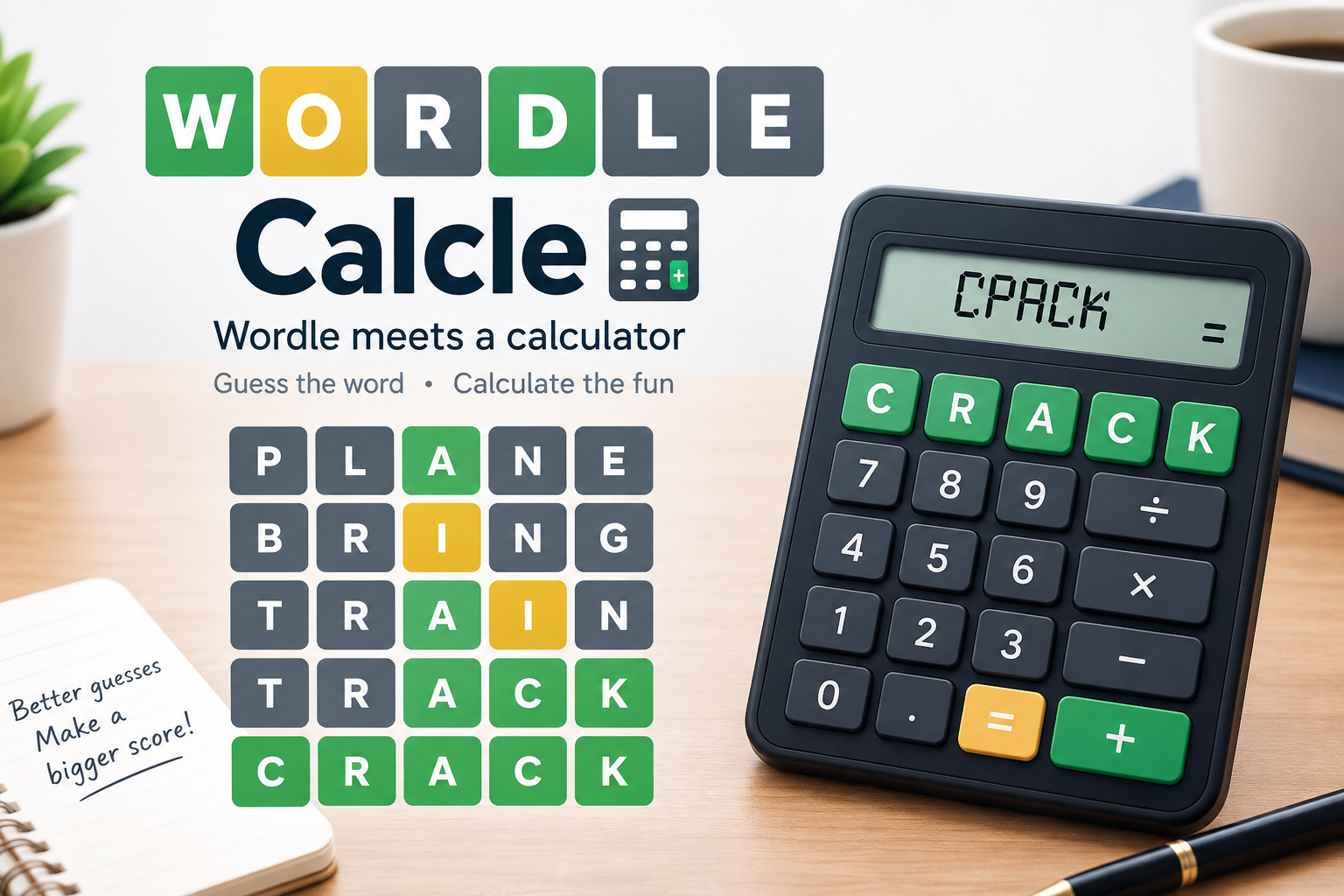
If you enjoy Wordle but want a puzzle that challenges your mathematical thinking, Wordle Calcle offers an interesting alternative. Instead of guessing a hidden five-letter word, you work with numbers, arithmetic operations, and logical clues to solve a mathematical equation.
The concept is straightforward, but finding the correct numbers within a limited number of attempts can be surprisingly challenging. Every guess provides valuable feedback, helping you eliminate incorrect possibilities and move closer to the solution.
Whether you’re playing for the first time or trying to improve your daily results, this guide explains how Calcle works, what the colored tiles mean, and which strategies can help you solve puzzles more efficiently.
What Is Wordle Calcle?
Wordle Calcle is a browser-based mathematical puzzle game inspired by the popular word-guessing game Wordle. It replaces letters with numbers and challenges players to complete a hidden arithmetic equation using deduction and mathematical reasoning.
In the commonly available daily version of Calcle, the arithmetic operators and target result are already displayed. Your task is to identify the missing numbers that make the equation correct, typically within five attempts.
Like Wordle, the game uses colored tiles to indicate whether your guesses contain correct elements.
Rather than testing your vocabulary, Calcle rewards your understanding of arithmetic, number relationships, and logical elimination.
Wordle Calcle at a Glance
| Feature | Details |
|---|---|
| Game type | Mathematical logic puzzle |
| Main objective | Find the missing numbers in an equation |
| Attempts allowed | Five in the standard daily version |
| Feedback system | Green, yellow, and gray tiles |
| Core skills | Arithmetic, deduction, and pattern recognition |
| Puzzle frequency | New daily challenge |
| Platform | Web browser |
| Cost | Free on commonly available versions |
| Difficulty | Depends on the equation and available clues |
Some websites offer different games under the Calcle name, including more advanced mathematical variations. This guide focuses on the daily arithmetic version in which players guess missing numbers.
How to Play Wordle Calcle: Step-by-Step Instructions
You don’t need advanced mathematics to begin playing. Understanding basic calculations and learning how to interpret the feedback are enough to get started.
Step 1: Open the Calcle Game
Access a browser-based version of Calcle, such as the one listed in the Calcle game directory.
The game displays a mathematical equation containing missing numbers, along with the operators and target result.
Before entering anything, examine the structure of the equation. Identify how many digits are missing and which operations you need to perform.
Step 2: Understand the Equation
Suppose a simplified puzzle shows:
_ _ + _ = 19
Your objective is to determine which numbers can fill the empty positions while making the equation mathematically correct.
Possible combinations include:
-
12 + 7 = 19
-
14 + 5 = 19
-
16 + 3 = 19
These examples demonstrate that several mathematically valid answers may exist.
The actual challenge is to identify the specific combination selected by the puzzle using the clues provided after each guess.
Step 3: Enter Your First Guess
Use the on-screen numeric keypad to enter the missing digits.
Your first attempt should be mathematically valid and, where possible, provide useful information about several different digits.
Avoid entering arbitrary numbers without checking whether they satisfy the equation. A thoughtful opening attempt can reveal more helpful clues than a guess chosen without any reasoning.
Step 4: Interpret the Colored Tiles
After submitting a guess, the game highlights the entered digits using its feedback system.
5
Green — Correct position
The digit belongs in the equation and occupies the correct position.
7
Yellow — Wrong position
The digit appears in the solution but belongs in a different position.
3
Gray — Not included
The digit is not part of the solution, subject to how repeated digits are handled.
The colors are more than visual indicators. They provide the information necessary to reduce the number of possible solutions.
Step 5: Refine Your Next Guess
Use the feedback to construct a better equation.
Keep green digits in their confirmed positions, reconsider the placement of yellow digits, and eliminate digits that the clues rule out.
Each attempt should narrow your choices rather than simply repeat a previous idea.
Step 6: Solve the Equation Within Five Attempts
Continue adjusting your guesses until the entire equation matches the hidden solution.
In the standard daily Calcle game, you have five attempts to find the correct answer.
If you succeed, you can share your result or return for the next daily challenge. If you use all five attempts without solving the equation, review the feedback to understand where your reasoning went wrong.
Understanding the Mathematical Logic Behind Calcle
The most important difference between Calcle and ordinary arithmetic exercises is that calculating the correct result isn’t always enough.
You must discover the particular numbers selected by the game.
Multiple Equations Can Produce the Same Result
Consider the following equation:
A + B = 15
Several combinations satisfy it:
| Value of A | Value of B | Result |
|---|---|---|
| 6 | 9 | 15 |
| 7 | 8 | 15 |
| 8 | 7 | 15 |
| 9 | 6 | 15 |
All four combinations are mathematically correct.
However, if the hidden solution is 8 + 7 = 15, only that arrangement will solve the puzzle.
This is where colored feedback becomes essential. It helps distinguish the selected answer from other valid equations.
Position Matters as Much as Value
A yellow digit tells you that the digit belongs somewhere in the solution, but not in the position where you placed it.
For example, imagine the hidden digits are 8 and 7, and you enter them in reverse order.
Both digits may receive yellow feedback because each digit exists in the solution but occupies the wrong position.
The logical next step is to exchange their positions, provided the resulting equation remains valid.
Arithmetic Constraints Reduce the Possibilities
Mathematical rules are powerful filters.
If a puzzle requires two positive numbers to add up to 20, the value of one number determines the other.
For instance:
20 - 13 = 7
Once you establish that one missing number is 13, the other must be 7.
Similar relationships apply to multiplication, subtraction, and division.
The strongest players combine these mathematical constraints with the color clues instead of treating the two types of information separately.
Best Wordle Calcle Strategies to Win More Often
Successful play is less about making calculations quickly and more about selecting guesses that provide useful information.
The following techniques can improve both accuracy and efficiency.
1. Start With Informative Digits
Your opening guess creates the foundation for the entire puzzle.
When several valid combinations are available, consider choosing one that tests a variety of digits instead of unnecessarily repeating the same digit.
A guess containing several distinct digits may help establish which numbers belong in the hidden equation.
However, the guess must still respect the game’s mathematical requirements. Testing different digits is useful only when the proposed equation is valid.
2. Solve the Arithmetic Before Guessing
Before submitting an answer, calculate the missing values and identify possible combinations.
For an equation involving addition, think in terms of complementary numbers.
For example, if the target is 24:
15 + 9 = 24
16 + 8 = 24
17 + 7 = 24
This immediately establishes several valid candidates.
You can then compare them against the digits and positions revealed by previous attempts.
3. Use Green Digits as Fixed Anchors
A green tile provides reliable positional information.
Once a digit is confirmed in a particular position, preserve it when constructing future guesses.
Changing confirmed values without a reason wastes information and can make the puzzle more confusing.
Instead, focus your attention on unresolved positions and determine which digits could realistically occupy them.
4. Treat Yellow Digits as Placement Problems
Yellow tiles identify digits you need but haven’t positioned correctly.
When you receive a yellow tile, ask two questions:
-
Which other positions could contain this digit?
-
Would moving it to those positions produce a valid equation?
Checking both conditions helps you avoid guesses that satisfy the color clues but violate arithmetic rules.
5. Respect the Order of Operations
Some mathematical puzzles include multiple arithmetic operations.
In such cases, standard order-of-operations rules become essential.
For example:
4 + 3 × 5 = 19
The multiplication occurs before the addition:
4 + 15 = 19
Calculating strictly from left to right would produce an incorrect result.
When parentheses are present, evaluate them first. Then apply multiplication and division before addition and subtraction, as appropriate.
6. Pay Attention to Repeated Digits
Repeated numbers can complicate color-based puzzles.
Suppose your guess contains two instances of the digit 4. One might receive positive feedback while the other does not, depending on the hidden solution and the game’s matching rules.
Don’t automatically assume that every occurrence of a digit is correct simply because one copy received a green or yellow tile.
Review both the number of repeated digits and their positions before making your next guess.
7. Prioritize Information Over Speed
Solving a puzzle quickly feels satisfying, but unnecessary rushing often increases mistakes.
Before submitting your next attempt, mentally check:
-
Does the equation produce the required result?
-
Have I preserved the confirmed positions?
-
Have I moved misplaced digits appropriately?
-
Does this guess provide useful information if it is incorrect?
That final question is particularly valuable. A guess that distinguishes between several competing possibilities may be more useful than one that merely looks close to the answer.
An Example of Solving a Calcle-Style Puzzle
To see how deduction works, consider a simplified two-digit puzzle.
Illustrative puzzle — not an actual daily Calcle result
Find the missing digits
_ + _ = 15
Guess 1: 6 + 9 = 15
6
+
9
= 15
Neither digit belongs in the hidden solution.
Guess 2: 7 + 8 = 15
7
+
8
= 15
Both digits appear, but each is in the wrong position.
Guess 3: 8 + 7 = 15
8
+
7
= 15
Correct solution in three guesses
This illustration demonstrates a useful principle: a mathematically valid guess can still be incorrect if it doesn’t match the hidden arrangement.
The second guess reveals both required digits. Because each receives yellow feedback, swapping their positions produces the solution.
Real Calcle puzzles may include longer number arrangements and more complex calculations, but the process of combining arithmetic with positional clues remains the same.
Advanced Techniques for Difficult Calcle Puzzles
Once you understand the basic rules, more systematic techniques can help with difficult equations.
Use Backward Calculation
Many players start by filling digits from left to right.
A more efficient approach is often to begin with the target result and work backward.
Suppose the structure is:
A × B = 36
Instead of trying arbitrary values, list the factor pairs:
-
4 × 9 = 36
-
6 × 6 = 36
-
3 × 12 = 36
-
2 × 18 = 36
The number of available digit positions determines which combinations are possible.
Once positional clues appear, you can eliminate incompatible factor pairs without making additional guesses.
Create a Mental Possibility List
After each guess, separate what you know from what you suspect.
For example, you may know that one digit is fixed, another digit belongs elsewhere, and two digits are excluded.
Use those facts to build a small list of possible solutions.
Avoid relying on memory alone when several candidates remain. Writing possibilities on paper can be useful for especially difficult puzzles.
Recognize Number Patterns
Familiarity with arithmetic patterns can dramatically reduce the amount of calculation needed.
Common patterns include:
-
Multiples of 5 usually end in 0 or 5 when dealing with whole numbers.
-
An even number multiplied by an integer produces an even result.
-
The sum of two odd numbers is even.
-
Multiplying any integer by 0 produces 0.
-
A number is divisible by 3 when the sum of its digits is divisible by 3.
These relationships allow you to eliminate impossible combinations before testing them.
For example, if two whole numbers multiply to produce an odd result, both numbers must be odd.
Track the Number of Remaining Possibilities
A strong guess should reduce uncertainty.
Suppose your existing clues leave four possible solutions. If a new guess could distinguish between those candidates, it is potentially valuable even if it doesn’t immediately solve the puzzle.
This approach is similar to the information-based strategies used in Wordle.
The objective is not simply to find an equation that works. It is to gain enough information to identify the exact hidden equation before your attempts run out.
Wordle Calcle vs. Wordle: What’s the Difference?
Although the games share a feedback-based guessing concept, they challenge different skills.
| Feature | Wordle | Calcle |
|---|---|---|
| Main challenge | Guess a hidden word | Guess missing equation digits |
| Subject | Language | Mathematics |
| Typical attempts | Six | Five in the standard daily version |
| Important skills | Vocabulary, spelling, letter patterns | Arithmetic, logic, number patterns |
| Feedback | Colored letter tiles | Colored number tiles |
| Winning condition | Identify the exact word | Identify the exact missing numbers |
| Daily play | Yes | Yes |
| Strategy focus | Letter frequency and placement | Mathematical constraints and digit placement |
Wordle primarily tests your ability to recognize words and use letter-frequency clues.
Calcle introduces arithmetic constraints, which can make some possibilities easier to eliminate mathematically while requiring more deliberate numerical reasoning.
Neither game is universally harder. The experience depends on your familiarity with vocabulary, calculations, and deduction.
Calcle vs. Nerdle vs. Mathler
Calcle isn’t the only Wordle-inspired mathematical puzzle.
Two other well-known options are Nerdle and Mathler.
| Game | Main objective | Key difference |
|---|---|---|
| Calcle | Find missing numbers in a displayed equation | Operators and result are supplied in the standard version |
| Nerdle | Guess a complete hidden mathematical equation | Numbers, operators, and their positions form the hidden answer |
| Mathler | Construct an equation matching a target number | Players work toward a given result using the game’s equation format |
Which Game Should You Choose?
Choose Calcle if you prefer arithmetic puzzles with a clearly defined equation structure and a limited number of attempts.
Try Nerdle if you enjoy discovering the entire equation, including the placement of operators.
Mathler may appeal to players who enjoy constructing calculations to reach a particular target.
All three reward mathematical reasoning, but their puzzle structures create different challenges.
Common Wordle Calcle Mistakes to Avoid
Even experienced players can lose attempts through small, preventable errors.
Guessing Without Checking the Equation
A guess may contain promising digits but still fail to satisfy the mathematical expression.
Always verify the arithmetic before submitting.
Ignoring Yellow Feedback
Yellow tiles provide confirmed information about digit presence.
Repeatedly entering those digits in the same incorrect positions wastes valuable attempts.
Changing Confirmed Digits
Once a green digit is correctly placed, changing it can undermine your progress.
Build subsequent guesses around the confirmed information.
Overlooking Repeated Numbers
A repeated digit may appear fewer times in the solution than in your guess.
Interpret the feedback carefully rather than treating every matching digit as an unlimited match.
Confusing Arithmetic Operations
Multiplication and division can produce significantly different results from addition and subtraction.
Read the displayed operators carefully, particularly when several operations appear in the same equation.
Using Too Many Similar Guesses
Trying several nearly identical combinations can provide little additional information.
When possible, choose a mathematically valid guess that tests a meaningfully different candidate or helps eliminate multiple possibilities.
Can Wordle Calcle Help Improve Math Skills?
Calcle can provide useful informal practice for arithmetic and logical reasoning.
While it isn’t a substitute for structured mathematics education, its puzzle format encourages players to work with numbers repeatedly and evaluate possible solutions.
Mental Arithmetic Practice
Frequent exposure to addition, subtraction, multiplication, and division can help players become more comfortable with everyday calculations.
The game creates a reason to practice these operations without relying on a traditional worksheet.
Logical Reasoning
Every colored tile provides a constraint.
Players must evaluate which conclusions follow from those constraints and which possibilities remain unproven.
This process encourages systematic deduction instead of random guessing.
Pattern Recognition
Repeated exposure to number combinations can make common mathematical relationships easier to recognize.
For example, players may become quicker at spotting factor pairs or complementary numbers that produce a particular target.
Error Analysis
One of the most valuable habits is reviewing incorrect guesses.
When a solution doesn’t work, consider whether the problem came from arithmetic, placement, or misinterpreting feedback.
This reflection can improve how you approach future puzzles.
How to Practice Calcle More Effectively
Improvement comes from developing a repeatable method rather than memorizing individual answers.
A useful routine is to begin each puzzle by identifying the equation’s structure and calculating several valid possibilities.
After your first attempt, use the colored feedback to eliminate incompatible candidates. Continue until only one arrangement remains.
If you’re trying to develop stronger mathematical reasoning, attempt the puzzle without a calculator first. Use one afterward to verify difficult calculations when necessary.
Another useful practice is to record how many guesses you needed and what caused any mistakes.
Over time, this can reveal whether you need to work on arithmetic accuracy, positional reasoning, or making more informative guesses.
Frequently Asked Questions About Wordle Calcle
Is Wordle Calcle free to play?
Yes. Commonly available browser versions of the daily Calcle game are free to play, and some do not require registration or downloads.
How many guesses do you get in Calcle?
The standard daily arithmetic version generally allows five attempts. Other games using the Calcle name may have different rules, including versions with six guesses.
Is Calcle the same as Wordle?
No. Calcle takes inspiration from Wordle’s guessing and colored-feedback mechanics but replaces word recognition with mathematical problem-solving.
Do you need to be good at math to play Calcle?
Not necessarily. Basic arithmetic is sufficient for the standard version, although familiarity with number relationships and logical deduction can make difficult puzzles easier.
Can you play Wordle Calcle on mobile?
Browser-based versions can be accessed from mobile devices through compatible web browsers. The layout and available controls depend on the site hosting the game.
Does Wordle Calcle have a new puzzle every day?
Yes. The standard version follows a daily challenge format. A new puzzle becomes available according to the game’s reset schedule.
Are there different versions of Calcle?
Yes. Some online games use the Calcle name for different mathematical challenges, including versions involving more advanced calculus concepts. The rules, equation formats, and permitted attempts may vary.
What is the best strategy for Calcle?
Start with a valid, informative guess, use green tiles as fixed positions, relocate yellow digits, and eliminate candidates using arithmetic rules.
The best strategy combines calculation with logical deduction rather than relying on trial and error.
Can I replay previous Calcle puzzles?
That depends on the version you’re using. Some daily Calcle pages focus on the current challenge and do not provide a visible archive of previous puzzles.
Is Calcle suitable for beginners?
Yes. The standard arithmetic version is approachable for players who understand basic mathematical operations. Beginners can improve gradually by learning the feedback system and practicing number patterns.
Final Thoughts: Master Wordle Calcle With Smarter Guessing
Wordle Calcle turns familiar arithmetic into a daily exercise in logic, deduction, and problem-solving. Its appeal comes from combining simple mathematical rules with the challenge of identifying one specific solution from several possible equations.
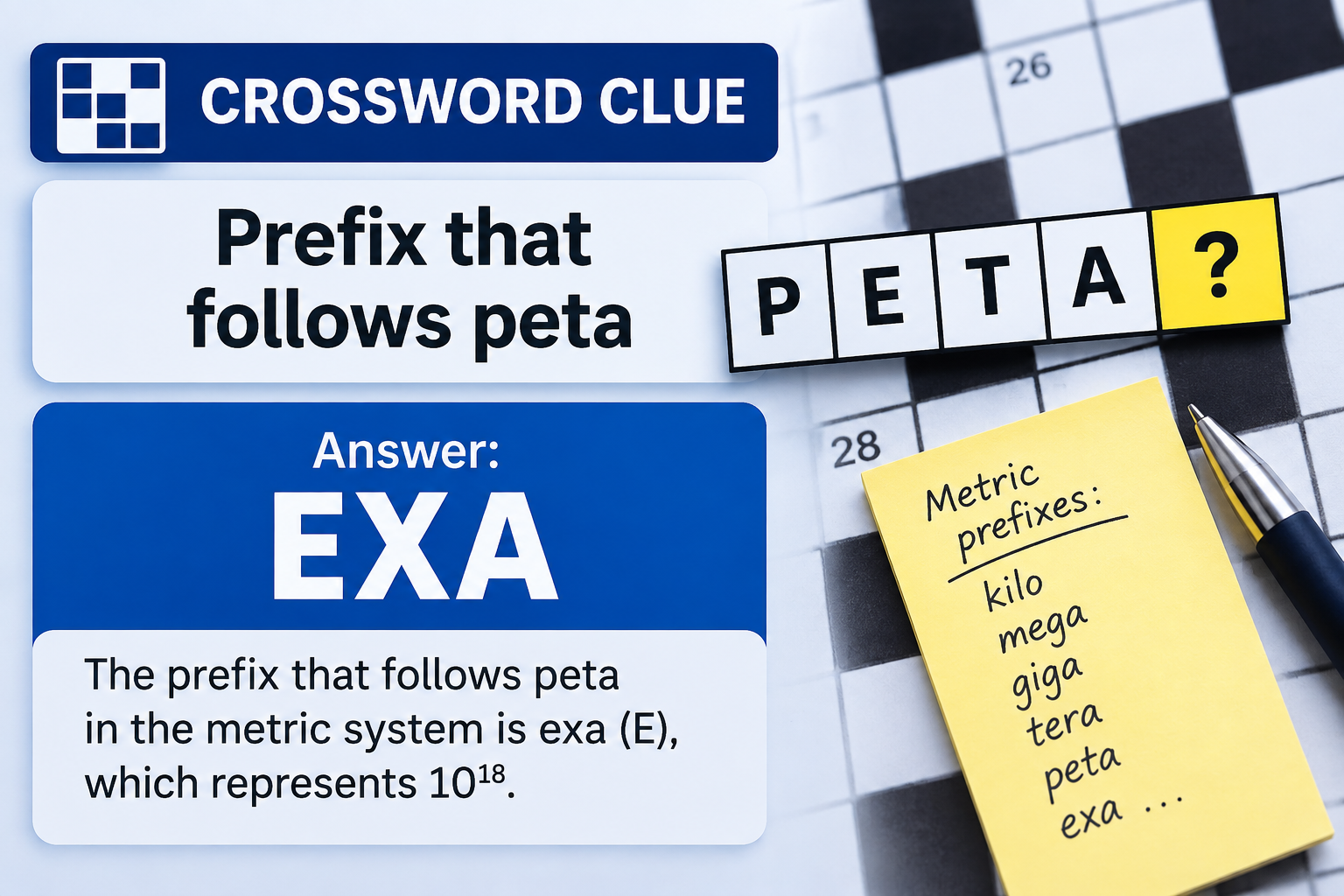
The answer to the prefix that follows peta crossword clue is EXA.
EXA is a three-letter SI metric prefix representing (10^{18}), or one quintillion. In the standard sequence of large metric prefixes, exa comes immediately after peta, making it the correct crossword answer. The clue has also appeared in published crossword databases with EXA as the solution.
Quick Answer
| Crossword Clue | Answer | Letters |
|---|---|---|
| Prefix that follows “peta-” | EXA | 3 |
| Prefix after peta | EXA | 3 |
| Metric prefix after peta | EXA | 3 |
Answer: EXA
If your puzzle requires a 3-letter answer, you can confidently enter E-X-A.
Why Is EXA the Correct Answer?
The clue refers to the order of prefixes used in the International System of Units (SI).
The relevant sequence is:
giga → tera → peta → exa → zetta → yotta
According to the International Bureau of Weights and Measures (BIPM), peta represents (10^{15}), while exa represents (10^{18}). Therefore, the prefix that follows peta is exa.
Peta vs. Exa
| Prefix | Symbol | Value |
|---|---|---|
| Tera | T | (10^{12}) |
| Peta | P | (10^{15}) |
| Exa | E | (10^{18}) |
| Zetta | Z | (10^{21}) |
| Yotta | Y | (10^{24}) |
Each of these large SI prefixes increases by a factor of 1,000 as you move up the sequence.
That pattern makes the clue easier to solve even when you do not immediately remember the word.
What Does Exa Mean?
Exa is an official SI prefix used to represent one quintillion, or:
1,000,000,000,000,000,000
Its official symbol is the uppercase letter E. BIPM lists exa as the (10^{18}) prefix, directly above peta at (10^{15}).
One familiar example is an exabyte, a unit used when discussing extremely large quantities of /
The prefix is not merely crossword vocabulary. It is part of the internationally recognized measurement system used in science, engineering, computing, and other technical fields.
How the Prefix Sequence Helps Solve the Crossword
Knowing a short section of the SI prefix sequence can make clues like this much easier.
Remember:
giga → tera → peta → exa → zetta
So when a crossword asks for the prefix that comes:
- after tera → PETA
- after peta → EXA
- after exa → ZETTA
- before exa → PETA
- between peta and zetta → EXA
This is particularly useful because crossword setters often reuse metric prefixes as short answers.
Is the Answer EXA or PETA?
The answer is EXA, not PETA.
The wording of the clue is important. It asks for the prefix that follows peta, meaning you need the next prefix in the sequence.
Think of it this way:
PETA → EXA
If the clue instead asked for the prefix that follows tera, then the answer would be PETA.
Does This Clue Refer to PETA the Organization?
No.
In this crossword clue, peta- refers to the metric prefix, not the acronym PETA associated with the animal-rights organization.
The hyphen in versions of the clue written as “peta-” is a useful hint that the setter is talking about a prefix attached to units of measurement.
That distinction can save time if your first thought is the well-known organization rather than the SI system.
Where Does Exa Fit in the Full SI Prefix Order?
For larger measurements, the modern SI sequence includes:
| Power | Prefix | Symbol |
|---|---|---|
| (10^9) | giga | G |
| (10^{12}) | tera | T |
| (10^{15}) | peta | P |
| (10^{18}) | exa | E |
| (10^{21}) | zetta | Z |
| (10^{24}) | yotta | Y |
| (10^{27}) | ronna | R |
| (10^{30}) | quetta | Q |
The BIPM recognizes these as official SI prefixes. Peta and exa were formally added to the SI system in 1975, while larger prefixes were added in later updates.
For the crossword clue, however, the only sequence you really need to remember is:
tera → peta → exa → zetta
Common Crossword Clues With EXA as the Answer
Crossword constructors can describe EXA in several ways. Similar clues may include:
- Prefix after peta
- Prefix that follows peta-
- Metric prefix after peta
- Prefix before zetta
- Prefix meaning one quintillion
- Prefix past tera and peta
- (10^{18}) prefix
- Prefix in “exabyte”
If the answer space contains three letters, EXA is a strong match for these clues.
How to Confirm EXA From Crossing Letters
Even when a clue appears obvious, crossing answers can provide useful confirmation.
For EXA, you should expect:
E _ _
then:
E X _
and finally:
E X A
The X is especially helpful because it is less common than many crossword letters. If your crossing answer gives an X in the middle position, that strongly supports EXA.
If your crossings produce a completely different pattern, recheck the neighboring clues before changing this answer.
Common Mistakes to Avoid
Choosing Zetta
Zetta comes after exa, not directly after peta.
The correct order is:
peta → exa → zetta
Entering Peta
Peta is already given in the clue. The puzzle wants the prefix that comes next.
Thinking of the PETA Acronym
The clue concerns SI measurement terminology. Reading peta- as a metric prefix makes the solution much clearer.
Ignoring the Letter Count
Most appearances of this clue require a 3-letter answer, which fits EXA perfectly.
A Simple Way to Remember Peta and Exa
Use the short sequence:
Tera, Peta, Exa, Zetta
or:
T → P → E → Z
You do not need to memorize every SI prefix to solve this type of crossword. Remembering those four large-unit prefixes will cover several common clue variations.
Frequently Asked Questions
What is the answer to the prefix that follows peta crossword clue?
The answer is EXA, a three-letter SI prefix representing (10^{18}).
How many letters are in the answer?
EXA has three letters.
What prefix comes directly after peta?
Exa comes directly after peta in the SI prefix sequence. BIPM lists peta as (10^{15}) and exa as (10^{18}).
What comes after exa?
The prefix following exa is zetta, which represents (10^{21}).
What comes before peta?
Tera comes before peta and represents (10^{12}).
What does exa stand for?
Exa is the SI prefix for a multiplication factor of (10^{18}), equal to one quintillion.
Is EXA a common crossword answer?
Yes. Its short three-letter form and distinctive X make it useful in crossword grids, and crossword databases record clues connecting EXA with the sequence following peta.
Final Answer: EXA
The solution to the prefix that follows peta crossword clue is EXA.
EXA — 3 letters
Remember the sequence tera → peta → exa → zetta, and you will be able to solve this clue and several similar metric-prefix crossword clues quickly.
Understanding the competitive edge theserpentrogue provides players and enthusiasts with a deeper look into how strategy, decision-making, and execution create long-term success. Whether you are exploring the mechanics, improving your performance, or studying advanced approaches, gaining a true advantage requires more than basic knowledge.
This guide breaks down the key elements behind building a competitive advantage, from resource management and tactical choices to common mistakes that prevent consistent progress.
Quick Facts About competitive edge theserpentrogue
| Element | Key Insight |
|---|---|
| Main Focus | Creating strategic advantages through smarter decisions |
| Skill Requirement | Planning, adaptability, and efficient execution |
| Best Improvement Area | Understanding systems rather than relying on luck |
| Long-Term Goal | Consistent performance and mastery |
Understanding the Core Competitive Edge
A competitive edge comes from identifying opportunities that others overlook. In any strategic environment, small advantages compound over time.
The strongest performers typically focus on:
- Better information gathering
- Faster adaptation to changing situations
- Efficient use of available resources
- Learning from previous decisions
- Creating repeatable strategies
The difference between an average approach and an expert approach is often the ability to recognize patterns before they become obvious.
Why Strategy Matters More Than Speed
Many players assume success comes from acting quickly, but speed without planning often creates unnecessary risks.
A stronger approach involves:
- Evaluating the current situation
- Predicting possible outcomes
- Choosing the highest-value action
- Adjusting based on new information
Strategic patience often creates opportunities that aggressive but unplanned actions miss.
Advanced Techniques to Improve Your Competitive Edge
Analyze Patterns and Opponent Behavior
One of the most valuable skills is recognizing repeated behaviors. Strong competitors do not only react; they anticipate.
Look for:
- Predictable choices
- Resource weaknesses
- Timing mistakes
- Inefficient strategies
Pattern recognition transforms random encounters into manageable situations.
Optimize Resource Management
Resources are not limited to physical items or currency. Time, positioning, information, and available options all influence outcomes.
Effective resource management includes:
- Avoiding unnecessary risks
- Prioritizing high-impact actions
- Saving advantages for critical moments
- Reducing wasted effort
Players who manage resources efficiently usually outperform those who focus only on immediate rewards.
Adapt Instead of Repeating Failed Strategies
A common mistake is repeating the same approach despite poor results.
Improvement requires:
- Reviewing what went wrong
- Identifying the exact weakness
- Testing alternative solutions
- Measuring the outcome
Adaptability is one of the biggest indicators of advanced skill.
Common Mistakes That Reduce Performance
Relying Too Much on Familiar Tactics
A strategy that works repeatedly can create overconfidence. Experienced competitors understand that successful methods eventually face new challenges.
Ignoring Small Advantages
Minor improvements often appear insignificant, but they create meaningful differences over time.
Examples include:
- Better timing
- Improved positioning
- More efficient choices
- Stronger preparation
Focusing Only on Short-Term Results
Winning a single encounter does not always represent true improvement. Sustainable success comes from building systems that work consistently.
Competitive Edge theserpentrogue: Beginner vs Advanced Approach
| Beginner Approach | Advanced Approach |
|---|---|
| Reacts to situations | Predicts future possibilities |
| Uses familiar strategies | Adjusts based on circumstances |
| Prioritizes immediate gains | Plans for long-term success |
| Learns after mistakes | Studies patterns before mistakes happen |
How to Develop a Stronger Competitive Mindset
A competitive mindset is built through continuous improvement rather than instant mastery.
Focus on:
1. Review Every Decision
After important moments, ask:
- Why did this choice work?
- What alternative options existed?
- What could be improved next time?
2. Build Consistent Habits
Skill development improves when learning becomes routine.
Useful habits include:
- Practicing specific weaknesses
- Studying successful strategies
- Tracking improvement areas
- Experimenting with new approaches
3. Balance Confidence With Flexibility
Confidence helps execution, but flexibility prevents stagnation.
The best competitors trust their abilities while remaining willing to change their methods.
Expert Tips for Maximizing Results
To strengthen your overall performance:
- Study successful examples instead of copying them blindly
- Develop multiple strategies for different situations
- Avoid predictable patterns
- Improve decision quality before increasing speed
- Treat mistakes as valuable feedback
The goal is not simply to find one winning method. The goal is to develop the ability to create advantages repeatedly.
Final Thoughts: Building Your competitive edge theserpentrogue Advantage
The competitive edge theserpentrogue comes from combining knowledge, strategy, adaptability, and disciplined execution. Real improvement happens when players move beyond basic actions and start understanding why certain decisions create better outcomes.
By analyzing patterns, managing resources wisely, and continuously refining your approach, you can develop a stronger and more reliable competitive advantage.


imageflings.com: What It Is, Website Status, Safety, and Everything You Should Know

TeamViewer Pricing vs. Splashtop: Complete 2026 Comparison Guide

What Is Globalunpaid Com? Complete Website Guide for 2026
-

 Fashion9 years ago
These ’90s fashion trends are making a comeback in 2017
-
Entertainment9 years ago
The final 6 ‘Game of Thrones’ episodes might feel like a full season
-
Fashion9 years ago
According to Dior Couture, this taboo fashion accessory is back
-
Business9 years ago
Uber and Lyft are finally available in all of New York State
-
Entertainment9 years ago
The old and New Edition cast comes together to perform
-
Sports9 years ago
Steph Curry finally got the contract he deserves from the Warriors
-
Sports9 years ago
Phillies’ Aaron Altherr makes mind-boggling barehanded play
-
Entertainment9 years ago
Disney’s live-action Aladdin finally finds its stars