
Entertainment
Speaker Biography Sample: Templates & Examples

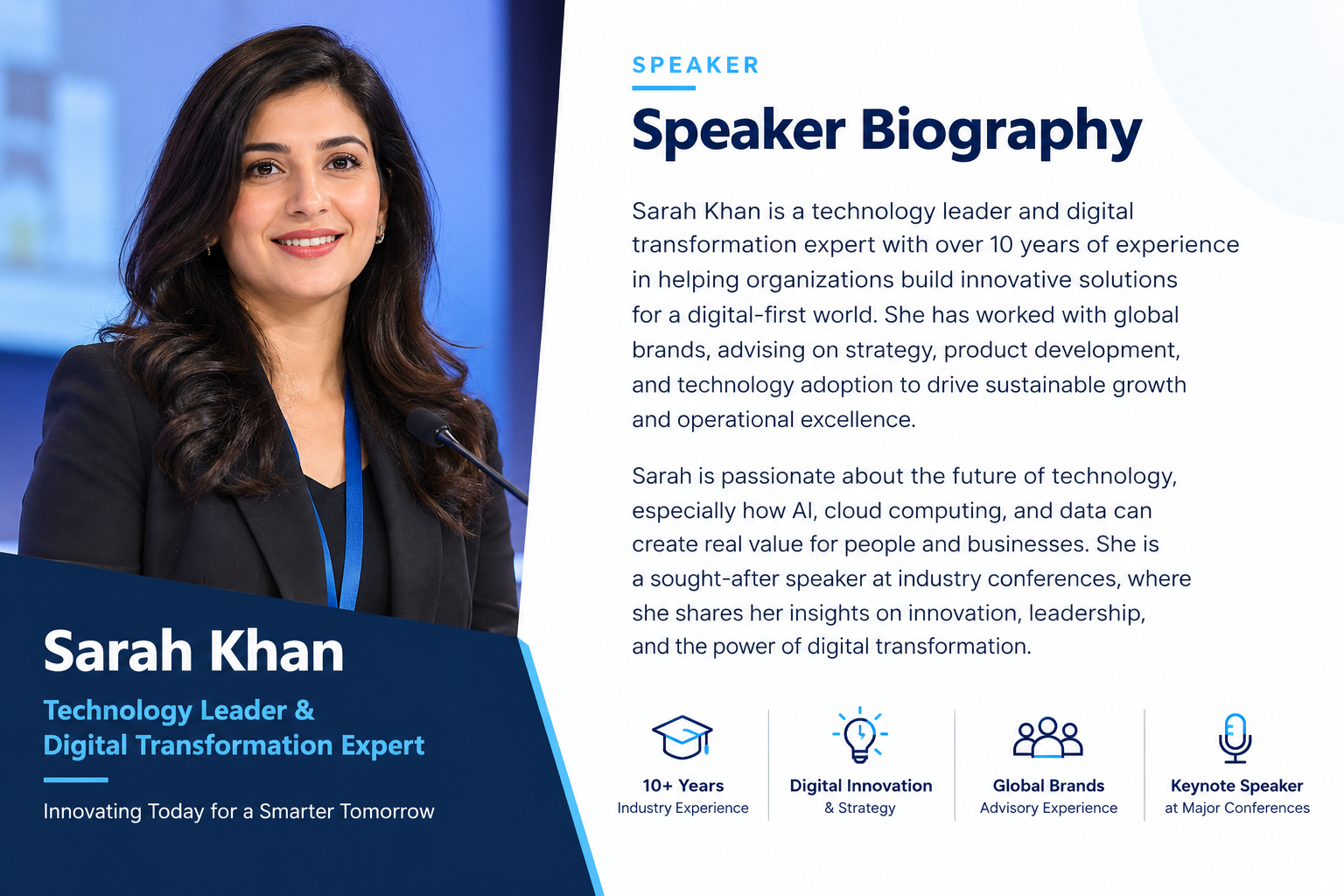
A strong speaker biography sample does more than list qualifications. It tells an event organizer and audience why the speaker matters, what expertise they bring, and what listeners can expect to gain from hearing them.
The challenge is getting the balance right. A speaker bio should establish credibility without sounding like a résumé, promote expertise without becoming overly promotional, and provide enough context without burying the reader in unnecessary details.
This guide includes ready-to-use speaker biography examples, adaptable templates, formatting advice, and practical techniques for writing bios for conferences, corporate events, webinars, panels, workshops, and professional speaking engagements.
What Is a Speaker Biography?
A speaker biography is a short professional description that introduces a person presenting at an event.
It usually explains:
- Who the speaker is
- What they do
- Their area of expertise
- Their most relevant achievements
- Why their experience matters to the audience
- Their current professional role or organization
Event organizers may use the biography on conference websites, registration pages, event programs, speaker profiles, social media posts, introductions, and promotional materials.
Unlike a full professional biography, a speaker bio is highly selective. Its job is not to document an entire career. Its job is to establish relevance quickly.
Quick Facts: What Makes a Good Speaker Bio?
| Element | Best Practice |
|---|---|
| Length | Usually 50–150 words |
| Point of view | Third person is most common |
| Opening | Name + current role + expertise |
| Achievements | Include only relevant accomplishments |
| Tone | Professional, clear, and human |
| Audience focus | Explain why the speaker is worth hearing |
| Credentials | Use specific, verifiable details |
| Ending | Current focus, mission, or relevant expertise |
A useful rule is simple: every sentence should strengthen the reader’s understanding of the speaker.
If a detail does not establish authority, relevance, personality, or context, it probably does not need to be there.
Speaker Biography Sample for a Conference
Here is a professional speaker biography sample suitable for a conference website or event program:
Dr. Maya Richardson is a leadership consultant, organizational psychologist, and workplace researcher specializing in employee engagement and high-performing teams. Over the past 15 years, she has advised organizations across technology, healthcare, and financial services on leadership development and organizational change. Her research focuses on how managers can build resilient teams during periods of rapid growth and uncertainty. Maya regularly speaks at industry conferences and executive workshops, translating behavioral research into practical strategies leaders can apply immediately.
Why does this version work?
It quickly establishes the speaker’s profession, expertise, experience, industry relevance, research focus, and value to the audience. It avoids unrelated career history.
Short Speaker Biography Sample
Sometimes organizers ask for only 50 to 75 words.
A shorter bio should prioritize current role, specialization, and one or two credibility signals.
Daniel Carter is a cybersecurity strategist and technology advisor specializing in digital risk, data protection, and cyber resilience. He has spent more than a decade helping organizations strengthen security programs and prepare for emerging threats. Daniel speaks to business and technology audiences about making cybersecurity understandable, practical, and relevant to everyday decision-making.
Short does not mean vague.
A compact bio can still communicate expertise clearly if every sentence serves a purpose.
50-Word Speaker Bio Example
Sarah Mitchell is a digital marketing strategist who helps growing companies build stronger customer acquisition and content programs. With more than 10 years of experience across SaaS and ecommerce, she specializes in SEO, audience research, and conversion strategy. Her talks turn complex marketing concepts into practical, measurable actions.
This format works especially well for conference agendas, webinar landing pages, event brochures, and moderator introductions.
100-Word Speaker Biography Sample
James Walker is an entrepreneur, business strategist, and advisor who works with founders navigating growth, operations, and organizational change. He has helped launch and scale businesses across technology, professional services, and ecommerce. His work focuses on building sustainable systems that allow companies to grow without creating unnecessary operational complexity. James frequently speaks on entrepreneurship, business strategy, leadership, and decision-making. Known for his practical approach, he combines lessons from real-world business challenges with clear frameworks audiences can apply to their own organizations.
At around 100 words, there is enough space to establish experience while still keeping the biography easy to scan.
Speaker Biography Sample for a Keynote Speaker
A keynote bio should communicate authority quickly because keynote speakers are often positioned as major attractions for an event.
Dr. Elena Brooks is an innovation strategist, bestselling business author, and keynote speaker who helps organizations prepare for technological and workplace change. For more than 20 years, she has worked with executives, entrepreneurs, and public-sector leaders navigating transformation. Her research explores artificial intelligence, emerging technology, organizational adaptability, and the future of work. Elena is known for making complex trends understandable and connecting them to practical business decisions. Her presentations challenge audiences to think beyond short-term disruption and build organizations capable of adapting continuously.
Notice that the bio does not simply say she is an “inspiring speaker.”
It provides evidence explaining why an audience should consider her credible.
Speaker Biography Sample for a Motivational Speaker
Motivational speaker bios can include more personal context, but credibility still matters.
Marcus Reed is a motivational speaker, leadership coach, and former professional athlete who speaks about resilience, discipline, and personal responsibility. After a career-ending injury forced him to rebuild his professional life, Marcus began studying the habits that help people adapt to unexpected change. Today, he works with corporate teams, students, athletes, and emerging leaders. His presentations combine personal stories with practical techniques for building confidence, maintaining focus, and taking meaningful action during difficult periods.
The strongest motivational bios connect a personal story to a clear professional message.
They should not rely entirely on dramatic language.
Speaker Biography Sample for a Business Expert
Priya Shah is a business consultant and growth strategist who advises small and mid-sized companies on operations, market expansion, and sustainable growth. She has worked with founders and executive teams across retail, technology, and professional services, helping them improve decision-making and build scalable business systems. Priya’s speaking topics include growth strategy, operational efficiency, entrepreneurship, and strategic planning.
This version works because it emphasizes areas directly relevant to business audiences.
Speaker Biography Sample for an Academic
Academic speakers often have extensive credentials. The mistake is trying to include all of them.
A conference bio should highlight only what relates to the event.
Professor Michael Chen is a researcher and educator specializing in artificial intelligence, machine learning, and human-computer interaction. He is Professor of Computer Science at Northbridge University, where his research examines how intelligent systems can support human decision-making. He has published extensively on responsible AI and collaborates with researchers and industry teams developing human-centered technology. His current work explores transparency, trust, and accountability in AI-assisted systems.
Publications, awards, and institutional roles can be valuable, but they should support the topic rather than dominate the biography.
Speaker Biography Sample for a Panelist
Panel bios usually need to be brief because several participants must appear together.
Aisha Rahman is a sustainability consultant who works with companies developing practical environmental and ESG strategies. Her experience includes sustainability reporting, supply-chain analysis, and corporate climate initiatives. She advises leadership teams on turning sustainability commitments into measurable operational programs.
The audience only needs enough information to understand why the person belongs on that panel.
Speaker Biography Sample for a Webinar
Webinar biographies often benefit from being slightly more conversational.
Alex Turner is a sales enablement consultant who helps B2B teams improve prospecting, pipeline management, and sales communication. Over the past 12 years, he has trained sales teams in software, professional services, and technology markets. In this webinar, Alex will share practical methods for improving sales conversations and building a more consistent follow-up process.
Adding “In this webinar…” works because it directly connects the speaker’s expertise with the session.
Speaker Biography Sample for an Entrepreneur
Olivia Bennett is the founder and CEO of BrightPath Labs, a technology company focused on workflow automation for growing businesses. She has spent more than a decade building digital products and helping organizations simplify complex operational processes. As a speaker, Olivia discusses entrepreneurship, product development, business growth, and the lessons founders learn while turning early ideas into scalable companies.
Founders should avoid turning speaker bios into advertisements for their companies.
The business provides credibility. The speaker’s expertise remains the main focus.
How to Write a Speaker Biography
A reliable speaker biography can be built using five core elements.
1. Start With the Speaker’s Name and Current Role
The opening sentence should answer two immediate questions:
Who is this person?
Why should I listen to them?
For example:
Rachel Morgan is a workplace strategist and leadership consultant specializing in hybrid teams and organizational culture.
Compare that with:
Rachel has always been passionate about helping people achieve their potential.
The second sentence says almost nothing specific.
Specificity creates credibility.
2. Define the Speaker’s Expertise
Avoid broad claims such as:
- Business expert
- Thought leader
- Success coach
- Technology specialist
Instead, define the actual subject matter.
For example:
He specializes in supply-chain optimization, manufacturing automation, and operational efficiency.
This helps audiences understand what knowledge the speaker brings.
3. Add Relevant Experience
Experience should support the subject of the presentation.
Possible credibility signals include:
- Years of professional experience
- Executive positions
- Research
- Companies founded
- Organizations advised
- Books published
- Professional qualifications
- Major projects
- Industry experience
- Recognized awards
Avoid adding achievements simply because they sound impressive.
Relevance beats volume.
4. Explain the Speaker’s Current Focus
Current work often matters more than distant accomplishments.
For example:
Her current research examines how generative AI is changing knowledge work and organizational decision-making.
That sentence gives the biography immediacy and context.
5. Connect the Bio to the Audience
Great speaker bios subtly answer:
What will this person help me understand?
Instead of ending with another credential, consider highlighting practical value.
For example:
His talks help leadership teams translate cybersecurity risks into decisions nontechnical executives can understand and act on.
That is far stronger than:
He is passionate about cybersecurity.
Speaker Biography Template
Use this adaptable format:
[Name] is a [professional role] specializing in [primary expertise]. With [number] years of experience / relevant background], [he/she/they] has [important achievement, role, or type of work]. [Name]’s work focuses on [specific subjects or problems]. [He/She/They] has worked with [relevant organizations, industries, or audiences] and speaks about [presentation topics]. [Optional closing sentence explaining current focus or audience value.]
The template is intentionally simple.
Good speaker biographies rarely require complicated writing.
They require strong editing.
Short Speaker Bio Template
For tighter word limits:
[Name] is a [role] specializing in [expertise]. [He/She/They] has [key experience or achievement] and works with [audience/industry] on [specific problem]. [Name] speaks about [two or three topics], sharing practical insights on [audience benefit].
First-Person Speaker Biography Sample
Third person remains standard for most event materials, but some platforms request first-person biographies.
Here is an example:
I’m a leadership consultant and executive coach specializing in organizational change and team development. For more than 12 years, I’ve worked with managers and executive teams navigating growth, restructuring, and workplace transformation. My speaking and consulting work focuses on practical ways leaders can communicate clearly, build trust, and help teams perform effectively during periods of uncertainty.
First-person bios often work well for personal websites and social platforms.
For formal conference programs, third person is generally easier for organizers to publish directly.
First Person vs. Third Person Speaker Bios
| Format | Best Used For |
|---|---|
| First person | Personal website, social profile, informal webinar |
| Third person | Conferences, programs, event pages, media kits |
| Very short third person | Moderator introductions and agendas |
| Extended third person | Speaker pages and professional profiles |
When unsure, provide organizers with a third-person version.
It is the most flexible format.
What Should You Include in a Speaker Bio?
Prioritize information using this order:
- Current role
- Core expertise
- Relevant professional experience
- Strongest credentials
- Current work or research
- Speaking topics
- Audience relevance
Optional details may include:
- Significant books
- Major awards
- Professional certifications
- Well-known organizations served
- Media appearances
- Educational background
Personal hobbies, childhood history, unrelated jobs, and generic personality descriptions are usually unnecessary unless they directly support the speaker’s story.
What Should You Leave Out?
Many bios become weaker because they contain too much rather than too little.
Remove:
- Every previous job title
- Long lists of qualifications
- Unverifiable superlatives
- Excessive company promotion
- Irrelevant personal history
- Outdated achievements
- Multiple quotations
- Generic claims about passion
- Buzzwords that do not communicate expertise
For example:
John is an innovative, dynamic, results-driven, visionary thought leader passionate about creating transformative solutions.
This sounds impressive but communicates almost no useful information.
Compare:
John is a supply-chain consultant who helps manufacturers reduce inventory waste and improve production planning.
The second sentence establishes expertise immediately.
Common Speaker Biography Mistakes
Writing a Résumé Instead of a Biography
A résumé is designed to document professional history.
A speaker biography is designed to establish relevance.
Choose the details that support the speaking topic and remove the rest.
Making Unsupported Claims
Terms like “world-renowned,” “leading expert,” and “internationally acclaimed” should only appear when credible evidence supports them.
Specific facts are usually more convincing.
Instead of:
She is one of the world’s leading marketing experts.
Try:
She has spent 18 years developing customer acquisition strategies for technology and ecommerce companies.
Ignoring the Audience
A biography written for an academic symposium should not necessarily be identical to one written for a startup conference.
Adapt the emphasis.
An academic event may value publications and research credentials. A business conference may care more about operational experience and measurable outcomes.
Using an Outdated Bio
Speaker biographies should be reviewed before every major event.
Check:
- Job titles
- Organization names
- Years of experience
- Publications
- Awards
- Current projects
- Areas of expertise
An old biography can create awkward contradictions between the event page and the speaker’s current professional profile.
Making the Bio Too Long
Organizers often receive dozens or hundreds of biographies.
A 400-word career story creates unnecessary editing work.
Unless specifically requested, aim for approximately 75 to 150 words.
How Long Should a Speaker Biography Be?
The ideal length depends on where it will appear.
| Use Case | Recommended Length |
|---|---|
| Moderator introduction | 30–60 words |
| Event agenda | 40–75 words |
| Webinar page | 60–100 words |
| Conference speaker profile | 75–150 words |
| Media kit | 100–200 words |
| Personal speaker website | 150–300 words |
A smart approach is to maintain several versions.
Prepare:
- 50-word bio
- 100-word bio
- 150-word bio
- Full professional biography
When an organizer requests a bio, you can immediately provide the appropriate version.
How to Make a Speaker Bio More Credible
Credibility comes from evidence.
Compare these two descriptions:
Weak:
Rebecca is a highly respected expert who has helped countless businesses achieve incredible success.
Stronger:
Rebecca has advised more than 60 early-stage technology companies on pricing, customer acquisition, and go-to-market strategy.
The second version provides concrete information.
Whenever possible, replace adjectives with evidence.
Useful credibility signals include:
- Specific experience
- Measurable scope
- Recognized institutions
- Named publications
- Relevant qualifications
- Defined professional roles
- Documented achievements
How to Write a Speaker Bio When You Are New
You do not need decades of experience to create a credible biography.
Focus on relevance rather than prestige.
For example:
Emma Lewis is a UX researcher specializing in accessibility and inclusive product design. She works with digital product teams to understand how people with different abilities experience websites and mobile applications. Her recent work has focused on accessible user research practices, inclusive interfaces, and helping design teams incorporate accessibility earlier in the product development process.
There are no exaggerated credentials here.
The expertise is clear, specific, and relevant.
How to Customize Your Bio for Different Events
Using one biography everywhere is convenient but rarely optimal.
Suppose someone works in artificial intelligence and speaks at three events.
For a technology conference, emphasize:
- Technical expertise
- Product development
- AI systems
- Engineering experience
For a business conference, emphasize:
- AI strategy
- Productivity
- Organizational adoption
- Business implications
For an education conference, emphasize:
- AI literacy
- Learning
- Teaching applications
- Responsible classroom use
The professional background may be identical.
The framing changes according to audience intent.
A Simple Formula for a Strong Speaker Introduction
Event hosts often need an introduction rather than a full biography.
A useful formula is:
Name + role + authority + topic relevance + welcome
Example:
Our next speaker is Dr. Laura Bennett, an organizational psychologist and leadership advisor who has spent more than 15 years studying team performance and workplace culture. Today, she will share practical strategies for leading teams through organizational change. Please welcome Dr. Laura Bennett.
This sounds natural when spoken aloud and avoids forcing the moderator to read an entire professional résumé.
Should a Speaker Biography Mention Awards?
Yes, when the award strengthens credibility for the topic.
Include one or two meaningful honors rather than a long list.
For instance:
Her research received the 2025 Innovation in Healthcare Award from [Organization].
That adds useful context.
By contrast, an award unrelated to the subject may distract from the biography.
Should You Mention Education?
Education is worth including when:
- Academic credentials are directly relevant
- The speaker holds a specialized professional degree
- The event is research-focused
- Formal qualifications establish important authority
A PhD discussing scientific research may reasonably highlight academic credentials.
A founder speaking about ecommerce growth may gain little from listing an unrelated undergraduate degree.
Should You Include the Speaker’s Company?
Usually, yes.
The speaker’s current company or organization helps establish professional context.
However, avoid turning the bio into promotional copy.
Weak:
Sarah is CEO of AmazingTech, the world’s most revolutionary platform offering industry-leading solutions that transform businesses.
Better:
Sarah is CEO of AmazingTech, a software company developing workflow tools for logistics teams.
The second description informs rather than advertises.
Speaker Biography Checklist
Before submitting your bio, confirm that it:
- Includes your correct professional title
- Clearly identifies your expertise
- Matches the event topic
- Uses third person if required
- Meets the organizer’s word limit
- Includes only relevant credentials
- Avoids unsupported claims
- Uses accurate organization names
- Removes outdated information
- Explains what you actually do
- Sounds natural when read aloud
- Contains no unnecessary jargon
- Has been proofread for grammar and spelling
One final test is especially useful:
Could someone read your biography and correctly predict what you are qualified to speak about?
If not, revise it.
Frequently Asked Questions
What is the best format for a speaker biography?
A strong format begins with the speaker’s name and role, followed by expertise, relevant professional experience, significant credentials, and a short explanation of their current focus or speaking topics.
How many words should a speaker bio contain?
Most professional speaker biographies fall between 50 and 150 words. Conference speaker pages may allow longer versions, while event agendas and moderator introductions usually require shorter bios.
Should a speaker bio be written in first or third person?
Third person is standard for conferences, event websites, programs, and introductions because organizers can publish it directly. First person works well on personal websites and informal professional profiles.
Can I use the same speaker bio for every event?
You can maintain a core version, but customizing it is usually better. Highlight the experience and expertise most relevant to each audience.
What makes a speaker bio stand out?
Specificity. Clearly stating what the speaker does, what they know, whom they have worked with, and what topics they address is more persuasive than using broad adjectives such as “dynamic” or “inspiring.”
Should a speaker biography include personal information?
Only when it supports the speaking topic or story. Most professional event biographies do not need information about hobbies, family life, or unrelated personal interests.
Do new speakers need impressive achievements in their bios?
No. New speakers should focus on relevant expertise, professional work, projects, research, or specialized knowledge rather than trying to imitate the credentials of established keynote speakers.
Final Speaker Biography Sample
For a flexible version that can work across many professional events, use this structure:
Jordan Williams is a strategy consultant and speaker specializing in business growth, operational improvement, and organizational decision-making. Over the past 10 years, Jordan has worked with founders and leadership teams across technology, retail, and professional services. His work focuses on helping organizations turn complex business challenges into practical strategies and measurable actions. Jordan speaks on growth strategy, leadership, operations, and building systems that help companies scale sustainably.
A strong speaker biography sample should feel concise, credible, and relevant rather than exaggerated. Start with the speaker’s current role, define their expertise clearly, include evidence that supports their authority, and shape the biography around the audience they are about to address.

If you searched for Master Uncuymaza, you probably expected a clear definition, technique, person, practice, or system that you could learn. The difficulty is that the term uncuymaza currently has no single, consistently documented meaning across reliable academic, linguistic, or industry sources.
Online publications describe uncuymaza in dramatically different ways. Some present it as Andean knowledge or textile tradition, another describes it as a sustainable material, while another explicitly treats it as an invented or evolving concept. Eo Pis
That uncertainty is essential. Rather than pretending there is one established definition, this guide explains what Master Uncuymaza may refer to, how to evaluate claims about it, and how to approach the concept intelligently.
What Does Master Uncuymaza Mean?
The phrase Master Uncuymaza is best understood from its context rather than from a universally accepted dictionary definition.
In ordinary search language, “master” suggests learning something thoroughly. A person searching for Master Uncuymaza may therefore be looking for:
- the meaning of uncuymaza;
- its supposed origins;
- instructions for understanding or practising it;
- techniques associated with the term;
- cultural or creative interpretations;
- or a complete beginner-to-advanced guide.
The challenge is that the second half of the phrase remains ambiguous.
Why Is Uncuymaza Difficult to Define?
Current web sources do not agree on what uncuymaza actually represents.
One publication describes it as an Andean system of protected or hidden knowledge. Another treats it as a form of Andean textile weaving. A separate site describes uncuymaza as a bio-based sustainable material, while another article says it is an invented word used for abstract and AI-influenced concepts. Eo Pis
These interpretations cannot automatically be treated as descriptions of the same established concept.
That means anyone trying to master uncuymaza should first determine which version they are actually dealing with.
Master Uncuymaza Quick Facts
| Question | Practical Answer |
|---|---|
| Is uncuymaza clearly defined? | Not consistently |
| Is there one verified meaning? | No widely established definition was evident in current sources |
| Is it described as Andean? | Yes, by several online publications |
| Is it described as a material? | Yes, by at least one publication |
| Is it described as an invented concept? | Yes |
| Should all online claims be trusted? | No |
| Best way to master it? | Identify the intended context before learning techniques |
| Is further verification important? | Absolutely |
The Main Interpretations of Uncuymaza
Understanding the competing interpretations is the first step toward making sense of Master Uncuymaza.
1. Uncuymaza as Andean Knowledge
One detailed online account presents uncuymaza as a form of knowledge preservation within Andean communities, describing information transmitted selectively through relationships, cultural practices, landscape, agriculture, and community experience. Peruse Magazine
Under this interpretation, mastering uncuymaza would not simply mean memorizing information.
It would involve understanding principles such as:
- learning gradually;
- preserving valuable knowledge;
- respecting cultural boundaries;
- observing before interpreting;
- connecting knowledge with lived experience;
- and recognizing that not every tradition can be separated from its cultural context.
However, these claims should be treated carefully because independently established academic documentation for the term itself is not clearly demonstrated by the available search results.
2. Uncuymaza as Textile Tradition
Another publication presents uncuymaza as an ancient Andean weaving practice associated with indigenous identity, storytelling, textile patterns, and cultural transmission. Blogwhatutalkingboutwillis
This interpretation connects the term with the broader reality that textile production has historically played an important role in Andean societies.
But the historical importance of Andean weaving does not, by itself, prove that uncuymaza is an established traditional name for a particular weaving system.
That distinction matters.
3. Uncuymaza as a Sustainable Material
A completely different source describes uncuymaza as a plant-fiber material supposedly produced from agricultural residues and positioned as an alternative to leather and synthetic materials. Howey Industries
If this interpretation were the intended meaning, “Master Uncuymaza” would suggest learning how to manufacture, shape, dye, sew, or design with the material.
Yet this version conflicts sharply with cultural interpretations of the same word.
Claims about technical performance, biodegradability, manufacturing methods, commercial adoption, or environmental impact should therefore be independently verified before being treated as established facts.
4. Uncuymaza as an Invented or Emerging Concept
Perhaps the most useful interpretation for understanding the confusion comes from a publication that explicitly describes uncuymaza as an invented word with no fixed definition.
In that account, the term functions as a flexible concept associated with creativity, AI-generated language, ambiguity, artistic experimentation, and evolving meaning. Eo Pis
If that explanation is closer to the term’s actual online origin, it would explain why unrelated websites attach entirely different meanings to uncuymaza.
How to Master Uncuymaza Step by Step
Because the term is ambiguous, the smartest learning strategy begins with verification rather than memorization.
Step 1: Identify Where You Encountered the Term
Ask where you originally saw Master Uncuymaza.
Was it found in:
- a social media video?
- an online game?
- an article?
- a craft tutorial?
- a cultural discussion?
- a design community?
- a product description?
- an AI-generated page?
- a course or training platform?
The original context may immediately reveal which interpretation applies.
Step 2: Separate Claims From Evidence
Do not assume that a detailed article is automatically authoritative.
A page can contain precise dates, technical specifications, historical stories, expert quotations, or geographic details while still failing to provide verifiable evidence.
For every major claim, ask:
- Who published it?
- What evidence is provided?
- Are primary sources cited?
- Can another independent source confirm it?
- Does a recognised institution use the same terminology?
- Are the supposed experts identifiable?
- Is the information consistent across credible sources?
This method is particularly important with obscure terms.
Step 3: Determine the Intended Definition
Before trying to master anything, write a simple working definition.
For example:
“In this source, uncuymaza refers to ______.”
Do not mix definitions from unrelated websites.
If one source treats uncuymaza as a textile practice and another treats it as biodegradable material, combining the two creates a concept that neither source actually describes.
Step 4: Learn the Surrounding Field
Once you know the intended meaning, study the established subject around it.
If uncuymaza is being discussed as Andean culture, investigate recognised sources on:
- Quechua language;
- Andean history;
- indigenous knowledge;
- Andean agriculture;
- textile traditions;
- reciprocity systems;
- Peruvian cultural heritage.
If it is presented as a material, examine:
- biomaterials;
- lignocellulosic fibers;
- agricultural-waste composites;
- tensile testing;
- biodegradability;
- binders;
- lifecycle analysis.
This wider knowledge makes questionable claims much easier to spot.
Step 5: Move From Information to Practice
Real mastery requires application.
Depending on the context, that might mean:
- analysing textile motifs;
- practising weaving techniques;
- conducting linguistic research;
- testing biomaterial samples;
- developing conceptual artwork;
- studying oral knowledge systems;
- comparing primary and secondary sources;
- or documenting how the term is used across online communities.
The specific activity matters less than connecting theory to observable evidence.
Step 6: Verify Before Teaching Others
Once you feel you understand uncuymaza, resist the temptation to immediately present your interpretation as established history or science.
Instead, classify information carefully:
- Verified: supported by strong independent evidence.
- Plausible: reasonable but insufficiently verified.
- Source-specific: claimed by one particular publication.
- Interpretive: based on analysis rather than documented fact.
- Unverified: currently lacking reliable support.
That simple habit dramatically improves accuracy.
A Better Framework for Mastering Ambiguous Concepts
Master Uncuymaza can also be approached as a broader lesson in information literacy.
Use the following framework whenever you encounter a poorly documented term.
Define
Establish exactly what the word means within the source you are reading.
Verify
Find independent evidence supporting the definition.
Compare
Look for competing interpretations.
Contextualize
Connect the concept with established knowledge.
Test
Determine whether practical or historical claims survive scrutiny.
Refine
Update your understanding when stronger evidence becomes available.
This process prevents false certainty.
Common Mistakes When Learning Uncuymaza
Several mistakes can quickly lead researchers in the wrong direction.
Assuming the First Google Result Is Correct
Search visibility does not equal authority.
A highly optimized article may outrank a better source simply because it was written specifically to capture a keyword.
Combining Contradictory Definitions
Do not describe uncuymaza simultaneously as an ancient tradition, modern biomaterial, game, philosophy, and linguistic concept unless credible evidence shows those meanings are genuinely related.
Current web results show dramatically different interpretations. Eo Pis
Treating Specific Details as Proof
Numbers often create an impression of credibility.
A claim containing exact percentages, dates, measurements, names, or locations still requires evidence.
Precision without sourcing is not verification.
Repeating Cultural Claims Without Primary Sources
Claims involving indigenous communities deserve particularly careful handling.
Cultural terminology should ideally be supported by community sources, qualified linguists, anthropological research, museums, universities, government cultural bodies, or other relevant primary and scholarly materials.
Confusing Semantic Similarity With Etymology
A word may resemble terms from another language without actually deriving from them.
Etymological claims require linguistic evidence rather than creative decomposition of syllables.
How to Research Master Uncuymaza Properly
A strong research process should go beyond ordinary blog posts.
Start With Exact-Phrase Searches
Search variations such as:
"Master Uncuymaza""Uncuymaza""Uncuymaza meaning""Uncuymaza origin""Uncuymaza Quechua""Uncuymaza Peru"
Exact matching helps determine whether the phrase existed before recent online coverage.
Check Academic Databases
Look for the term in:
- Google Scholar;
- JSTOR;
- university repositories;
- anthropology journals;
- linguistic databases;
- library catalogues;
- museum archives.
A purported ancient cultural concept should normally leave some trace within specialist literature, although spelling variations can complicate research.
Check Language Sources
If a source claims that uncuymaza comes from Quechua or another indigenous language, investigate reputable dictionaries and linguistic publications.
Do not rely solely on websites repeating one another.
Trace the Oldest Usage
One of the most useful questions is:
When did the word first appear online?
If supposedly ancient terminology appears almost exclusively in recent SEO articles, that discrepancy deserves investigation.
Archived webpages, books, academic repositories, newspaper databases, and historical dictionaries can help establish a timeline.
Master Uncuymaza Through the 5-Level Learning Method
For readers who genuinely want to develop expertise, use this progression.
Level 1: Awareness
Understand the different meanings currently attached to uncuymaza.
Goal: avoid assuming that one interpretation is automatically correct.
Level 2: Context
Study the broader discipline connected with your chosen interpretation.
Goal: acquire enough background knowledge to recognise inaccurate statements.
Level 3: Verification
Compare primary evidence, reputable secondary sources, and online claims.
Goal: separate established knowledge from repetition.
Level 4: Application
Use the concept in research, design, craft, experimentation, or critical analysis.
Goal: turn theoretical understanding into practical competence.
Level 5: Mastery
Be able to explain:
- what is known;
- what remains uncertain;
- where specific claims originated;
- which evidence supports them;
- and which interpretations should remain provisional.
That is a more meaningful form of mastery than simply memorising one webpage’s definition.
Can Uncuymaza Be Used Creatively?
Yes—especially if it is clearly presented as an invented, conceptual, or evolving term rather than falsely attributed to a historical culture.
Creative uses could include:
- fictional world-building;
- abstract art;
- branding experiments;
- poetry;
- speculative design;
- conceptual storytelling;
- AI-language research;
- philosophical exercises;
- or invented cultural systems for fiction.
The ambiguity itself can become useful.
A writer might define uncuymaza as “knowledge hidden inside ordinary objects.” A designer could interpret it as the combination of ancestral aesthetics and future materials.
Creative interpretation is perfectly valid when labelled as interpretation.
Traditional Knowledge vs. Modern Interpretation
| Aspect | Traditional-Knowledge Claim | Modern/Conceptual Interpretation |
|---|---|---|
| Meaning | Supposed inherited knowledge system | Flexible or invented concept |
| Evidence needed | Historical, linguistic and community sources | Creator-defined meaning |
| Learning method | Cultural research and respectful engagement | Experimentation and interpretation |
| Main risk | Misrepresentation or appropriation | Presenting invention as historical fact |
| Best practice | Verify primary sources | Clearly state that the meaning is creative |
The distinction protects both accuracy and creativity.
Why Mastering Context Matters More Than Memorizing Definitions
Rare or emerging search terms often acquire meaning differently from established words.
Repeated online publication can make a definition appear settled even when the original evidence remains weak. Once multiple sites repeat similar descriptions, search engines may surface those descriptions more frequently, creating an illusion of consensus.
The antidote is contextual research.
Instead of asking only, “What does uncuymaza mean?” ask:
- Who first used the term?
- Where did they use it?
- What evidence supports that definition?
- Did independent sources use it earlier?
- Has the meaning changed?
- Are websites citing one another?
- Is the term cultural, commercial, fictional, or algorithmically generated?
Those questions lead much closer to genuine mastery.
Frequently Asked Questions About Master Uncuymaza
What is Master Uncuymaza?
Master Uncuymaza appears to be a search phrase used by people seeking deeper knowledge or practical guidance about “uncuymaza.” The underlying term does not currently have one consistently documented meaning across available online sources.
What does uncuymaza mean?
Different websites define it differently. Interpretations include Andean hidden knowledge, textile tradition, sustainable material, and an invented conceptual term. Eo Pis
Is uncuymaza a Quechua word?
Some online publications claim a Quechua connection, but such an etymology should be verified through authoritative linguistic or academic sources rather than accepted solely from general web articles. Peruse Magazine
Is uncuymaza an ancient Andean tradition?
Several websites describe it in Andean cultural terms, but the available search results do not establish enough independent primary or scholarly evidence to treat that interpretation as unquestionably verified.
Is uncuymaza a sustainable material?
One online source describes it as a biomaterial made from agricultural fibers. Because this interpretation differs substantially from others, technical and commercial claims about the material should be independently verified. Howey Industries
Is uncuymaza an invented word?
At least one publication explicitly characterizes uncuymaza as an invented term whose meaning changes according to creative or conceptual usage. Eo Pis
How can beginners master uncuymaza?
Start by identifying the context in which you encountered the term. Then investigate the underlying subject, verify claims through independent sources, practise relevant skills, and distinguish confirmed facts from interpretation.
Why are there so many definitions of uncuymaza?
The conflicting definitions may indicate that the word is emerging, highly contextual, inaccurately documented, or being interpreted differently by various online publishers. More reliable evidence is needed before one universal definition can be established.
Final Thoughts on Master Uncuymaza
The smartest way to Master Uncuymaza is not to memorize whichever definition appears first in search results. It is to understand the uncertainty surrounding the term, identify the context in which it is being used, and verify important claims before building further conclusions.
That approach gives you something more valuable than a convenient definition: genuine understanding.
Whether uncuymaza ultimately proves to be a cultural term, creative concept, specialised practice, modern invention, or something else entirely, mastering it begins with the same principle—context first, evidence second, application third.

Japanese is the main language spoken in Japan, where it is called Nihongo (日本語). The word “Japanese” also describes the country’s people and culture, but for language learners, the first questions are usually practical: How does the writing work, what should you learn first, and how do you start speaking?
A useful starting point is to combine simple conversations with reading practice. You can learn greetings, recognize characters, and build short sentences together, without waiting to master an entire writing system.
This guide explains the foundations and gives you a manageable plan for turning them into everyday skills.
How the Japanese Language Works
Three features shape much of the learning experience: a mixed writing system, sentence patterns that differ from English, and expressions that change with the social situation.
Written Japanese combines hiragana, katakana, and kanji. Spoken Japanese also has regional dialects, with differences in vocabulary, pronunciation, and grammatical endings, while standard Japanese provides a widely understood form of communication. Web Japan
For beginners, standard Japanese is a practical starting point. Choose lessons with clear recordings, everyday situations, and explanations of who is speaking to whom.
Your learning priorities should also reflect your goal:
- Travel: directions, prices, food, transport, and asking for help.
- Conversation: listening, common sentence patterns, and follow-up questions.
- Reading: vocabulary, kanji, and texts suited to your level.
- Work or study: broader comprehension, appropriate politeness, and relevant terminology.
These goals overlap, but choosing one helps you decide what to practice first.
Understanding the Japanese Writing System
The three main scripts appear together in ordinary writing. Each serves useful functions, so studying them as connected parts of the language makes reading less confusing.
| Script | Common uses | Example | Meaning |
|---|---|---|---|
| Hiragana | Grammatical endings, particles, and many everyday words | ありがとう | Thank you |
| Katakana | Many borrowed words, foreign names, and emphasis | コーヒー | Coffee |
| Kanji | Meaning-bearing characters used in words | 山 | Mountain |
Hiragana and katakana each have 46 basic characters, with additional sounds represented through marks and combinations. Kanji represent words or meaningful parts of words. Web Japan
Start With Hiragana, Then Add Katakana
Learn a small group of characters, listen to their sounds, and read them inside words. Mix up the order when reviewing so you recognize individual characters instead of reciting a memorized chart.
Add katakana early. It appears in menus, product names, signs, and everyday vocabulary, making it useful even when your main goal is travel.
Romaji, which represents Japanese using Latin letters, can help during your first lessons. Gradually cover it when reading familiar words so you practice recognizing the Japanese script directly.
Learn Kanji Through Vocabulary
Study characters inside words you can understand and use. For example, connect 山 with yama, meaning “mountain,” then encounter the character again in other vocabulary.
Avoid making every possible reading of a character your first target. Learn the reading needed for the word in front of you, along with its meaning and a short example.
Keep reading and handwriting goals separate. Recognizing a word on a sign, typing it correctly, and writing it from memory are different skills that deserve different kinds of practice.
Japanese Pronunciation: What Deserves Attention?
Accurate pronunciation involves sound length, rhythm, and pitch. Listening carefully from the beginning helps you notice details that Latin-letter spellings can hide.
Give Long Vowels Enough Time
Long vowels last longer than short vowels without changing into a different vowel sound. Tokyo University of Foreign Studies explains that Japanese speakers perceive a long vowel as occupying two timing units, called moras. coelang.tufs.ac.jp
For example, obasan means “aunt,” while obāsan means “grandmother.” The line above ā marks the longer vowel.
When practicing, compare short recordings and repeat the whole word. Stretching the correct sound matters more than simply speaking slowly.
Notice Doubled Consonants and Pitch
The small っ signals a consonant timing distinction. Compare kite (きて), meaning “come,” with kitte (きって), meaning “postage stamp.”
Standard Japanese also uses pitch accent, involving patterns of higher and lower pitch. The Japan Foundation includes pitch, writing, and sentence structure in its introductory learning materials. jpf.go.jp
A practical exercise is to record one short sentence, compare it with the original, and correct one feature at a time. Start with missing sounds and incorrect sound length, then refine the pitch pattern.
Essential Japanese Grammar for Beginners
You can begin making useful sentences with a few patterns. Understanding how those patterns work is more valuable than memorizing a large collection of disconnected rules.
The Verb Usually Comes Near the End
A basic Japanese sentence commonly places the verb after the object. This differs from the usual English subject-verb-object order. jpf.go.jp
Consider this example:
私はコーヒーを飲みます。
Watashi wa kōhī o nomimasu.
“I drink coffee.”
The parts work like this:
- 私 (watashi): I.
- は (wa): marks the topic.
- コーヒー (kōhī): coffee.
- を (o): marks the object.
- 飲みます (nomimasu): drink, in a polite form.
Use this as a starting pattern, while remembering that natural sentences often leave out information already clear from context.
Particles Show Relationships
Particles are short grammatical markers that follow words or phrases. They help show what a sentence is about and how its parts connect.
Three useful starting points are:
- は (wa): introduces the topic.
- を (o): marks the direct object in many action sentences.
- で (de): can mark where an action happens.
Learn particles through complete examples. Giving each one a single English translation can cause confusion because its function depends on the sentence.
Begin With Everyday Polite Forms
Forms using です (desu) and ます (masu) are useful for many introductory conversations. They provide a manageable starting point for speaking with people you do not know well.
You will also encounter plain forms in conversations, dictionaries, and entertainment. Learn how the forms relate, and pay attention to the relationship between speakers before copying an expression.
Useful Japanese Phrases for Everyday Situations
Start with phrases that help you greet people, express thanks, and keep a conversation going.
| Japanese | Romanization | Meaning or use |
|---|---|---|
| おはようございます | Ohayō gozaimasu | Good morning, politely |
| こんにちは | Konnichiwa | Hello, generally during the daytime |
| ありがとうございます | Arigatō gozaimasu | Thank you, politely |
| すみません | Sumimasen | Excuse me or sorry, depending on context |
| わかりません | Wakarimasen | I do not understand |
| もう一度お願いします | Mō ichido onegaishimasu | Please say it again |
| これはいくらですか | Kore wa ikura desu ka | How much is this? |
Learn how to ask for repetition early. The Japan Foundation’s beginner materials introduce this skill near the beginning because it helps learners handle moments when they cannot understand someone. irodori.jpf.go.jp
Practice the likely response as well as your question. If you can ask a price, your next task is recognizing the number in the answer.
A Practical 30-Day Japanese Study Plan
Treat your first month as a foundation-building period. Adjust the pace to your available time, and repeat difficult material before adding more.
| Period | Main focus | Practical checkpoint |
|---|---|---|
| Days 1–7 | Basic sounds, hiragana practice, greetings | Greet someone and recognize the characters you have studied |
| Days 8–14 | More hiragana, introductory katakana, numbers | Read familiar words and understand simple numbers |
| Days 15–21 | Basic particles, polite sentences, useful vocabulary | Make several sentences about your own life |
| Days 22–30 | Short dialogues, beginner reading, kanji in words | Complete a rehearsed everyday exchange and understand a likely reply |
These are practice targets, not guaranteed deadlines. If recognizing characters still takes effort, continue reviewing them while keeping listening and speaking in your routine.
Use a Balanced Daily Session
For a 30-minute session, try:
- Five minutes reviewing: recall yesterday’s words before checking the answers.
- Ten minutes learning: work through one small part of a structured lesson.
- Ten minutes listening and speaking: understand a short recording, then repeat or respond.
- Five minutes reading or writing: use the same vocabulary in a short text or personal sentence.
Reuse material across activities. A dialogue about ordering food can supply your listening practice, vocabulary review, reading exercise, and spoken role-play.
Measure What You Can Do
Choose one task each week, such as introducing yourself or asking where something is. Attempt it without looking at your notes.
Record where you get stuck: recalling a word, forming the sentence, or understanding the response. That gives you a specific target for the next practice session.
Reliable Resources for Learning Japanese
A structured course, a source of clear audio, and a manageable review system are enough to begin. Add resources when they solve a problem you can identify.
Irodori: Japanese for Life in Japan
The Japan Foundation’s Irodori focuses on communication in daily life. It provides downloadable lessons and audio, with activities involving situations such as shopping, eating, and interacting with others. IRODORI Japanese for Life in Japan
Use a lesson’s practical objective to guide your study. After learning its vocabulary, try completing the situation without reading the dialogue.
Kids Web Japan
Kids Web Japan’s language section includes introductory lessons and character charts with audio. These offer a straightforward way to connect written kana with their sounds. Web Japan
Tokyo University of Foreign Studies
The university’s Japanese pronunciation modules explain features such as long vowels, rhythm, and accent. Use them when a particular sound distinction needs focused practice. coelang.tufs.ac.jp
What Do JLPT Levels Mean?
The Japanese-Language Proficiency Test, or JLPT, has five levels. N5 is the easiest and N1 is the most difficult, with N4 covering basic understanding and N3 bridging the lower and upper levels. JLPT Japanese-Language Proficiency Test
The test assesses language knowledge, reading, and listening. It does not directly test speaking or writing, so exam preparation should be paired with conversation and written practice when those skills matter to your goals. JLPT Japanese-Language Proficiency Test
An exam can provide structure, but you can also track progress through practical tasks. Understanding a station announcement or explaining a simple problem measures something a vocabulary score alone cannot show.
Common Mistakes That Slow Progress
Memorizing Questions Without Preparing for Answers
A practiced question can start an exchange, but the reply may contain unfamiliar words. Study the most likely answers and learn a phrase for requesting clarification.
Treating Recognition as Recall
Recognizing a flashcard answer does not always mean you can produce the word while speaking. Occasionally hide both the translation and the Japanese, then respond to a picture or situation.
Using Entertainment Without Checking Context
Anime, games, and dramas can make study enjoyable. Before adopting a line, check who says it, how formal it is, and whether it suits the situation where you want to use it.
Adding More Material Than You Can Review
If yesterday’s vocabulary is already difficult to recall, reduce the number of new items. Build a review load you can maintain alongside listening, reading, and speaking.
Frequently Asked Questions About Japanese
Is Japanese Hard to Learn?
The difficulty depends on your first language, previous learning experience, and goals. Reading unfamiliar scripts and understanding natural conversation present different challenges, so assess your progress skill by skill.
Should I Learn Hiragana or Kanji First?
Begin with hiragana while learning useful spoken phrases. Add katakana early and introduce kanji through common vocabulary as you encounter it.
Can I Learn Japanese on My Own?
You can build a foundation through structured lessons, audio, and regular practice. Feedback from a teacher or capable conversation partner is especially useful for finding errors you do not notice yourself.
How Long Does It Take to Become Fluent?
There is no single timeline because “fluent” can describe very different abilities. Define a concrete goal, such as handling a short conversation or reading a particular kind of text, and track progress toward it.
Start Learning Japanese With One Useful Task
Japanese becomes more manageable when each study session connects sounds, words, and sentences to something you want to do. Choose one small task today: greet someone, introduce yourself, or ask for repetition.
Listen to a model, understand the words, and practice without your notes. Return to the task later, then add a question or response so your skills grow into a conversation.





Speaker Biography Sample: Templates & Examples

EIBC Conference: A Complete Guide for Researchers and Students

eMetrics Summit: History, Purpose, and Marketing Analytics Legacy
-

 Fashion9 years ago
These ’90s fashion trends are making a comeback in 2017
-
Entertainment9 years ago
The final 6 ‘Game of Thrones’ episodes might feel like a full season
-
Fashion9 years ago
According to Dior Couture, this taboo fashion accessory is back
-
Business9 years ago
Uber and Lyft are finally available in all of New York State
-
Entertainment9 years ago
The old and New Edition cast comes together to perform
-
Sports9 years ago
Steph Curry finally got the contract he deserves from the Warriors
-
Sports9 years ago
Phillies’ Aaron Altherr makes mind-boggling barehanded play
-
Entertainment9 years ago
Disney’s live-action Aladdin finally finds its stars