
Health
Wry Neck Chick: Causes, Treatment, Care, and Recovery


Finding a Wry Neck Chick can be alarming. A chick that suddenly holds its head sideways, twists its neck, looks upward, falls backward, or struggles to eat may appear severely injured.
Wry neck, sometimes called torticollis or crookneck, is not a disease by itself. It is a clinical sign that can have several possible causes, ranging from nutritional problems and injury to infectious or neurological disease.
Some chicks recover with prompt supportive care. Others need veterinary diagnosis and treatment, especially when several birds are affected or additional symptoms appear.
Wry Neck Chick Quick Facts
| Question | Quick Answer |
|---|---|
| What is wry neck? | Abnormal twisting or positioning of the head and neck |
| Is it a disease? | No. It is a symptom with multiple possible causes |
| Can chicks recover? | Yes, depending on the underlying cause |
| Is vitamin deficiency possible? | Yes, particularly deficiencies affecting neurological or muscular function |
| Can infection cause it? | Yes, some infectious diseases can produce neurological signs |
| Should the chick be separated? | Usually yes, for protection, observation, and easier feeding |
| When is a vet needed? | Severe, worsening, unexplained, or flock-wide symptoms warrant veterinary attention |
What Is Wry Neck in Chicks?
Wry neck describes an abnormal head or neck position caused by dysfunction affecting the nervous system, muscles, balance, or coordination.
A chick may hold its head tilted permanently to one side. In more severe cases, the neck can twist dramatically so the head points backward, downward, or toward the body.
Because young chicks need frequent access to feed and water, the condition can quickly create a second problem: dehydration and inadequate nutrition.
That makes early supportive care important even before the exact cause is known.
What Does a Wry Neck Chick Look Like?
Symptoms vary considerably between birds.
Common signs include:
- Head tilted to one side
- Neck twisting or curling
- Head pulled backward
- Looking upward involuntarily
- Difficulty maintaining balance
- Walking in circles
- Falling or rolling backward
- Trouble standing
- Difficulty reaching food or water
- Reduced eating and drinking
- Weakness or lethargy
- Repeated abnormal head movements
Some chicks remain alert and interested in food despite the unusual posture. Others develop significant weakness or neurological abnormalities.
Mild vs. Severe Wry Neck
A mild case may involve little more than a persistent head tilt.
A severely affected chick might be unable to stand, drink independently, or control its head well enough to eat.
Severity matters because a bird unable to hydrate or feed itself needs more intensive supportive care.
What Causes Wry Neck in Chicks?
There is no single universal cause of wry neck.
That is one of the most important points for poultry keepers to understand. Treating every affected chick as though it simply needs one particular vitamin can delay appropriate diagnosis.
Possible causes include nutritional deficiencies, trauma, toxins, congenital abnormalities, and diseases affecting the nervous system.
1. Nutritional Deficiencies
Nutritional problems are commonly considered when neurological abnormalities develop in young poultry.
Vitamin E is particularly important for normal neurological function, while selenium works closely with vitamin E in antioxidant systems. Other nutritional deficiencies or imbalances can also affect growth, muscles, nerves, and coordination.
Risk may increase when chicks receive:
- An incomplete homemade ration
- Feed intended for adult birds
- Poorly stored or deteriorated feed
- Excessive treats replacing balanced starter feed
- Improper supplementation
- A diet that is nutritionally unbalanced
The foundation of a chick’s diet should therefore be an appropriate complete chick starter feed.
2. Head or Neck Injury
Trauma can sometimes produce a sudden abnormal neck posture.
A chick may be injured through:
- Falls
- Being stepped on
- Rough handling
- Pecking from larger birds
- Collisions while frightened
- Getting caught in feeders, fencing, or brooder equipment
If symptoms appeared immediately after an accident, injury becomes an especially important possibility.
Avoid repeatedly forcing or manipulating the neck, as this could aggravate an existing injury.
3. Infectious Disease
Neurological signs in poultry should never automatically be assumed to be nutritional.
Certain infectious diseases can cause twisting of the neck, paralysis, tremors, poor coordination, or other neurological abnormalities.
Concern is greater when multiple birds become sick, particularly when neurological signs occur alongside:
- Respiratory symptoms
- Diarrhea
- Sudden deaths
- Paralysis
- Tremors
- Severe lethargy
- Reduced feed consumption
- Rapid spread through the flock
In these situations, isolate affected birds and contact a poultry veterinarian or appropriate animal-health authority rather than relying exclusively on home treatment.
4. Congenital or Developmental Problems
Occasionally, a chick may hatch with or develop an anatomical or neurological abnormality.
This possibility becomes more relevant when abnormal positioning appears very early in life and does not correspond with an obvious injury, dietary problem, or infectious outbreak.
A veterinarian can help distinguish developmental abnormalities from potentially treatable conditions.
5. Toxins or Feed Problems
Contaminated, spoiled, moldy, or improperly stored feed can create health problems in poultry.
Check feed carefully if several birds develop unexplained symptoms.
Discard feed that is:
- Moldy
- Wet or damp
- Rancid-smelling
- Heavily contaminated
- Stored improperly
- Past its useful storage life
Fresh, nutritionally complete feed should always be stored somewhere cool, dry, and protected from rodents and moisture.
How to Help a Wry Neck Chick
The immediate priorities are safety, hydration, nutrition, warmth, and identifying the underlying cause.
Step 1: Separate the Chick Safely
Move the affected chick into a small, clean recovery area.
Isolation helps prevent stronger chicks from trampling or pecking the bird and makes it easier to monitor exactly how much it eats, drinks, and defecates.
Keep the chick close enough to appropriate warmth without overheating it.
Step 2: Make the Recovery Area Secure
A chick with severe balance problems can repeatedly fall or roll.
Use secure footing and remove objects it could strike during an episode. A small enclosure may be safer than giving a severely uncoordinated chick a large area in which to tumble.
Avoid deep water containers.
Step 3: Check Whether It Can Drink
Hydration deserves immediate attention.
Place clean water where the chick can reach it easily. A shallow, stable drinker can help reduce the risk of an uncoordinated bird falling into water.
If the chick cannot drink normally, professional guidance is advisable.
Do not squirt water forcefully into a chick’s mouth. Birds can aspirate liquid into their respiratory tract when fluids are administered incorrectly.
Step 4: Provide Complete Chick Starter Feed
Continue offering a nutritionally balanced chick starter appropriate for the bird’s age.
For a chick struggling to peck normally, placing food within easy reach may help. Depending on veterinary advice and the bird’s ability to swallow safely, starter feed may sometimes be softened to make eating easier.
Avoid replacing balanced feed with large amounts of treats or improvised foods.
Step 5: Review the Entire Diet
Ask several practical questions:
- Is the chick eating complete starter feed?
- Is the feed fresh?
- Has it been stored somewhere dry?
- Are treats displacing substantial amounts of starter?
- Are supplements being used unnecessarily?
- Are all chicks able to access feeders?
- Have there been recent dietary changes?
Correcting the feeding environment may be just as important as focusing on the affected bird.
Step 6: Investigate Possible Trauma
Look at the brooder setup.
Check for:
- High surfaces chicks can fall from
- Slippery flooring
- Gaps where heads can become trapped
- Aggressive flockmates
- Unsafe feeders or waterers
- Overcrowding
Removing the source of injury can prevent another chick from developing similar problems.
Step 7: Contact a Veterinarian When Appropriate
Wry neck has too many potential causes for appearance alone to provide a reliable diagnosis.
A poultry or avian veterinarian may evaluate diet, neurological function, injuries, flock history, infectious disease risk, and other symptoms before recommending treatment.
Should You Give Vitamin E to a Wry Neck Chick?
Vitamin E frequently appears in discussions about wry neck because deficiencies affecting neurological function can produce serious abnormalities in poultry.
However, the presence of wry neck does not prove vitamin E deficiency.
Giving arbitrary doses of supplements without understanding the chick’s diet, age, body weight, and underlying condition is not ideal. Selenium deserves particular caution because excessive supplementation can be toxic.
A better approach is to:
- Confirm the chick receives complete age-appropriate feed.
- Examine whether the feed could be old or nutritionally compromised.
- Seek veterinary guidance regarding targeted supplementation.
- Follow product or veterinary dosing instructions rather than estimating.
More supplementation is not automatically better.
Can You Treat Wry Neck With Selenium?
Selenium and vitamin E have related biological functions, which is why they are often discussed together.
But selenium has a relatively narrow margin between nutritional requirement and excessive intake. Giving concentrated selenium products without knowing the chick’s total dietary intake can create unnecessary risk.
If deficiency is suspected, ask a veterinarian about an appropriate poultry-specific nutritional plan.
What Should You Feed a Chick With Wry Neck?
The primary diet should generally remain a complete commercial chick starter formulated for the bird’s stage of development.
This matters because starter feeds are designed to provide appropriate proportions of:
- Protein
- Energy
- Vitamins
- Minerals
- Amino acids
Random combinations of eggs, seeds, vegetables, grains, supplements, and human foods may provide calories without delivering the nutritional balance a rapidly growing chick requires.
Keep Food Accessible
A chick whose head continually twists may struggle with a normal feeder even when hungry.
Bring feed closer to its natural resting head position and use a stable container that cannot easily tip.
Observe the chick rather than assuming it has eaten simply because food is available.
What Not to Do With a Wry Neck Chick
Well-intentioned treatment can sometimes make the situation worse.
Avoid these common mistakes:
Don’t Force the Neck Straight
Wry neck is not simply a stiff neck that needs stretching.
Forceful manipulation can cause pain or potentially worsen an injury.
Don’t Force Liquids Down the Throat
Incorrect syringe feeding can cause aspiration.
A chick that cannot swallow safely needs experienced assistance.
Don’t Assume Every Case Is Vitamin Deficiency
Nutritional problems are only one category of potential causes.
Neurological disease, injury, toxins, and developmental abnormalities can produce similar signs.
Don’t Use Several Supplements at Random
Combining poultry vitamins, human supplements, fortified feed, electrolytes, and additional selenium can make actual nutrient intake difficult to determine.
Use targeted supplementation rather than a “more is better” approach.
Don’t Ignore Other Sick Birds
One chick developing symptoms may indicate an individual problem.
Several chicks developing neurological or systemic symptoms at approximately the same time changes the situation substantially and raises concern about shared feed, environmental exposure, or infectious disease.
Is Wry Neck Contagious?
Wry neck itself is not contagious because it is a symptom, not a specific disease.
The underlying cause determines whether there is a contagious risk.
For example, an individual nutritional or traumatic problem would not spread from bird to bird. An infectious disease capable of causing neurological signs potentially could.
Until the cause is clearer, separating an affected chick is a sensible biosecurity precaution.
How Long Does Wry Neck Take to Heal?
There is no universal recovery timeline.
A chick with a reversible nutritional problem may improve after the underlying deficiency and feeding problem are appropriately addressed. Trauma-related cases depend on the severity and location of the injury.
Other neurological conditions may require prolonged treatment or may not resolve completely.
Instead of judging recovery by a fixed number of days, monitor functional improvement.
Signs the Chick May Be Improving
Look for:
- Better head control
- Less frequent twisting
- Improved balance
- Standing for longer periods
- Eating independently
- Drinking independently
- Increased activity
- Steady weight gain
Keeping brief daily notes can make gradual improvement easier to recognize.
When Is Wry Neck an Emergency?
Seek veterinary assistance promptly when the chick:
- Cannot swallow
- Cannot drink
- Has severe or rapidly worsening neurological signs
- Experiences repeated seizures or seizure-like episodes
- Cannot remain upright
- Has significant breathing difficulty
- Has suffered major trauma
- Becomes extremely weak or unresponsive
- Continues deteriorating despite supportive care
Veterinary advice is also particularly important when multiple birds develop symptoms or unexplained deaths occur.
These patterns may indicate a flock-level problem rather than an isolated case.
How to Prevent Wry Neck Problems in Chicks
Not every case can be prevented, but good husbandry reduces several important risk factors.
Feed a Complete Starter Diet
Use quality feed designed specifically for chicks.
Store it in a dry, protected container and avoid keeping opened feed indefinitely.
Limit Nutritionally Incomplete Treats
Treats can dilute the nutritional value of the overall diet when they replace too much complete feed.
Growing chicks have demanding nutritional requirements, so balanced starter feed should remain the dietary foundation.
Maintain a Safe Brooder
Use:
- Non-slip flooring
- Stable feeders
- Safe drinkers
- Appropriate stocking density
- Secure brooder walls
- Correct brooder temperature
Remove objects that could trap or injure an active chick.
Observe Chicks Every Day
Early detection makes supportive care easier.
Watch chicks walk, eat, drink, and interact rather than checking only whether they are alive and active.
Changes in balance or head positioning can be subtle initially.
Practice Good Biosecurity
Keep equipment clean and avoid introducing new birds directly into an established flock without appropriate precautions.
If unexplained illness spreads through a flock, obtaining veterinary advice early can protect more than the initially affected bird.
Wry Neck Chick vs. Other Problems
Several conditions can produce superficially similar behavior.
| Sign | Possible Explanation |
| Persistent twisted neck | Neurological dysfunction, nutrition, trauma, or disease |
| Head tilt with poor balance | Neurological or balance-system problem |
| Sudden symptoms after accident | Trauma should be considered |
| Weakness without neck twisting | Broader nutritional, environmental, or disease causes |
| Multiple birds affected | Shared feed/environmental issue or infectious disease becomes more concerning |
| Unable to stand and severe twisting | Significant neurological dysfunction requiring prompt evaluation |
These observations can help organize what you are seeing, but they cannot establish a diagnosis on their own.
Frequently Asked Questions
Can a Wry Neck Chick Survive?
Yes. Some chicks recover well, particularly when the underlying problem is reversible and supportive care begins before severe dehydration or malnutrition develops.
The prognosis depends heavily on what caused the neurological signs.
Should I Separate a Chick With Wry Neck?
Usually, yes.
A separate recovery enclosure protects the chick from trampling and pecking while allowing you to monitor food intake, hydration, droppings, and neurological symptoms more closely.
Can Wry Neck Fix Itself?
Mild symptoms may sometimes improve, but waiting without investigating the cause is risky.
A chick unable to eat or drink can deteriorate even if the original condition might otherwise have been treatable.
Is Wry Neck Always Caused by Vitamin E Deficiency?
No.
Vitamin E deficiency is one possible explanation, but injury, other nutritional problems, toxins, developmental abnormalities, and infectious or neurological diseases can also cause abnormal neck positioning.
Can Too Much Selenium Hurt a Chick?
Yes. Excessive selenium can be toxic.
Avoid guessing at concentrated selenium doses, especially when the chick already receives fortified commercial feed.
Should I Massage a Chick’s Twisted Neck?
Forceful massage or stretching is not recommended when the cause is unknown.
If trauma is involved, manipulating the neck could potentially worsen the injury.
Why Is My Chick Twisting Its Head Backward?
Backward neck extension can be a neurological sign associated with several underlying conditions.
Because appearance alone cannot identify the cause, evaluate the bird’s diet, recent injuries, other symptoms, and whether additional birds are affected.
What if Several Chicks Suddenly Develop Wry Neck?
Treat this as more concerning than an isolated case.
Separate visibly ill birds, review feed and environmental exposures, strengthen biosecurity, and contact a veterinarian or relevant animal-health professional promptly. Avoid moving or selling potentially sick birds until the cause has been assessed.
Final Thoughts
A Wry Neck Chick needs more than a one-size-fits-all home remedy. Wry neck is a symptom, and successful treatment depends on determining whether the underlying problem involves nutrition, trauma, infection, developmental abnormalities, or another neurological issue.
Start by protecting the chick, keeping appropriate food and water accessible, reviewing its complete diet, and monitoring symptoms closely. Avoid force-feeding liquids, aggressively manipulating the neck, or giving concentrated supplements without appropriate guidance.
Most importantly, pay attention to the entire flock. A single affected chick and several birds developing neurological symptoms represent very different situations. When symptoms are severe, progressive, unexplained, or spreading, prompt veterinary evaluation is the safest course of action.
If you searched for Bddiabetes.com, you are probably looking for one of three things: BD diabetes products, guidance on insulin injections, or educational resources that were previously associated with BD’s diabetes-care business.
The important context is that the diabetes-care landscape at BD changed significantly in 2022. Becton, Dickinson and Company completed the spin-off of its Diabetes Care business into an independent company called embecta on April 1, 2022. BD retained no ownership interest in the new company after the separation. embecta Corp.
That corporate change explains why older references to Bddiabetes.com, BD-branded injection resources, and diabetes-care pages may no longer lead users where they expect.
This guide explains the history, what users may have found through the old BD diabetes ecosystem, how the transition affects product searches, and how to locate reliable diabetes information without relying on an outdated bookmark.
Bddiabetes.com Quick Facts
| Topic | What to Know |
|---|---|
| Search intent | Mostly navigational and informational |
| Associated brand | BD, or Becton, Dickinson and Company |
| Main subject | Diabetes care and insulin-delivery resources |
| Major corporate change | BD spun off its Diabetes Care business in 2022 |
| Successor company | embecta |
| Spin-off completion | April 1, 2022 |
| Current relevance | Older BD diabetes references may now point users toward embecta or other updated resources |
| Medical caution | Online education should supplement, not replace, individualized medical advice |
What Was Bddiabetes.com?
Bddiabetes.com is associated in search results and older web references with BD’s historical diabetes-care ecosystem.
BD had a long-standing presence in diabetes injection technology, particularly products designed for insulin administration. Its diabetes-related materials covered topics such as insulin syringes, pen needles, injection techniques, education, and day-to-day diabetes management.
Archived and surviving BD resources show that the company provided educational information around correct insulin administration and emphasized the importance of appropriate injection technique. BD
That helps explain the intent behind searches for the domain today. Someone entering the address may not simply be looking for a company homepage. They may be trying to recover an old product guide, instructions, patient-support material, or information referenced on packaging or in a healthcare document.
Why Bddiabetes.com Searches Can Be Confusing Today
The biggest source of confusion is not necessarily the website itself. It is the corporate history behind it.
BD announced plans in 2021 to separate its Diabetes Care business into a standalone company. The new business was named embecta, and the separation was formally completed on April 1, 2022. embecta Corp.
After the transaction:
- embecta became an independent publicly traded company.
- Its shares began trading under the Nasdaq ticker EMBC.
- BD retained no ownership stake in embecta.
- The former BD Diabetes Care operation became part of embecta’s standalone business. embecta Corp.
As a result, an old BD diabetes web address, PDF, brochure, bookmark, product insert, or search result may use branding that does not reflect the current corporate structure.
The Key Point
An outdated Bddiabetes.com reference should not automatically be interpreted as proof that a resource is invalid.
Instead, check:
- Who originally published it?
- When was it published or revised?
- Does the product still exist under the same branding?
- Is newer documentation available from BD or embecta?
- Does the medical guidance remain consistent with current professional recommendations?
This verification process is especially important for health-related information.
What Happened to BD Diabetes Care?
BD’s connection to diabetes care stretches back decades.
Historical company materials describe a diabetes injection-device legacy dating to 1924. The business developed multiple generations of insulin syringes and pen needles over the following century. BD
The 2022 spin-off did not mean that the operation simply disappeared. Rather, the former BD Diabetes Care business became an independent company.
BD Before the Separation
Before the transaction, diabetes care operated as part of Becton, Dickinson and Company.
Its portfolio was particularly associated with products used to administer injectable diabetes medications.
embecta After the Separation
Following the spin-off, embecta became focused specifically on diabetes management and injection delivery.
At launch, the company stated that it was manufacturing billions of injection devices annually and serving diabetes patients in more than 100 countries. embecta Corp.
For someone searching Bddiabetes.com today, this distinction is essential because the company responsible for a legacy diabetes product may no longer be the same organization listed on older material.
What Could Users Have Been Looking for on Bddiabetes.com?
The keyword has strong navigational intent, but several secondary intents sit underneath it.
1. Insulin Pen Needle Information
Pen needles attach to compatible insulin or medication pens and allow the medicine to be injected into subcutaneous tissue.
Older BD diabetes resources frequently discussed:
- needle length;
- needle gauge;
- injection comfort;
- pen compatibility;
- injection-site technique;
- safe disposal.
If an older document directs you to Bddiabetes.com for a pen needle, search using the exact product name and reference number rather than relying only on the old domain.
Product specifications can change, and similarly named products may differ between countries.
2. Insulin Syringe Information
BD also has a long history involving syringes designed specifically for insulin administration.
Users may be searching for information about:
- syringe capacity;
- needle size;
- unit markings;
- compatibility with prescribed insulin concentration;
- single-use instructions;
- storage or disposal.
These details matter. Choosing or using an insulin syringe incorrectly can lead to dosing errors, so product-specific instructions should come from current manufacturer documentation or a qualified healthcare professional.
3. Injection Technique Guidance
Injection technique was another major educational topic within BD’s diabetes resources.
Correct technique can involve decisions about injection site, needle handling, site rotation, device preparation, and disposal. However, the appropriate method may vary depending on the medication, device, patient characteristics, and instructions provided by the healthcare team.
Current BD-related diabetes materials have also emphasized that educational content is not intended to replace diagnosis, treatment, or recommendations from a healthcare professional. BD
4. Diabetes Education
Some users looking for Bddiabetes.com may simply want general diabetes education.
Historical BD resources included subjects such as:
- nutrition;
- physical activity;
- habit tracking;
- medication injections;
- glucose management;
- diabetes-friendly recipes;
- educational articles.
A BD diabetes guide and app materials described resources such as data logging, injection tracking, how-to videos, goal setting, recipes, and personalized educational articles. BD
For general education, however, users should favor recently updated sources rather than relying on older webpages alone.
Bddiabetes.com vs. BD vs. embecta
The names can easily blur together, so this distinction helps.
| Name | Role |
|---|---|
| Bddiabetes.com | A legacy web term/domain associated with searches for BD diabetes resources |
| BD | Becton, Dickinson and Company, the medical-technology company that formerly operated the Diabetes Care business |
| embecta | The independent diabetes-care company created from BD’s former Diabetes Care business in 2022 |
The transition was a corporate separation, not merely a website redesign.
According to BD’s SEC filing, the spin-off was completed on April 1, 2022, and Embecta became an independent publicly traded company. SEC
That distinction matters when verifying warranties, product support, regulatory information, or current instructions.
How to Find an Old Bddiabetes.com Resource
If you have an old link that no longer works, don’t immediately search for a random copy of the page.
Use a more precise recovery process.
Step 1: Identify the Exact Product
Look for:
- full product name;
- model or catalog number;
- needle length or gauge;
- package reference number;
- country of sale.
A product number is considerably more reliable than a generic query such as “BD diabetes needle.”
Step 2: Check Who Currently Supports the Product
Determine whether the product belongs to:
- BD’s current portfolio;
- embecta’s current portfolio;
- a discontinued legacy line;
- another regional distributor.
This matters because contact information printed on an old package may no longer represent the current support channel.
Step 3: Prioritize Manufacturer Documentation
For device instructions, look first for current:
- Instructions for Use;
- product manuals;
- safety information;
- regulatory documentation;
- official FAQs.
Avoid treating blogs, forums, or rewritten product pages as authoritative instructions for a medical device.
Step 4: Confirm the Country
Medical-device names, package sizes, labeling, approvals, and availability can differ between markets.
A product page for the United States may not accurately describe the version sold in the UK, Pakistan, Canada, Australia, or another country.
Step 5: Check the Publication Date
A diabetes article can remain online for years even after recommendations, products, or corporate ownership have changed.
Look for:
- publication date;
- last-reviewed date;
- references;
- current clinical guidelines.
For health information, freshness matters.
Is Bddiabetes.com Still the Best Place for BD Diabetes Information?
People searching the exact term Bddiabetes.com should approach the domain primarily as a legacy navigation query rather than automatically assuming it is the current central source for BD diabetes care.
The major reason is clear: the former BD Diabetes Care business has operated independently as embecta since April 1, 2022. embecta Corp.
Some BD-hosted diabetes materials remain discoverable online, including educational pages and historical resources. That does not mean every old page is necessarily the best source for current product or clinical information.
The safest strategy is to identify the specific information you need and verify it against a current first-party source.
How to Evaluate Diabetes Websites Safely
Medical information deserves a higher standard than ordinary web content.
A polished design does not guarantee accuracy.
Check the Publisher
Reliable health content should make it clear whether the publisher is:
- a healthcare organization;
- government health agency;
- medical-device manufacturer;
- professional medical association;
- hospital or specialist center.
Anonymous health content warrants more caution.
Look for Qualified Review
Strong medical pages often identify the clinician, medical reviewer, or organization responsible for the information.
That is particularly important for claims involving medication dosage, blood glucose targets, insulin adjustment, or treatment decisions.
Look at the References
Useful educational content should be grounded in recognized clinical guidance or peer-reviewed evidence.
For example, established diabetes education organizations emphasize structured patient education as part of effective self-management rather than treating online articles as substitutes for professional care.
Separate Education From Treatment Advice
There is a major difference between:
Educational information:
“What is an insulin pen needle?”
and:
Personal treatment advice:
“How many units of insulin should I inject tonight?”
The second question depends on individual medical circumstances and should be handled according to the treatment plan provided by the patient’s clinical team.
Common Mistakes People Make When Searching Bddiabetes.com
Assuming Every Old BD Page Is Current
A page can remain searchable even after a product, brand structure, or recommendation changes.
Always check the date.
Buying a Medical Product Based Only on Appearance
Two pen needles or syringes may look nearly identical while differing in dimensions, compatibility, labeling, or regulatory status.
Confirm the exact product specifications.
Following Injection Advice From Social Media
Short-form videos can oversimplify injection technique.
Manufacturer instructions and guidance from qualified diabetes professionals should take priority over viral tips.
Reusing Single-Use Supplies Without Clinical Guidance
Do not assume that a needle, syringe, lancet, or other product is reusable merely because it still appears functional.
Follow the current manufacturer’s labeling and disposal instructions for the specific device.
Ignoring Local Availability
A product mentioned in an American BD resource may not be sold under the same branding in another country.
Search by both product name and local market.
What to Do If You Found Bddiabetes.com Printed on Old Packaging
Old packaging deserves special attention.
First, check the expiration date and integrity of the product. Do not assume an item is suitable for use simply because the package remains sealed.
Then compare the packaging with current manufacturer information.
Look for:
- Product or catalog number
- Lot number
- Expiration date
- Manufacturer name
- Country-specific regulatory markings
- Storage instructions
- Current Instructions for Use
If there is uncertainty about authenticity, compatibility, damage, expiration, or safe use, contact the current manufacturer or a pharmacist rather than guessing.
Is Bddiabetes.com the Same as Bangladesh Diabetes Care?
No. Similar wording can produce misleading search results.
Bddiabetes.com should not automatically be confused with Bangladesh Diabetes Care, which operates a different website and provides diabetes-related services and products in Bangladesh. Bangladesh Diabetes Care describes services including diabetic-foot examinations and related care. Bangladesh Diabetes Care
Domain similarity is not evidence that two healthcare organizations are connected.
This is an important web-safety lesson: verify the full domain, organization name, contact information, and branding before sharing personal or medical information.
What Information Should a Modern Diabetes Resource Provide?
A useful diabetes website should go beyond a few generic explanations.
Ideally, it should organize information around actual patient needs.
For Newly Diagnosed Patients
Topics should include:
- understanding diabetes type;
- glucose monitoring;
- medication basics;
- nutrition;
- physical activity;
- warning signs requiring medical attention;
- regular follow-up.
For People Using Injectable Medication
Resources should clearly address:
- device preparation;
- injection-site selection;
- site rotation;
- safe needle handling;
- sharps disposal;
- storage requirements;
- troubleshooting.
For Caregivers
Caregivers benefit from guidance on:
- recognizing hypoglycemia;
- emergency planning;
- medication organization;
- monitoring;
- supporting healthy routines.
For Healthcare Professionals
Clinical resources should provide detailed product information, training materials, references, and clearly dated technical documentation.
That layered approach is far more useful than treating every visitor as though they have the same knowledge level.
Why the History of Bddiabetes.com Still Matters
The keyword remains relevant because printed materials often outlive the websites they reference.
A person may encounter Bddiabetes.com on:
- an old PDF;
- archived healthcare documentation;
- product packaging;
- educational handouts;
- forum posts;
- academic references;
- bookmarks;
- search-engine results.
Understanding the BD-to-embecta transition helps users interpret those references correctly.
BD officially completed the separation in April 2022, while embecta inherited the former Diabetes Care business as a standalone diabetes-management company. SEC
That historical context is more useful than simply saying that an old URL “doesn’t work.”
Frequently Asked Questions About Bddiabetes.com
What is Bddiabetes.com?
Bddiabetes.com is a term associated with older online references to BD’s diabetes-care resources. People searching it commonly appear to be looking for information about insulin injection products, pen needles, syringes, or diabetes education.
Does BD still own its former Diabetes Care business?
No. BD completed the spin-off of its Diabetes Care operation into Embecta Corp. on April 1, 2022. BD stated that it retained no ownership interest following the separation. embecta Corp.
What is embecta?
embecta is the independent company created from BD’s former Diabetes Care business. It became publicly traded under the Nasdaq ticker EMBC after the 2022 separation. embecta Corp.
Why do I still see BD-branded diabetes pages?
Older educational materials, search results, archived resources, packaging, or regional web pages may continue to carry BD branding.
Always check when the resource was published and whether a newer version exists.
Can I trust old Bddiabetes.com medical instructions?
Do not rely solely on an older webpage for current treatment or medical-device instructions.
Check the latest product documentation and consult a qualified healthcare professional when the information could affect dosing, medication administration, or safety.
Did BD have diabetes educational resources?
Yes. BD-related materials have covered areas including injection technique, lifestyle management, diet, exercise, tracking, and other diabetes-support topics. BD
Can online diabetes education replace a doctor?
No. Educational resources can improve understanding, but individualized diagnosis and treatment decisions require appropriate professional care. BD’s own diabetes-related materials have included similar medical disclaimers. BD
Final Thoughts on Bddiabetes.com
The most important thing to understand about Bddiabetes.com is the context behind the name.
BD built a substantial legacy in insulin-delivery products and diabetes education, but its former Diabetes Care business became the independent company embecta on April 1, 2022. That transition explains why older BD diabetes links, product references, and educational materials can be confusing today. embecta Corp.
If you encounter Bddiabetes.com in an old document or search result, identify exactly what you need—such as a product manual, pen-needle specification, injection guide, or educational resource—then verify it through an up-to-date manufacturer or trusted medical source.
For something as important as diabetes management, current, traceable information matters far more than simply finding the page that used to rank first.
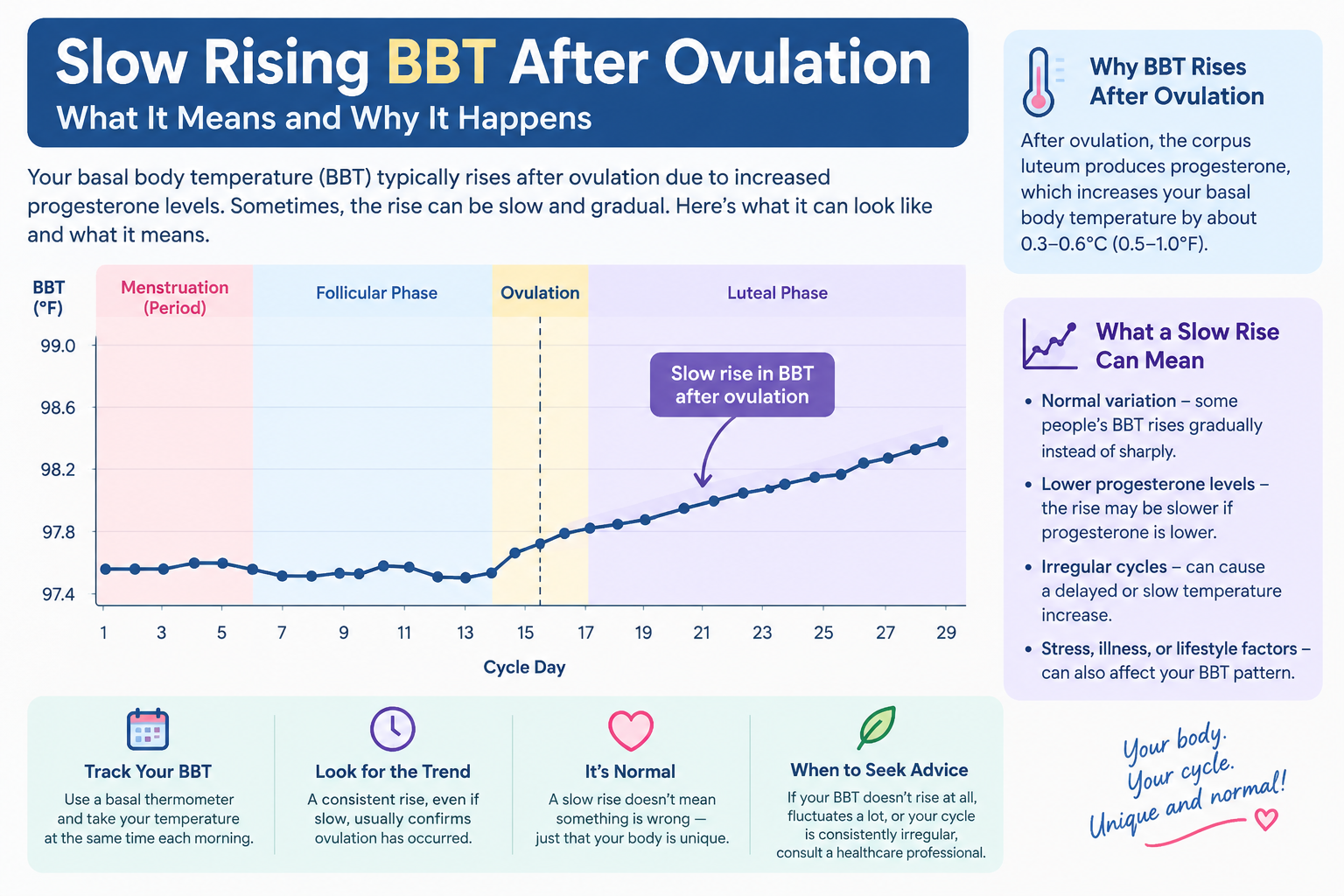
A slow rising BBT after ovulation can be confusing, especially when you are tracking fertility and expecting a clear temperature jump. Some basal body temperature charts show an obvious rise within a day, while others climb gradually over two or more days.
A gradual increase does not automatically mean that something is wrong. Basal body temperature varies from person to person, and factors such as progesterone, sleep, measurement timing, illness, alcohol, and normal cycle variation can all influence the pattern.
The key is to look at the overall temperature shift, not a single reading.
Quick Facts About Slow Rising BBT After Ovulation
| Question | Quick answer |
|---|---|
| Does BBT rise after ovulation? | Usually, yes |
| Why does it rise? | Progesterone increases after ovulation |
| Must the rise happen in one day? | No |
| Can BBT rise gradually? | Yes |
| How long should temperatures stay higher? | Generally through the luteal phase |
| Can slow-rising BBT confirm pregnancy? | No |
| Can BBT confirm ovulation? | It can support evidence that ovulation likely occurred |
| Is one unusual chart concerning? | Usually not by itself |
The American College of Obstetricians and Gynecologists notes that basal body temperature normally rises slightly around ovulation and remains elevated during the latter part of the menstrual cycle. ACOG
What Is Basal Body Temperature?
Basal body temperature, or BBT, is your body’s temperature when you are fully at rest. When tracking fertility, it is generally measured immediately after waking and before getting out of bed, eating, drinking, or becoming physically active.
After ovulation, the corpus luteum produces more progesterone. Progesterone has a thermogenic effect, meaning it can raise your resting body temperature slightly.
Cleveland Clinic explains that the temperature increase following ovulation is caused by increased progesterone. Cleveland Clinic
The change itself is small. Mayo Clinic notes that the post-ovulation rise is typically less than about 0.5°F (0.3°C). Mayo Clinic
What Does a Slow Rising BBT After Ovulation Look Like?
A classic textbook BBT chart might look something like this:
- Day before ovulation: 97.3°F
- Ovulation day: 97.2°F
- 1 DPO: 97.7°F
- 2 DPO: 97.8°F
- 3 DPO: 97.9°F
That produces an obvious temperature shift.
A slow rise pattern might look more like:
- Day before ovulation: 97.3°F
- 1 DPO: 97.4°F
- 2 DPO: 97.5°F
- 3 DPO: 97.7°F
- 4 DPO: 97.8°F
The second pattern may still be consistent with ovulation if the temperatures eventually establish a clearly higher range and remain there.
BBT interpretation is therefore about patterns rather than requiring one dramatic temperature spike.
Is a Gradual BBT Rise After Ovulation Normal?
Yes. A gradual temperature rise can occur in otherwise normal ovulatory cycles.
Not every person’s progesterone concentration or temperature response changes at exactly the same speed. Even within the same person, one cycle may show a sharp shift while another shows a staircase-like increase.
What matters more is whether you eventually develop a biphasic pattern:
- A generally lower temperature range before ovulation.
- A generally higher temperature range afterward.
Cleveland Clinic recommends looking for higher temperatures maintained for at least three days when using BBT as evidence that ovulation has likely occurred. Cleveland Clinic
Why BBT Rises After Ovulation
Understanding progesterone makes a slow rise easier to interpret.
Before ovulation, estrogen is relatively more influential. After an egg is released, the follicle that released it becomes the corpus luteum.
The corpus luteum produces progesterone, which helps prepare the uterine lining for a possible pregnancy.
Progesterone also increases body temperature. As progesterone rises during the early luteal phase, BBT generally rises with it.
That is why fertility charts usually have two temperature phases.
Follicular phase
Temperatures tend to remain relatively lower before ovulation.
Luteal phase
Temperatures generally shift upward after ovulation because progesterone levels have increased.
The difference does not have to be dramatic. The relationship between your own pre- and post-ovulation temperatures is generally more useful than comparing your numbers with someone else’s.
Common Reasons for Slow Rising BBT After Ovulation
Several explanations may account for a gradual rise.
1. Normal Hormonal Variation
The simplest explanation is ordinary cycle variation.
Progesterone does not necessarily reach its luteal-phase level instantaneously. Your body temperature response may therefore appear progressively over several mornings.
One gradual-rise chart cannot diagnose a hormonal problem.
2. Ovulation Happened Later Than You Think
A common charting mistake is assuming the exact day of ovulation based on an app prediction.
Calendar apps generally estimate ovulation from previous cycle lengths. Your actual ovulation day can shift from month to month.
BBT is especially important here because it is mainly a retrospective indicator. ACOG states that BBT can help confirm that ovulation occurred but cannot reliably predict it beforehand. ACOG
If your rise begins later than expected, your ovulation date may simply have been later.
3. You Are Seeing a Stair-Step Temperature Shift
Some charts show temperatures rising in stages rather than all at once.
For example:
97.2 → 97.4 → 97.5 → 97.7°F
This may still produce a clear post-ovulatory temperature range.
Instead of focusing exclusively on the first high temperature, look at whether subsequent readings remain consistently above your earlier baseline.
4. Inconsistent Temperature-Taking Time
Taking your temperature at 6 a.m. one morning and 9 a.m. the next can make a fertility chart harder to interpret.
For the most useful BBT chart, measure:
- Immediately after waking.
- At roughly the same time each day.
- Before getting out of bed.
- Using the same thermometer.
- Using the same measurement location.
Mayo Clinic recommends taking BBT at the same time and in the same way each day because consistency improves chart reliability. Mayo Clinic
5. Interrupted or Insufficient Sleep
BBT represents your resting temperature. Poor or fragmented sleep can therefore alter measurements.
Potential disruptors include:
- Waking repeatedly during the night.
- Shift work.
- Very early mornings.
- Changing sleep schedules.
- Travel or jet lag.
Mark unusually disrupted nights on your chart rather than trying to force those readings into the pattern.
6. Alcohol
Alcohol can change body temperature and sleep quality.
A temperature following a night of drinking may therefore be unusually high or otherwise inconsistent with the surrounding readings.
One disturbed reading should not outweigh an entire chart.
7. Illness or Fever
A cold, infection or fever can significantly distort BBT.
ACOG specifically notes that illnesses accompanied by fever can make BBT less reliable for fertility tracking. ACOG
If you are sick, record the temperature but mark the reading as potentially disturbed.
8. Stress and Travel
Temperature charts are surprisingly sensitive to everyday life.
Cleveland Clinic identifies factors such as stress, travel, lack of sleep, alcohol, medications and certain health conditions as variables that may affect BBT readings. Cleveland Clinic
This is why fertility chart interpretation should consider context rather than treating every decimal change as meaningful.
Does Slow Rising BBT Mean Low Progesterone?
Not necessarily.
A slow temperature rise alone is not enough to diagnose low progesterone or a luteal-phase disorder.
BBT provides indirect information about hormonal activity. It does not measure progesterone concentration.
Someone could have a gradual BBT increase and normal progesterone levels. Conversely, a seemingly textbook chart does not prove that every reproductive hormone is optimal.
If there is a medical reason to evaluate ovulation or progesterone, a healthcare professional may recommend appropriate blood testing or other investigations rather than relying exclusively on BBT.
Slow Rising BBT and Pregnancy: Is There a Connection?
A gradual BBT rise cannot reliably tell you whether conception occurred.
Pregnant and non-pregnant cycles can look extremely similar during the first several days after ovulation.
The more meaningful pattern is whether temperatures remain elevated beyond the time your period would normally begin.
Mayo Clinic notes that a BBT elevation lasting 18 days or longer after ovulation may be an early sign of pregnancy, although pregnancy should be confirmed with a pregnancy test. Mayo Clinic
In practical terms:
Slow rise + sustained high BBT ≠ confirmed pregnancy.
A home pregnancy test detecting hCG is much more informative.
Does a Slow BBT Rise Mean Implantation Happened?
No specific BBT pattern can confirm implantation.
Some fertility charts show a brief temperature dip or a second rise during the luteal phase, but similar patterns can occur in cycles where pregnancy does not occur.
That means terms such as:
- Implantation dip
- Triphasic chart
- Second thermal shift
should be interpreted cautiously.
BBT is valuable for identifying cycle patterns, but it cannot show exactly when an embryo implants.
What About an “Implantation Dip”?
An implantation dip is commonly described online as a one-day decrease in temperature several days after ovulation followed by another rise.
The problem is that a one-day dip may also occur because of normal hormonal fluctuations, measurement differences, sleep disturbances or random temperature variation.
Therefore, neither a dip nor the absence of one can confirm or rule out pregnancy.
How Much Should BBT Rise After Ovulation?
There is no universal number that every chart must reach.
Cleveland Clinic reports that some people see increases around 0.4°F to 1°F (approximately 0.22°C to 0.56°C) after ovulation. Cleveland Clinic
Mayo Clinic describes the typical change as less than approximately 0.5°F (0.3°C). Mayo Clinic
The apparent difference highlights an important point: individual patterns vary.
Instead of asking:
“Did my temperature increase by exactly 0.5°F?”
A more useful question is:
“Has my temperature established a sustained range that is clearly higher than my pre-ovulation range?”
How Many Days Does BBT Take to Rise After Ovulation?
Many people notice a rise soon after ovulation, but chart patterns vary.
A temperature shift that becomes obvious over two or three readings can still be consistent with ovulation.
Because BBT records the body’s response to progesterone after ovulation, it is not precise enough to establish the exact moment the egg was released.
If timing intercourse for conception is your goal, relying solely on the first temperature rise may actually be too late.
BBT Rise Versus Ovulation Predictor Kits
These two fertility tools measure different events.
| Method | What it detects | Timing |
|---|---|---|
| BBT | Temperature effect associated with progesterone | Mainly after ovulation |
| LH test | Luteinizing hormone surge | Usually before ovulation |
| Cervical mucus | Estrogen-related mucus changes | Around the fertile window |
| Ultrasound | Follicle development/ovulation | Clinical monitoring |
| Progesterone testing | Hormonal evidence of luteal activity | After suspected ovulation |
For people trying to conceive, combining multiple fertility signs can provide a clearer picture than BBT alone.
Mayo Clinic notes that home ovulation predictor kits detect the hormonal rise that occurs before ovulation, making them more useful for identifying the fertile window in advance. Mayo Clinic
How to Interpret a Slow-Rise BBT Chart Correctly
Avoid analyzing every temperature independently.
Instead, use this process:
Step 1: Establish Your Pre-Ovulation Baseline
Look at your follicular-phase temperatures.
You are trying to determine your personal lower-temperature range rather than comparing yourself with an internet average.
Step 2: Look for a Sustained Shift
Once readings move upward, see whether they stay elevated for approximately three consecutive days.
Mayo Clinic states that ovulation has likely occurred when the higher temperature remains steady for at least three days. Mayo Clinic
Step 3: Review Other Fertility Signs
Consider whether your chart also showed:
- Positive LH testing.
- Egg-white cervical mucus.
- Cervical changes.
- Typical mid-cycle symptoms.
Multiple indicators can help clarify an ambiguous BBT chart.
Step 4: Mark Disturbed Temperatures
Flag readings affected by:
- Fever.
- Poor sleep.
- Alcohol.
- Travel.
- Unusually late waking.
- Medication changes.
This prevents one abnormal temperature from distorting your interpretation.
Step 5: Compare Multiple Cycles
One cycle provides limited information.
Several months of charting may reveal whether slow rises are simply your normal pattern.
A Practical Example
Imagine your normal pre-ovulation temperatures range between 97.1°F and 97.4°F.
Your chart then shows:
| Day | BBT |
|---|---|
| Cycle Day 13 | 97.2°F |
| Cycle Day 14 | 97.3°F |
| Cycle Day 15 | 97.4°F |
| Cycle Day 16 | 97.5°F |
| Cycle Day 17 | 97.7°F |
| Cycle Day 18 | 97.8°F |
| Cycle Day 19 | 97.7°F |
The shift is gradual rather than dramatic.
However, by days 17–19, a higher temperature range has become established. Combined with other ovulation signs, that may support the interpretation that ovulation occurred several days earlier.
Exact ovulation timing cannot be determined from those temperatures alone.
Common BBT Charting Mistakes
Obsessing Over One Temperature
A single low or high reading rarely tells you much.
Look at several consecutive readings.
Comparing Your Temperatures With Other People’s Charts
Your normal BBT might be lower or higher than someone else’s.
The important information is the change relative to your own baseline.
Assuming Your App Knows Your Ovulation Date
Apps make predictions.
Your ovaries do not follow an app calendar.
Use predictions as estimates and combine them with real-time fertility signs.
Assuming Every Dip Means Implantation
Temperature dips happen in both pregnant and non-pregnant cycles.
Avoid assigning biological meaning to every small fluctuation.
Assuming a Slow Rise Automatically Means Infertility
It does not.
Fertility cannot be assessed from the shape of one BBT chart alone.
Taking Temperatures After Getting Out of Bed
Walking to the bathroom, drinking water, talking or remaining awake for an extended period can affect the measurement.
Take BBT immediately after waking whenever possible.
How to Improve BBT Tracking Accuracy
Use the same routine every morning.
For better-quality data:
- Keep your thermometer beside your bed.
- Measure before sitting or standing.
- Take your temperature at approximately the same time.
- Use the same measurement method every day.
- Record temperatures immediately.
- Note illness, alcohol, poor sleep and travel.
- Track cervical mucus if comfortable doing so.
- Consider ovulation predictor kits if timing conception.
Consistency matters more than achieving a “perfect” temperature.
What If Your Temperature Never Clearly Rises?
Occasionally, a chart never develops a recognizable post-ovulation shift.
That does not automatically prove that you did not ovulate because inaccurate measurements and external factors can hide a thermal pattern.
However, if this happens repeatedly, especially alongside irregular or absent periods, discuss it with a qualified healthcare professional.
Conditions affecting ovulation can have many causes, including hormonal disorders, thyroid problems and elevated prolactin. ACOG notes that thyroid function and prolactin levels are among the factors clinicians may evaluate during infertility assessment. ACOG
When Should You Speak With a Healthcare Professional?
Consider seeking medical advice if you repeatedly notice:
- No apparent temperature shift across several cycles.
- Very irregular menstrual cycles.
- Missing periods.
- Unusually short or long cycles.
- Persistent abnormal bleeding.
- Significant pelvic pain.
- Difficulty conceiving.
- Other symptoms suggesting a hormonal problem.
If pregnancy is your goal, professional fertility evaluation may also be appropriate depending on your age, reproductive history and how long you have been trying to conceive.
BBT can provide useful information to bring to an appointment, but it should complement rather than replace medical evaluation.
Can BBT Tell You the Exact Day You Ovulated?
Usually not with certainty.
BBT identifies a thermal shift caused by post-ovulatory progesterone, so it tells you about ovulation retrospectively.
ACOG specifically describes temperature charting as a method that can confirm ovulation but cannot predict it. ACOG
This distinction is particularly important for people trying to conceive because your most fertile days are generally before the temperature rise.
Is Slow Rising BBT After Ovulation Bad for Fertility?
By itself, no.
A slow rise may simply reflect your individual hormonal and temperature response.
A chart becomes more clinically meaningful when the same unusual pattern occurs repeatedly alongside issues such as:
- Irregular ovulation.
- Abnormal cycle lengths.
- Recurrent difficulty conceiving.
- Abnormal bleeding.
- Other reproductive symptoms.
Even then, BBT alone cannot identify the cause.
Frequently Asked Questions
Is it normal for BBT to rise slowly after ovulation?
Yes. Some people experience an immediate temperature shift, while others show a gradual increase over several days. A sustained higher temperature pattern is more important than how quickly the rise happens.
Can BBT rise three days after ovulation?
A clearly recognizable temperature shift may not appear immediately, and determining the exact ovulation day from BBT alone is difficult. If your chart rises later than expected, ovulation may also have happened later than you assumed.
Does a slow BBT rise mean progesterone is low?
Not necessarily. BBT is an indirect marker and cannot measure progesterone concentration. Blood testing and clinical assessment are needed when a progesterone problem is suspected.
Can you be pregnant with a slow BBT rise?
Yes. The speed of the temperature rise does not determine whether pregnancy occurred. Pregnant and non-pregnant charts often look similar early in the luteal phase.
How many high temperatures confirm ovulation?
A common charting approach is to look for approximately three consecutive higher readings. Mayo Clinic and Cleveland Clinic both describe a sustained rise of about three days as evidence that ovulation likely occurred. Cleveland Clinic
Does BBT stay high if you are pregnant?
It may remain elevated because progesterone continues to be produced. However, an elevated BBT cannot confirm pregnancy. Use a pregnancy test for confirmation.
Why did my BBT rise but my ovulation test was negative?
Possible explanations include missing a brief LH surge, testing at the wrong time, urine dilution, natural test variability or misinterpreting the temperature shift. Neither method is perfect.
Should BBT rise immediately after a positive LH test?
Not necessarily. An LH test identifies a hormonal surge associated with approaching ovulation, while BBT reflects the progesterone-related change occurring after ovulation. The two events are therefore not expected to occur simultaneously.
The Bottom Line
A slow rising BBT after ovulation is not automatically a sign that something is wrong. Temperature shifts can happen gradually, and normal cycles vary considerably from person to person and even from month to month.
Focus on the larger pattern: consistent measurement, a sustained post-ovulation temperature increase, other fertility signs and trends across multiple cycles. If your charts repeatedly show no clear temperature shift, your periods are irregular, or you have concerns about ovulation or fertility, a healthcare professional can provide much more reliable answers than BBT alone.
Searching for Activevitalspark Com usually means you want to find the website, understand what it publishes, or decide whether its information deserves your trust. Public descriptions associate the domain with health, fitness, wellness, and lifestyle content, although some describe a broader general-interest publication. These descriptions provide a starting point, but they do not establish the quality of individual articles. dotmagazines.com
The most useful approach is to separate what can be verified from what other websites claim. This guide explains the available evidence, the limits of that evidence, and how to assess any article you find there.
What Is Activevitalspark Com?
Activevitalspark Com refers to the website at activevitalspark.com. Third-party coverage generally presents it as an informational blog covering wellness and lifestyle, with additional subjects such as technology, business, and finance. dotmagazines.com
However, its current editorial scope could not be independently confirmed through a live homepage inspection. During research on September 26, 2026, both the main domain and its www version returned a 403 Forbidden response to the research browser.
That access limitation matters: descriptions of its navigation, publishing schedule, authors, or services should not be presented as firsthand observations without checking the live pages.
What the Available Evidence Shows
| Question | Available evidence |
|---|---|
| What website does the keyword refer to? | activevitalspark.com |
| How is it described elsewhere? | A wellness, lifestyle, and general-interest content website |
| Was the live homepage inspected successfully? | No; research access returned a 403 response |
| Is historical content discoverable? | Yes; a search-indexed page dated May 7, 2024 covers Kolkata Fatafat tips |
| Are current author qualifications and medical review procedures verified? | Not established by the material available for this review |
The historical page is especially relevant because its subject differs from the wellness focus described elsewhere. It shows that the domain has published other material, although it does not establish what appears on the homepage today. activevitalspark.com
What Topics Does the Website Cover?
External descriptions commonly associate the website with:
- Health and wellness: general well-being and healthy-living information.
- Fitness and nutrition: exercise and food-related topics.
- Lifestyle: everyday habits and personal development.
- General-interest subjects: technology, business, finance, and education.
Treat these as reported categories rather than a verified current directory. Third-party reviews describe this range, but direct confirmation of the present category structure was unavailable. digiblogs.co.uk
A broad subject range can help readers discover new interests. To decide whether a particular article is useful, examine how clearly it answers its question and how well it supports its claims.
For example, an introductory article may help you understand a new term. A page recommending a treatment or financial decision requires much stronger evidence because acting on it carries greater consequences.
Why Descriptions of Activevitalspark Com Need Careful Reading
The search results contain confident descriptions of the website, but confidence alone does not establish accuracy. Some reviews characterize it as a wellness resource, while others describe a general-purpose publication. Mytecharm
Three distinctions help readers make sense of this uncertainty.
A Website Description Is Not an Editorial Audit
Calling a platform “expert-led” or “evidence-based” should be supported by identifiable experts, relevant qualifications, and visible references. Without those details, the wording tells you how the platform is being presented, not how its content was checked.
Look for evidence attached to the specific article you plan to use. A broad statement about quality is less useful than a named reviewer explaining their relevant expertise.
Historical Pages Do Not Define the Current Website
The indexed 2024 Kolkata Fatafat page establishes a historical association between that content and the domain. It does not explain whether the website later changed direction, ownership, or editorial policy. activevitalspark.com
Avoid filling those gaps with assumptions. If an older search result conflicts with the current website, check the page date and look for an explanation from the publisher.
Unverified Does Not Mean False
A feature that could not be confirmed may still exist. Likewise, an inaccessible homepage does not justify declaring the entire website unreliable.
The fair conclusion is narrower: the available evidence supports some observations, while other questions remain open.
How to Evaluate an Article Before Relying on It
If you visit Activevitalspark Com, use the following checks to decide how much weight to give a page.
1. Identify Who Created the Content
Look for a named author and an informative biography. Relevant experience should connect directly to the subject: reviewing fitness equipment requires different knowledge from explaining a medical condition.
Google’s published content guidance encourages clear authorship, useful author background, and transparent sourcing as ways to help readers assess credibility. developers.google.com
2. Follow the Evidence
Open references supporting important claims. Check whether the linked material actually addresses the statement and whether the article accurately describes it.
For health information, MedlinePlus recommends checking the source, the review process, writer qualifications, and publication or update dates. It also advises comparing information with other reliable resources. medlineplus.gov
A useful question is: Could I explain why this claim is credible without repeating the article’s own reassurance?
3. Check What the Date Means
Look for separate publication and review dates when available. If a page says it was updated, examine whether its references, examples, and recommendations reflect that update.
Google specifically warns against changing dates merely to make content appear fresh when it has not changed substantially. A recent timestamp therefore deserves context. developers.google.com
4. Examine Commercial Disclosures
Check whether recommendations involve advertising, sponsorship, or affiliate links. MedlinePlus advises readers to consider who funds a health website and whether advertising is clearly identified. medlineplus.gov
Commercial relationships are useful context when weighing a recommendation. Ask whether the article explains drawbacks and alternatives as carefully as benefits.
5. Match the Evidence to Your Decision
Decide what you intend to do with the information. Saving an idea for further reading requires less certainty than buying a product or changing how you manage your health.
For decisions affecting your health, discuss what you have read with a qualified healthcare professional who can assess its relevance to you. medlineplus.gov
A Practical Example: Checking a Wellness Claim
Imagine finding an article claiming that a particular morning routine improves energy. This is an illustrative example, not a claim that such an article currently appears on the website.
Start by identifying the exact promise. Does “improves energy” mean feeling more alert, sleeping better, or treating persistent fatigue?
Next, examine the supporting reference. Does it investigate the same activity, the same outcome, and a comparable group of people?
Finally, consider how the article moves from evidence to advice. A modest finding should lead to a proportionate recommendation, with uncertainty explained clearly.
This method helps you assess the substance of a page without letting polished writing make the decision for you.
Is Activevitalspark Com Trustworthy?
The available evidence is insufficient for a blanket endorsement or a blanket rejection. Current authorship, editorial oversight, and the quality of the live article collection were not established during this review.
Trust also depends on the question being asked. Whether a website loads, identifies its publisher, and supports a particular claim are separate matters.
For practical purposes, assess each article individually. Give more weight to pages with clear authorship, relevant evidence, transparent disclosures, and an explanation of their limitations.
Frequently Asked Questions
Is Activevitalspark Com exclusively a health website?
External descriptions associate it with both wellness and broader general-interest topics. Historical indexed content also includes a Kolkata Fatafat page, so describing the domain as exclusively medical or wellness-focused would be too strong. digiblogs.co.uk
Is its health content medically reviewed?
Medical review could not be verified from the material available for this assessment. Check individual articles for a named reviewer, relevant qualifications, and a review date before assuming professional oversight.
Is the website currently unavailable?
The research browser received a 403 response, but that observation does not establish whether ordinary visitors can access it. It also does not establish the reason for the restriction.
Conclusion: Approach Activevitalspark Com With Clear Expectations
Activevitalspark Com is described publicly as a wellness and general-interest content website, but its current publishing practices remain only partly verified. Its historical search presence also warrants checking page dates and subjects carefully.
If you visit, begin with the article that interests you: identify its author, follow its references, and assess whether the evidence supports the advice. Those checks provide a stronger basis for trust than the website’s name or a favorable third-party description.


imageflings.com: What It Is, Website Status, Safety, and Everything You Should Know

TeamViewer Pricing vs. Splashtop: Complete 2026 Comparison Guide

What Is Globalunpaid Com? Complete Website Guide for 2026
-

 Fashion9 years ago
These ’90s fashion trends are making a comeback in 2017
-
Entertainment9 years ago
The final 6 ‘Game of Thrones’ episodes might feel like a full season
-
Fashion9 years ago
According to Dior Couture, this taboo fashion accessory is back
-
Business9 years ago
Uber and Lyft are finally available in all of New York State
-
Entertainment9 years ago
The old and New Edition cast comes together to perform
-
Sports9 years ago
Steph Curry finally got the contract he deserves from the Warriors
-
Sports9 years ago
Phillies’ Aaron Altherr makes mind-boggling barehanded play
-
Entertainment9 years ago
Disney’s live-action Aladdin finally finds its stars